



Table of Contents
If you’ve ever felt unsure about how to safely strengthen your core during pregnancy or early postpartum, you’re not alone. Traditional core workouts—heavy sit-up variations, twisting crunches, long planks—often don’t feel great as your body is changing. But here’s the good news: your “core” is so much more than your abs, and pregnancy safe core exercises can absolutely strengthen it in a way that supports your pelvis, spine, and daily movement… without ever doing a single crunch.
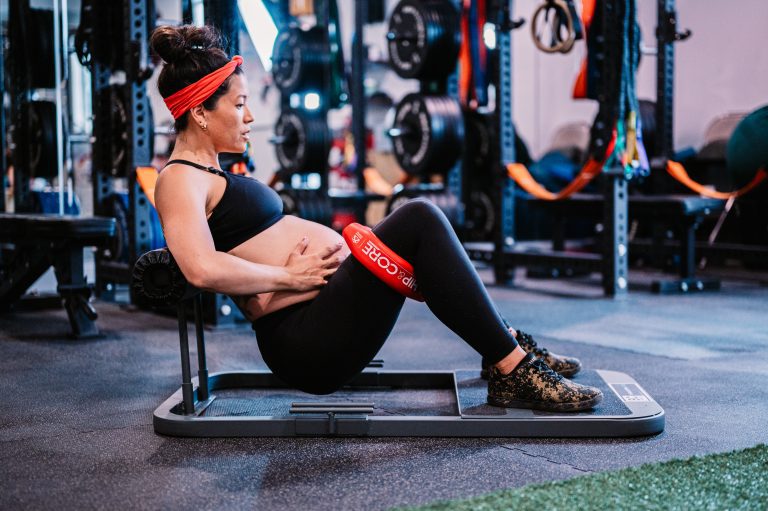
In today’s prenatal full-body workout, we’re combining strength training with unconventional core work. These movements might not look like typical core exercises, but they target major stabilizing systems of the body—the same systems supporting your posture, your pelvic health, and your ability to carry a growing baby comfortably. This workout is perfect for pregnancy and safe to continue into postpartum as you rebuild strength.
Let’s walk through what to expect, how to perform each movement, and why this type of training is so beneficial.
Subscribe to our YouTube Channel for more weekly workouts and educational videos! We publish one new workout video and 2-3 educational videos a week on our channel.
Why Unconventional Core Work?
Throughout pregnancy, your body shifts to support your growing baby. Your pelvis tilts, your ribcage expands, and your abdominal wall stretches. Instead of forcing traditional core exercises, it’s more effective—and more comfortable—to train the core through:
Anti-rotation
Hip-driven movement
Full-body patterns that integrate the core naturally
Breath-coordinated strength work
This is exactly what today’s exercises do. They strengthen your deep core, glutes, back, and pelvic stabilizers by training them the way you actually use them every day.
What You’ll Need
For this workout, gather:
Long resistance band
Two light to medium dumbbells
One medium to heavy dumbbell
We’ll move through two full rounds of the following exercises. Continue for additional rounds if you want a longer workout.
Exercise Breakdown: 5 Pregnancy Safe Core Exercises
1. Squat with Banded Row
1 minute each side
This move fires up the posterior oblique sling—a powerful connection between your glutes and opposite lat that stabilizes your pelvis and low back.
You can perform this using:
A band anchored at chest height
A band held and anchored with your non-working hand
A dumbbell held on one side
How to do it:
Stand wider than hip distance with toes slightly out.
Inhale as you squat and reach forward with the band.
Exhale to stand tall and row, thinking about lightly tucking your pelvis under to avoid low-back arching.
Switch sides after one minute.
You should feel:
Lengthening in the glute + lat at the bottom, then coordinated contraction at the top. This is functional “core” work at its best.


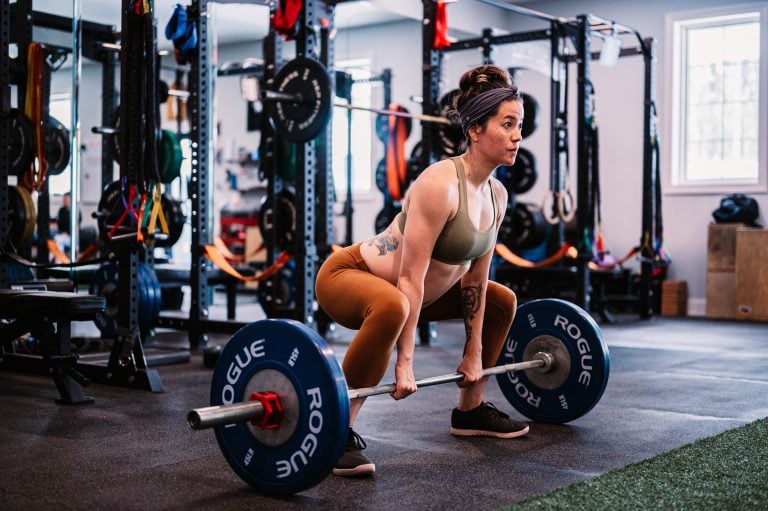
2. Suitcase Deadlift
1 minute each side
Holding weight on one side only makes your core work overtime to stabilize. This trains your anti-rotation system—vital for pelvic stability.
How to do it:
Feet hip-width.
Keep weight close to your body.
Hinge by sending hips back (not down).
Resist rotating toward the weight.
Exhale to stand tall.
If your belly touches your thighs, simply widen your stance slightly for comfort.


 On-demand video · 128 workoutsPrenatal Workout On-DemandFollow-along workouts from week 5 to week 41, four or five a week with guided warm-ups and cool-downs — over 128 sessions coached in real time alongside the video.Learn more
 App program · 40 weeksPrenatal Strength TrainingA gym-based program that syncs to your current week of pregnancy — four strength sessions plus one pelvic stability workout a week, with demo videos for every exercise.Learn more
 On-demand video · 30 workoutsCore, Pelvic Floor & Pelvic StabilityThirty follow-along workouts across beginner, novice, and advanced levels, ten per level — core and pelvic floor strength for pain relief in pregnancy or postpartum.Learn more
3. Curtsy Lunges
1 minute each leg
Curtsy lunges challenge your hips in a different plane of motion while strengthening your glutes and improving pelvic stability.
How to do it:
Step one leg diagonally behind you.
Lower to your comfortable depth.
Keep weight evenly distributed across your foot—big toe, pinky toe, and heel.
Switch legs after one minute.
Go bodyweight or add dumbbells for more intensity.


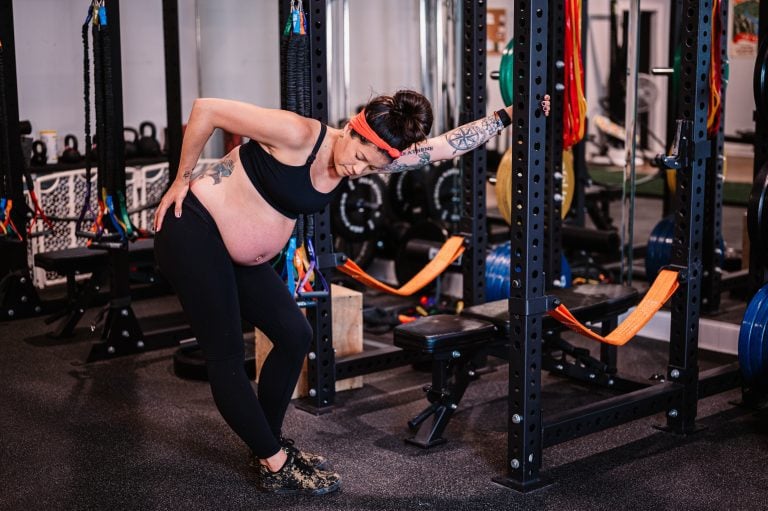
4. Lateral Hip Shift Rows
1 minute total
This exercise layers hip mobility, rotation, and upper-body strength—an amazing combination for core and pelvic training.
How to do it:
Stand with feet wider than hips.
Hinge forward with soft knees.
Shift your weight to one side as you straighten the opposite leg.
Row on the side you’re shifting toward.
Feel the stretch in the straight leg’s inner thigh and the deep glute engagement on the bent side.
Move slow or quick—your choice.
This move may feel complex at first, but once you find your rhythm, it feels incredible.


5. Standing March with Front Rack Hold
1 minute
This is the grand finale of each round—and a major core stabilizer.
How to do it:
Hold dumbbells in a front-rack or bicep-curl position.
Staying upright (no leaning back!), march in place.
The more upright you remain + the further forward the weights are, the more your core engages.
Think: slight tuck of the pelvis, ribs stacked over pelvis.
If you tend to overarch during pregnancy, this drill helps retrain your alignment.


Repeat for Round Two
After moving through all five exercises, you’ll repeat them for a second round. Feel free to continue for a third if you’re feeling energized.
Throughout the workout, I remind you to explore your range of motion each day and to honor how your body feels. Pregnancy changes your capacity day to day—that’s normal and expected.
Why This Workout Supports Pregnancy So Well
Strengthens the entire core system without strain
Improves SI joint stability
Builds glute strength to support pelvic balance
Enhances posture and reduces low-back discomfort
Prepares your body for labor and postpartum recovery
These movements work with your body, not against it.
Want More Prenatal Workouts Like This?
This full workout is part of the MamasteFit Prenatal On-Demand Program, where you can follow along with full-length videos from weeks 5–41 of pregnancy. It includes progressive strength training, mobility, and plenty of unconventional core work designed to keep you strong and comfortable.
Prefer a more traditional workout structure with exercise lists and demo videos?
The Prenatal Strength Program is also available.
Don’t forget to use code YouTube10 to get 10% off any online program—prenatal, postpartum, or educational.
And if you loved this workout, don’t forget to subscribe to the MamasteFit YouTube channel, where fresh workouts and educational content drop every Tuesday.
 Bundle · lifetime accessMamasteFit BundlesCombine courses and programs for lifetime access and save up to 15% — grouped for birth preparation, the third trimester, or the whole pre and postnatal journey.Learn more
 Video course · 7 modulesPrepare Your Pelvic Floor For BirthSeven modules on releasing the pelvic floor rather than only strengthening it — breathing drills, thoracic and pelvic mobility, and how to relax it during labor.Learn more
 App program · 16 weeksPostpartum Return to FitnessSixteen weeks of rebuilding, four strength sessions a week, with a vaginal or cesarean recovery track and follow-along videos for the first six weeks.Learn more