



Table of Contents
The pelvic floor is a big buzzword during pregnancy as a part of birth preparation, and especially after birth when you’re recovering from pregnancy in the postpartum. But, if you’re like me, you maybe didn’t even know you had a pelvic floor until you were pregnant for the first time, or maybe it just feels like this foreign muscle because you can’t really see it. In this blog, I’m gonna break down a few different strategies to help you connect with your pelvic floor and learn how to relax pelvic floor muscles so you can actually feel them doing something.
In this blog, I’m going to break down some positional cues, visual cues, different ways to use external props for tactile feedback, and mindset strategies that may help improve pelvic floor awareness and connection.
Sometimes one strategy works better than another, so we’re gonna explore a variety of ways to help you connect with and find your pelvic floor.
What Is Your Pelvic Floor and Why Should You Care?
First, let’s start with what the pelvic floor actually is in case you’re not totally sure what this mysterious muscle group is. The pelvic floor is a sling of musculature that sits at the bottom of your pelvis. The pelvic floor has a number of functions, including helping support your pelvic organs, helping with stabilization as a part of your deep core system, helping with sphincter control so it keeps stuff in and then releases to let stuff out, playing a big role in sexual function and orgasm in addition to childbirth, and helping with sump pump or lymphatic flow through the pelvis.
The pelvic floor is an anticipatory muscle within our deep core system, so it’s going to anticipate movements that it needs to respond to in order to aid with stabilization. The pelvic floor is also a part of a much larger system, so when the pelvic floor is not functioning the way that we need it to, solely focusing on the pelvic floor is not always the only solution. But sometimes simply feeling it again can help you reintegrate it into the system. Many of the strategies that we’re using in this blog also incorporate other portions of the system because the pelvic floor does not work in isolation. It works together with other muscles to aid in all of these functions.
In addition, another important thing to know is that the pelvic floor attaches to the pelvis, so different pelvic positions are going to change the tension throughout the pelvic floor. There’s no one position that is gonna stretch the whole pelvic floor, and there’s no one exercise that’s going to tighten the entire pelvic floor. Typically, we’re gonna be focusing on different halves or quadrants of the pelvic floor.
The pelvic floor can be divided into four quadrants where we have an anterior portion, a posterior portion, and then a left and right portion. Different hip and pelvic positions are going to change the tension within the pelvic floor based on how they change the structure and position of the pelvis.
Positions that favor more external rotation with more of an anterior pelvic tilt are going to stretch more of the front part of the pelvic floor. These positions also make it much easier to contract or shorten the posterior portion of the pelvic floor.
Positions that favor more internal rotation with more of a posterior pelvic tilt are going to stretch more of the back portion of the pelvic floor and make it much easier to contract or lift up in the front half of the pelvic floor.
Positions that favor a more one-sided open hip position are going to target more of the front quadrant of the pelvic floor, and positions that favor a more one-sided closed hip position are going to target more of the back quadrant of the pelvic floor.
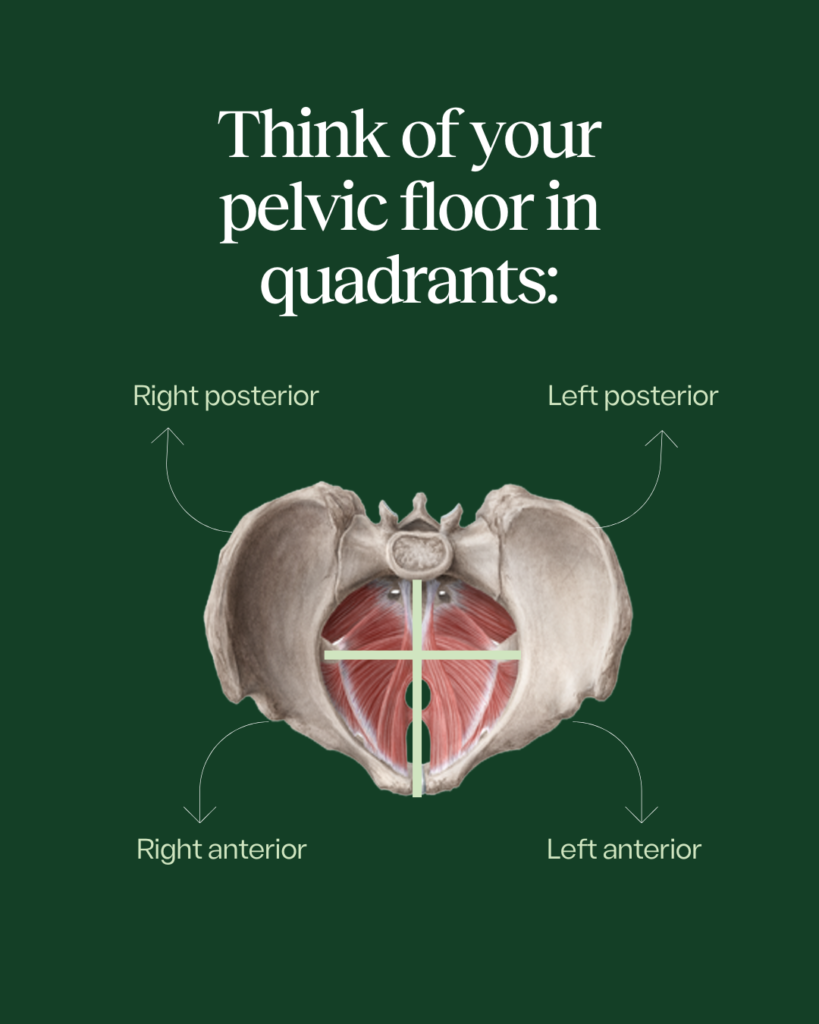
Now that we have an understanding of the overall function and structure of the pelvic floor, let’s break down some ways that we can connect with the pelvic floor.
Breathing Cues to Relax Your Pelvic Floor
The first way to connect with your pelvic floor is through your breath. The pelvic floor is a part of your deep core system and plays a big role in pressure management. Pressure management is how we move our pelvic floor and diaphragm, in addition to the other core musculature, to increase or decrease pressure within the thoracic and abdominal cavity. This change in pressure helps us breathe and also aids in stabilization of the spine and postural control.
So, the first way to connect with your pelvic floor is going to be through your breath. We take thousands of breaths per day, so it can be a great opportunity to intentionally move our pelvic floor.
When we inhale, the diaphragm is going to move down and flatten, which increases pressure within the abdominal cavity. This increase in pressure is going to cause the pelvic floor to lengthen and stretch. The eccentric lengthening of the pelvic floor with inhalation helps it gather energy so that when you exhale, the pelvic floor can recoil to counter the increase in pressure with exertion.
When you exhale, the pelvic floor can either relax and recoil back to a starting position, or if you have increased demand, such as lifting something heavy, you can exhale to help lift up through the pelvic floor. This can help counter the increased pressure demand.
Visualization Strategies
Next, we can use visualization strategies to help you connect to your pelvic floor. These strategies involve imagining different muscles turning on or different points moving closer together as an activation strategy.
The first visualization can involve thinking about zippering up the center of the abdomen with every exhale from the bottom upward. So, you’ll inhale downward, and then as you exhale, think about zippering up the center of your abdominal wall. The next progression can be to use that same zippering visualization, but now think about drawing the two hip bones closer together and then zippering upward through the center of the body.
Another visualization strategy targets areas where we tend to hold more tension versus areas that tend to have more length. When you inhale, you’ll think about breathing into your back and into your butt because this is commonly an area where we hold more tightness. Inhaling into this space can help create more length or stretch throughout that area. Then, with your exhale, you’re gonna think about lifting through the front part of your pelvic floor while gently pulling your belly button toward your spine. The front portion of the pelvic floor tends to naturally have a little bit more length to it for many women.
So your breathing pattern becomes more of this circular visualization strategy where you think about inhaling into the backside of your body to create length, and then exhaling to lift through the front side of your body to create shortening and support.
Positioning for Pelvic Floor Awareness
The next strategy is to change the position of the pelvis to help target different portions of the pelvic floor. As we previously discussed, different pelvic positions tend to stretch or shorten different portions of the pelvic floor. There is no one stretch that is going to stretch the whole pelvic floor at once, and there’s no one strengthening exercise that is going to shorten or contract the entire pelvic floor.
In addition, there are common postural tendencies that create predictable patterns of tension within the pelvic floor. Many of us favor more extension through the spine. We spend a lot of our time walking and moving forward, so it’s understandable that we may have more of an arch in the back with an anterior pelvic tilt. This pattern tends to result in more length through the front portion of the pelvic floor, while the back portion tends to be tighter.

In addition to more extension, we also tend to favor more weight in the right leg, which results in more of a right stance pelvic floor pattern. Commonly, the right anterior pelvic floor quadrant has more activation, while the left posterior pelvic floor quadrant tends to be tighter.
With these postural tendencies in mind, if you are having a hard time feeling your pelvic floor, adjusting your position can help change the tension within the pelvic floor and may help you connect to it more effectively.
Back Expansion Positions
If you wanted to stretch more of the back half of the pelvic floor, which tends to be tighter in many of us, finding a back-expanded or rounded-back position can help target more of a stretch through the posterior pelvic floor. It can also make it easier for you to contract and shorten the anterior portion of the pelvic floor, which may naturally have more length.
This can be as simple as finding a slight round in your back as you perform your breathing exercises.

Asymmetrical Positions
Another strategy is to target a specific quadrant of the pelvic floor, which can help release tension and make it easier for you to change positions within the pelvis and improve overall pelvic floor function. You can explore lateral hip shifts where you are stretching more of the inner thigh and groin on one side in a one-sided open hip position. This will stretch more of the front quadrants of the pelvic floor.
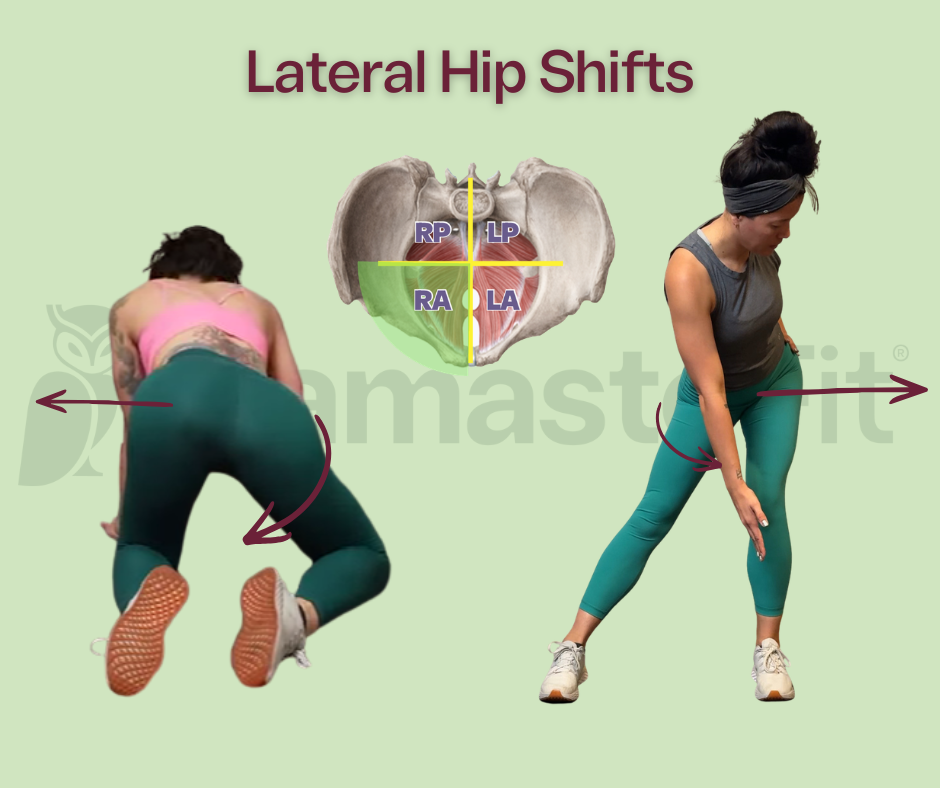
You can also explore hip shifts where you are stretching more of the deep glute musculature in a one-sided closed hip position. This will stretch more of the posterior quadrants of the pelvic floor.

So, if you’re struggling to feel your pelvic floor during your breathing exercises, try changing your position and see if that helps you connect to it better because changing your position changes the tension within the pelvic floor.
Some of my favorite ways to use positioning include finding more open hip positions to target the right anterior quadrant, which for me is overactive and may also be for you. I also like to focus on back-expansion exercises to target the posterior half of my pelvic floor.
If you’re struggling to connect with your pelvic floor, this is exactly why we include pelvic floor awareness drills, breathing exercises, and positional work throughout every phase of our prenatal and postpartum fitness programs. We offer both self-paced programming and follow-along video workouts depending on your preferred workout style.
Anti Gravity Positions
Another way that we can use positioning to help us connect with our pelvic floor is through anti-gravity positions. There are a few different variations, such as a tabletop position where the hips are higher than the chest, or laying on your back with your legs elevated. You may find that one position feels better for you than another.
For me personally, I found tabletop positions with my hips elevated did not feel very good in my body, especially in the earlier postpartum timeframe. So be willing to try different positions, and be okay if certain positions don’t feel great for you. You can temporarily remove them from your movement routine and revisit them later.

Activation Strategies
Sometimes we struggle to feel our pelvic floor because it is compensating for another muscle. The pelvic floor is not a prime mover, meaning it is not supposed to be the main muscle doing big movements for us. But when we are compensating elsewhere, the pelvic floor and surrounding musculature may start working for muscles that are not doing their job effectively.
For some of us, different activation strategies can help us connect better with our pelvic floor by turning on the muscles that should be contributing more to the movement.
One strategy is to place something between the thighs and gently squeeze it together as you perform your movements. Squeezing a block or ball between the thighs helps activate the inner thigh musculature, known as the adductors, which can help support the pelvic floor.

Another strategy to activate the adductors is to use a band around the inner thigh that is pulling one leg outward laterally. This single-sided inner thigh activation can help turn on the adductors to better support the pelvic floor.

You can also use a foam roller pressed into the inside of the knee to help activate the inner thigh musculature and again help you feel your pelvic floor more effectively.

In addition to the inner thigh musculature, sometimes it’s the outer glute musculature that needs to activate more for us to better connect with the pelvic floor. In these situations, using a mini band around the thighs that you actively press outward into can help activate the glutes. You can also do this one-sided with a long resistance band around one knee or by pressing the outer knee into a foam roller.
These different activation strategies can help improve your awareness of and connection to your pelvic floor.

Finger Trick
Next, we can use different awareness strategies to help direct breath into different areas to release tension. A cool trick that I found on Instagram is using different finger positions while breathing. I don’t totally understand why it works, although some of our commenters mentioned it may relate to mudras and energy flow, while others suggested it could relate to the nerve endings in our fingers and how they connect throughout the body.
You can start by pressing your thumb and index finger together in an “OK” hand gesture. Take an inhale, then gently exhale. You may notice that you feel more of the breath in your upper chest area. You could pair this breathing technique with an upper chest release where you reach your arm overhead while keeping the rib cage down.
Next, press your middle finger and thumb together. This inhalation may direct more breath into your mid-back area. It may be helpful to breathe in a back-expanded position to release more tension through the backside of the body with this breathing pattern.
Then you can press your ring finger and thumb together. This inhalation may direct more sensation into your lower back or pelvic area. This can pair really well with a hip-shifted position and may be one of the more helpful breathing techniques if you’re trying to connect more with your pelvic floor.
Finally, you can press your pinky finger and thumb together to feel more of your breath in your lower pelvis or perineum.
I’ve also been experimenting with pressing different fingers on each side to create a more asymmetrical release. For example, I may press my right pinky finger and thumb together while pressing my left ring finger and thumb together to target more of my right anterior pelvic floor and left posterior pelvic floor for an asymmetrical release. I’ve also experimented with my right middle finger and left index finger for more of an upper body asymmetrical release. You can explore different combinations in your own body and see what you notice.
I’ve also found that this can be a really helpful breathing technique during labor to support relaxation, or even during workouts. I’ve been using it during my runs when I’m trying to better control my breathing patterns.
If these breathing and positioning strategies are helping you better connect with your pelvic floor, we break these concepts down even further inside our prenatal and postpartum fitness programs with guided workouts, pelvic floor mobility sessions, and exercise modifications for every stage of pregnancy and postpartum recovery.
External Props
If you’re struggling to feel your pelvic floor, using external props can be another strategy to help you feel it! You can try deflating a Pilates ball or sitting on a soft object that you can feel against your perineum. Then inhale to feel your pelvic floor push down into the soft object, and exhale to lift away.
Conclusion
Connecting with your pelvic floor can sometimes feel frustrating, especially if you feel disconnected from it or aren’t totally sure what you’re supposed to be feeling. But the pelvic floor is a part of a much larger system, and sometimes changing your breathing strategy, your positioning, adding activation work, or using tactile feedback can make a huge difference in helping you connect with it.
And remember, there is not one single strategy that works for everyone. Some women may respond better to visualization cues, while others may connect more with positional changes, activation strategies, or tactile feedback. Be willing to explore different options and see what feels best in your body.
If you want more support, we include pelvic floor exercises, breathing strategies, pressure management, mobility work, and pelvic floor relaxation exercises throughout all of our prenatal and postpartum fitness programs. We also have a large library of free YouTube videos that can help guide you through different pelvic floor connection and relaxation exercises for pregnancy, birth preparation, postpartum recovery, and exercise.