



Welcome to the MamasteFit Podcast! In this episode, Gina is joined by Hayley Kava, an in-house physical therapist, to discuss the pros and cons of perineal massage during pregnancy. The conversation revolves around whether perineal massage can help prevent or decrease the risk of tearing during childbirth, especially focusing on first-time pregnancies. They delve into personal experiences, the mixed evidence on the topic, and alternative methods to prepare for birth. The episode also highlights important factors such as the role of healthcare providers and the importance of feeling safe and relaxed during labor. Additionally, the podcast emphasizes the significance of prenatal fitness and education to enhance the birthing process, while offering resources and discounts for listeners.
Read Episode Transcript
Gina: Welcome to the MamasteFit Podcast. In this episode we have Hayley Kava here who is our in-house PT, talking all about whether or not you should do perineal massage during your pregnancy to help ideally prevent tearing or decrease the risk of tearing- ’cause that’s something that a lot of us are a little bit nervous about. Especially if you’re wanting to have an unmedicated birth, the idea of an unmedicated repair sounds pretty awful. You do get local anesthetic, but it still sucks. So let’s talk about whether or not you should do perineal massage or not.
So again, Hayley is our in-house PT here, and let’s talk about it, Hayley. Should someone do perineal massage at the end of their pregnancy, will it just totally change all of their birth outcomes? What does the evidence say?
Hayley: The evidence? I guess, evidence, no evidence, you can do whatever you want.
Gina: Yeah.
Hayley: It’s your vulva. So, evidence that we have, right, albeit maybe imperfect, tells us that the most benefit that we see with perineal massage is for first time pregnant people. So if it’s your first pregnancy, your first attempt at a vaginal birth, that’s where it’s gonna be the most effective at reducing our relative risk of a high degree tear- so like a three and a four, meaning those tears extend through the perineum and into, or through, the anal sphincter. So we wanna avoid those, right?
Gina: Yeah.
Hayley: Those types of tears are pretty rare anyways. But if some perineal stretching helps reduce that risk in first time moms and it helps you feel more comfortable and helps you feel more confident avoiding something like that, then by all means, go ahead.
I’ve had lots of clients who just feel really uncomfortable with it, doesn’t feel natural to them to do, doesn’t feel like it’s something that they’re interested in doing. To which I say, also totally fine, because I don’t feel strongly that the evidence that we have is so strong that it is gonna be make or break for your labor, for your ability to go unmedicated, for your ability to push out your baby. Yeah.
Gina: Yeah. I’m a big fan of, if doing this thing helps you feel better, like it reduces anxiety for you, it gives you something that helps you feel like you’re in control, go for it. I’m all for it. If it’s something that it’s just adding an additional thing to your plate and making you feel more anxious and more nervous, where it’s like, “Oh my God, I forgot to do my perineal massage today, am I even doing this right?” then I would say it’s not necessary. And again, the risk of third and fourth degree tears is very low. It’s, I think if this is your first time giving birth vaginally, I think it’s like as low as 4%, 4 or 5%, maybe even lower than that. If you’ve had a third or fourth degree tear in a previous labor, your risk of tearing again, third or fourth degree tear, is a little bit higher than somebody who has not, just ’cause it could be due to scar integrity, but it’s still very low. And if you don’t do perineal massage, it doesn’t mean that you will have one of those types of tears. But again, I think evidence is pretty mixed on how beneficial perineal massage is.
Why do you think that it may help somebody?
Hayley: Yeah. I would say, my personal opinion is that the reason perineal massage, perineal stretching can help us is because of the mentality, the brain training that offers us. Most of us have never experienced pain, the pain or the sensation of crowning before. We’ve never experienced the sensation of even contractions before, or back labor, or whatever this like uncomfortable sensation is. And so what I talk about with my clients is that we can use perineal stretching, whether it be direct or indirect, so we can do things externally without having to actually go to the perineum to help us practice this ability to identify discomfort in our body, right? So if we say we’re doing it perineal stretching, we are applying a little bit of stretch and we hit this point of discomfort- “I don’t love the way that feels,” right? You could do it honestly, you can experiment with that like in your own like thumb crease.
Gina: Or you’re kinda like fish hooking your lip.
Hayley: The muscle of our, like the superficial muscles of our vaginal opening, our ischial cavernosus, or, sorry, our bulbar cavernosus is similar to our orbicularis oris around our mouth- it’s like a loopy muscle. And so when you pull on it, you hit this, “Ugh, yuck,” iffy, yucky kind of feeling, or this tensiony kind of feeling. And there’s two options you have when you feel that. You can fight back against it, or you can yield to it. And I think a whole lot of labor is figuring out how to yield, just give into what’s happening. And so then we hit that point, we just practice some of that, like, yielding, that letting go, that softening that breath work. And then, “Oh my gosh, I haven’t changed the pressure that I’ve applied, but now it doesn’t feel so bad. Okay, let me add a little bit more pressure. Okay. I feel that discomfort creep up again. Can I? Can I just give in to that pressure, or into that tension?” Because I think a really difficult part of your first unmedicated birth, or your first birth, period, is being able to recognize that I have to go through, right?
Gina: Yeah.
Hayley: And I have to hit this point of like discomfort of I’m unsure, but I know that I can anticipate that this isn’t gonna feel great. And when we tense up against that’s actually gonna make it harder. And again, not intuitive, but if we’ve practiced that through pregnancy, it’s a little easier to be able to access that in the moment of giving birth.
Gina: Yeah, no, I totally, I think perineal massage is not so much about making the tissue looser or more easy to stretch, but rather giving you like the mindset of what that stretching sensation may in theory feel like so that you can recognize it. Hey, this is what crowning is. I need to try to release into this and soften as much as I can.
I think that there’s a lot of other factors that are more influential on whether or not you, someone is gonna tear whether or not they do perineal massage.
Hayley: Correct.
Gina: The first one is gonna be their provider. Does their provider believe that everyone tears no matter what they do? Or does their provider believe that there are steps that they can take to decrease that risk of tearing?
And a really helpful question to ask if you are like, “I don’t know which one my provider is,” it’s just ask them, “Hey, I feel really anxious about tearing. What do you do to try to minimize that during my labor? How do you manage crowning to decrease my risk of tearing?” If they say something along the lines of, “Everyone tears,” or, “You just push your baby out,” then they’re probably someone that believes that everyone tears no matter what they do. “It’s just such a natural part of something that happens. I’ll just fix it, like, it’s not a big deal,” that would be the provider I would say probably is not gonna do a whole ton to decrease your risk of tearing. If you have a provider that’s like, “Oh, I’ll use warm compresses, we can relax tension in your legs, I’ll cue you to slow down and they give you some steps that they take to decrease that risk of tearing,” they’re probably a provider that believes that not everybody has to tear.
Yes, some people will, and sometimes there’s nothing that you can do, like babies get a say, too. If their elbow’s in a weird spot, or their hand, or, there could be other factors that can contribute towards tearing as well. But if they believe that you don’t have to, they’re gonna take steps to try to minimize that. During the moment, which is too late at this point, if your provider’s telling you to push as hard as you can when your baby is crowning, they think that everyone tears. If they are cueing you to slow down, to ease off, then they’re somebody that is trying to help you not tear. So I find that the provider is the biggest factor in whether or not somebody’s gonna tear.
Other things that you can do is, to slow down when your baby is crowning. So when you feel that stretching sensation of, again, like that sensation of stretching in your mouth, down there, let’s try to slow down. And it might be a little bit sooner, your body will just intuitively be like, “Oh, that’s a lot. Let me ease off.” You can put your hand on your baby’s head- if you don’t wanna touch your baby’s head, ’cause some people are like, “That’s a lot of fluid,” a mirror is like a really good tool that you could use. So you have that visual feedback of, “Wow, I see more of my baby than I did before. Let me ease off to try to slow down crowning.”
And then I also find relaxing the legs. So, not spreading them super wide, not trying to find as much knees in, ankles out position. Just release, because when tissues are relaxed, they’re more easy to stretch as well.
Hayley: Yeah. I think we your, legs don’t need to be way apart for a baby to come out, right?
Gina: No.
Hayley: Like you can be, and they don’t also need to be totally knees in and ankles out. We can be somewhere in that happy medium. I’m gonna spit all over your mic. One thing that I found really helpful with my last labor was, (blows out through lips).
Gina: Oh, yeah.
Hayley: So, horse’s breath, or raspberry blowing. Again, if this muscle is like our superficial pelvic floor muscles, vibrating there can also help with some of that slowing down.
Gina: Yeah, I have a really hard time doing that, so I was just like, “Ooh,” my whole labor.
Hayley: Yeah, low tones, like using those.
Gina: I have tried to practice that so hard. So if you cannot do horse lips, it’s okay. It’ll be, it, just choose a different low noise.
Hayley: Low sounds, like the humming. All of those things are gonna help, or at least I’ve found that.
Gina: Yeah. So is there any risk to perineal massage? Because normally I’ll hear, “Oh, it doesn’t do anything for you. Don’t bother. But if you want to, there’s no harm.”
Is there risk involved with doing perineal massage or doing things to try to stretch that perineal tissue?
Hayley: If you’re on pelvic rest, yeah, don’t do it. If you are dealing with- in pregnancy, our vulva microbiome is a little more sensitive, and so if you’ve been dealing with maybe some like recurrent yeast infections or recurrent BV or UTIs, maybe we don’t wanna be introducing things. Taking different precautions into mind can be helpful, but maybe we don’t wanna be disrupting our biome. So if that’s a potential like risk, there is a device, that is no longer allowed on the US market, but is popular other places in the world called the EpiNo Device. And it was actually removed from the American market because it was causing injuries. But it is a, like a balloon, that gets inserted into your vagina and you pump it up to get till you feel that sensation of stretch, and then you just rest and get used to that sensation of stretching. And, again, so there’s these types of aggressive stretching activities aren’t zero risk. I would say the, again, the risk is pretty low. You’re never gonna be able to,, it’s unlikely that you would be able to stretch that as much as you would with your babies.
Gina: Yeah. It’s a little hard to.
Hayley: You’re never gonna get, you’re never gonna take it that far. Yeah, and then I always like to remind people like tearing is physiologic. Again, our perineal tissues are so highly vascularized, they’re designed to heal, and they’re designed to stretch. So I think sometimes even that mindset is helpful of, it’s not the end of the world if I have a small tear, yes. Do we wanna avoid these higher grade tears, which are not physiologic? These then move into that pathologic category.
But yeah, I think just reducing our stress around the fear of tearing is like also a good intervention.
Gina: Yeah, absolutely. I think there’s things that we can do to minimize it. Again, we don’t want, we DON’T want the third and fourth three tears, as little as we possibly can, ’cause those do require more healing and a more deliberate approach to recovery. But if we have a first or even a second degree tear, it’s not the end of the world. And some of those could heal without getting stitches, too.
Hayley: Yeah.
Gina: Like I think with my birth with Eoghan, I had a really tiny tear. It was my second birth though, my second vaginal birth. And it was like a little bit of lidocaine and one stitch and it was good to go. And then I think my most recent one with Zoe, I had a really small tear, but it didn’t require stitches and it just healed on its own.
Hayley: Yeah.
Gina: And so like we don’t always need the repair, depending on where it’s at. If you do need a repair and you are unmedicated, there is a local anesthetic that they can give you. Some of the tissue may, like, the lidocaine doesn’t quite get to it, so it could still be a little sticky at certain points. But overall, there’s a lot that we can do if you do tear, but there are things that we can do to try to decrease that risk of tearing as well.
Hayley: And I think it’s important to remember if you do have a higher grade tear, is that you didn’t necessarily do anything wrong. Again, there might have been factors at play that you had no, no control over. And sometimes for medical reasons, we need to get babies out quickly, so sometimes that means you have to purple push. Sometimes that means you’re maybe bearing down more than you would like, or, whatever that may be- or you had an episiotomy or a forceps delivery, or vacuum delivery, which maybe created a more significant tear for you. And again, that’s not because you didn’t do enough perineal stretching.
Gina: Yeah.
Hayley: Right? Again, there are so many factors at play that can influence that. And so I think hopefully the message of, “You could do perineal stretching if you want. You can also not.”
Gina: Yeah.
Hayley: And all of that is, is okay. One of my favorite like simulations is actually to just squat or kneel on a foam roller, or you can sit and hook like a lacrosse ball under your pelvis, and you’re gonna get a similar uncomfortable sensation, right? So we can still practice that mental practice of, “I feel this uncomfortable thing and I can let go into it,” whether that’s, again, internal or external, and I think it will have a similar benefit.
Gina: Absolutely. I would say between the two, ’cause I didn’t really do perineal massage with any- I think I did my first just ’cause I felt like I was supposed to, but I don’t think I quite got what I was supposed to do. What I found more helpful for me during my pregnancies was internal pelvic floor release with the pelvic wand. And I found that sensation of, “Okay, this is a trigger point that is a little bit more uncomfortable for me. I’m just gonna breathe and try to melt into it,” that sensation was so much more helpful. And, if I had all of this tension within my pelvic floor, it was probably gonna make pushing even more painful, too.
Hayley: Right. Correct. And I think that’s where it’s like addressing position, addressing your whole body, addressing your mechanics in pregnancy is going to make that process hopefully smoother- or, stacking the cards in our favor to make that process smoother. And so, yeah, if you wanna add perineal stretching or pelvic floor muscle release into that process, I think that’s cool.
Gina: So in summary, Hayley, if somebody is like, “Give me a list of 10 things I need to do,” -that list is too long. What would your like top two or three things be for somebody who’s like, “I wanna decrease my risk of tearing. I feel overwhelmed by all of the options that I should be doing. What can I do? One or two things to help me, one, feel less anxious about it, but to give me something to do?” What would like your top few things be?
Hayley: Okay, top few things. I would say…
I would say, even if you don’t feel comfortable doing perineal massage on yourself, get to know your vulva. So grab a mirror. Lock the door if you want, or not, whatever! And just look at what your vulva looks like, because I think one of the most distressing things that we build up in our minds throughout pregnancy is how labor and birth is gonna wreck our vagina or wreck our vulva. “It’s not gonna look the same, it’s not gonna be appealing to my spouse anymore.” And then we have this birth, and, one, we’ve never really examined it before. We give birth, we maybe have a tear, we maybe have a couple stitches, and then we look at it postpartum, and we’re like, we have no point of reference.
Gina: Yeah.
Hayley: And we’re like, “It’s… What is this?! What is going on? This is terrible! This is all wrong! What is going on?” And as someone who looks at a lot of vulvas for my job, I can tell you that that early healing is actually pretty amazing, and most people’s vulvas don’t look that different. And so if you have no frame of reference, that can be really, really scary. So look at your vulva, one. Sometimes in pregnancy it can be a little scary if you have like varicosities, but we won’t talk about that.
And then, two is do what makes you feel comfortable and makes you feel, your nervous system feel safe. A safe nervous system is going to be far and away more effective for reducing your risk of tearing than any of the stretching you’re gonna do. So if you do perineal stretching and every single time you do it, it hurts and you don’t like it, and you want to get away from it, it makes you unsure, makes you sweaty, it makes you… triggers you, that’s not the feeling you wanna have when you’re giving birth. We wanna load that room with people that make you feel comfortable and make you feel safe, and allow your pelvic floor to be soft and relaxed for your baby to come out. And so we can create that environment without doing a single perineal stretch.
Gina: Absolutely. No.
Hayley: So those would be my two.
Gina: Yeah.
Hayley: Two things.
Gina: I remember after my first, I like had a mirror and I was like looking down there and I was like, “I don’t know if this looks normal…”
Hayley: Right!
Gina: ‘Cause I had no reference, right? And it was like really scary for me. And then I saw a pelvic PT and they’re like, “You’re good,” and I was like, “Oh, okay!” But I had no frame of reference, so I really wish that I went back to Gina in 2017 before my baby was born, or even like pre-pregnancy, and just took a look down there to be like, “This is what normal looks like.”
Hayley: “This is my baseline.”
Gina: Because it would’ve been less, I would’ve been so much less anxious after the fact when I’m over here Googling pictures of like “vulva, does this, is this supposed to be here?”
Hayley: Right? Yes, 100%. And I think that’s huge. That is huge. And I think, if we think about what we need, again, in order to get a baby out of our body, we need to feel comfortable and safe.
Gina: Absolutely.
Hayley: Number one, right? If we don’t have that, then, you know, what’s, what are we doing? And so if we’ve practiced, again, being able to downregulate in the face of some adversity in the face of some discomfort we’re gonna do great.
Gina: Absolutely. So, in summary, if you wanna do perineal massage, go for it. If you don’t want to, it’s probably not gonna hurt you in really any way. But if it helps you feel more confident approaching your birth, it’s totally fine to integrate into your prenatal routine. But there’s tons of other things that you could do if those options feel better for you.
So if you wanna learn more from us about how to support physiologic birth support, your labor process, how to help you during the end of your pregnancy, check out our online prenatal fitness programs and our online childbirth education course, where we include a ton of movements that you can do to help relax your pelvic floor to improve mobility of your hips, which would ideally help your baby navigate through your pelvis a little bit more easily.
And then our childbirth education course is filled with tons of laboring positions- and there’s a whole section just on pushing as well, so if that portion of labor is producing a lot of anxiety from you, a really helpful way to feel more confident approaching this really new and unknown experience is to educate yourself on what to expect.
So if you wanna check out our prenatal fitness programs, you can check ’em out at mamastefit.com and use code STORY10 to get 10% off any of our fitness programs, including our childbirth education, which you can bundle with prenatal fitness and save an additional 15% off.
And this podcast is sponsored by Needed. Needed is a perinatal nutrition company that specializes in optimizing nourishment for the perinatal timeframe. And you can use our code MAMASTEPOD to get 20% off your order at thisisneeded.com.
Additional Resources
Find Hayley Here:
Website: https://www.hayleykavapt.com/
Prenatal Support Courses
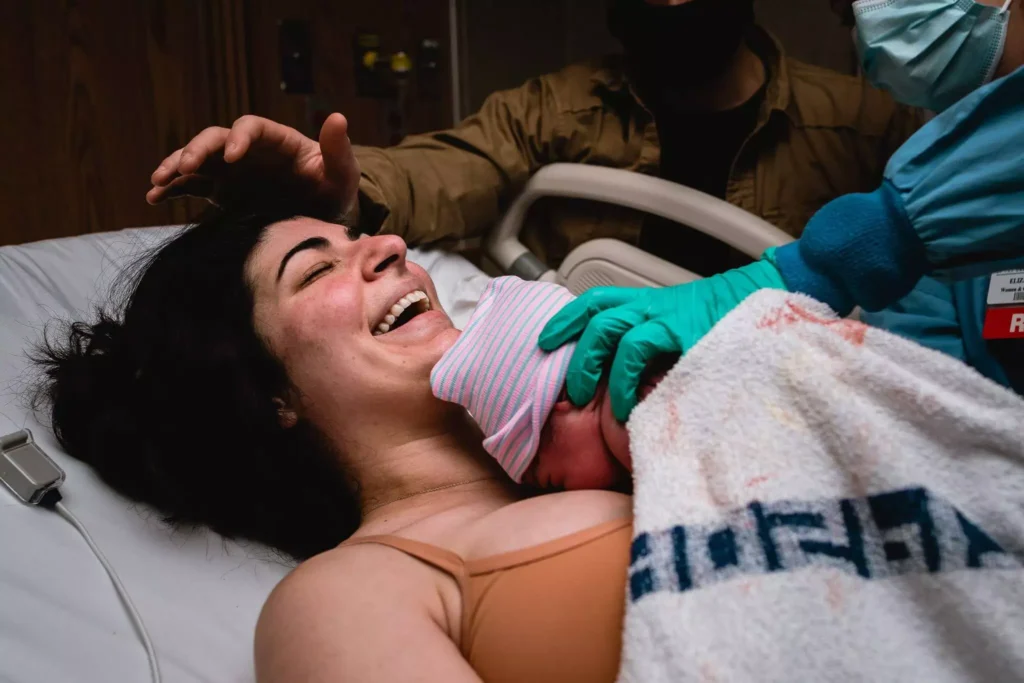

Learn the science of pregnancy and birth to take the mystery of labor away! Understand why you are feeling what you feel, and learn strategies to confidently move through pregnancy and birth!
- 9h+ of Video
- Support Group
- Close Captioning
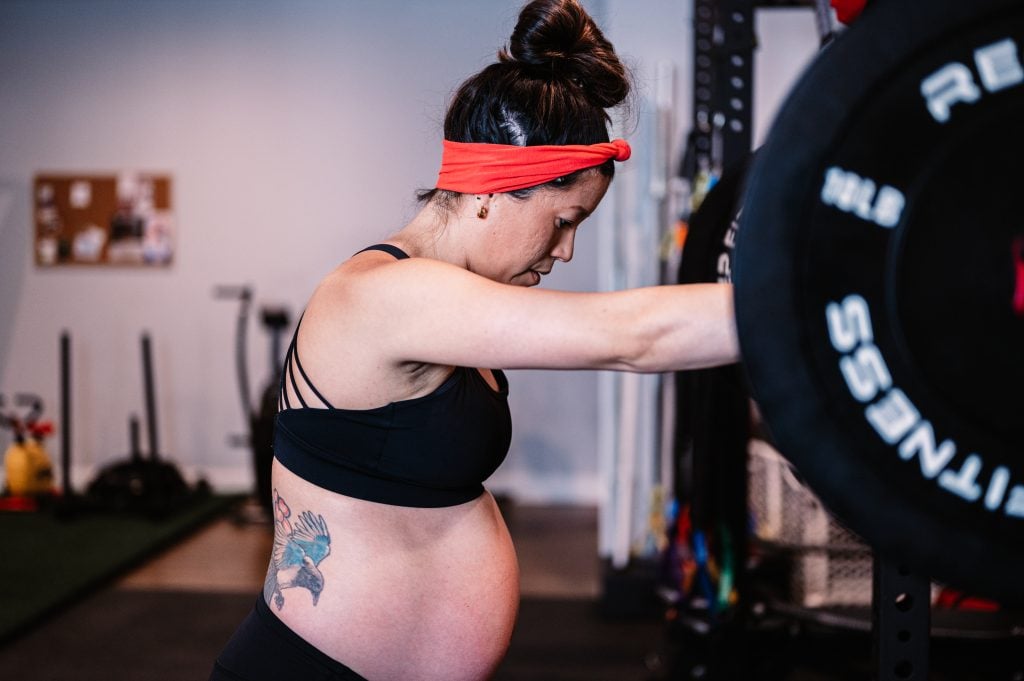

- 5 Workouts/Week
- Gym Workouts
- Self-Paced

Instructor
GINA
Workout on-demand with our prenatal fitness workout videos! Each workout is 30-40 minutes to follow along as you exercise at the same time!
- Birth Prep
- All Trimesters
- Mobility Work

Instructor
GINA
Find comfort and relief from pelvic girdle pain throughout your pregnancy and postpartum period! This program incorporates myofascial sling focused exercises to stabilize across the pelvic girdle joints.
- 3 Weeks
- On Demand Workout Videos to Follow