



As you prepare for a vaginal birth after a cesarean (VBAC), you may have a long list of all the things to do to prepare OR you may have no idea where to even begin.
In our professional experience, having a c-section is not your fault, and I can honestly say that for all my clients who have had a c-section: they needed it at that moment. But, that doesn’t mean you shouldn’t prepare for the birth you want!
As we approach to prepare for a VBAC, the things we want to focus on are ensuring that our own body is ready for labor and supporting our baby’s position, and possibly more importantly, we have a team set up to support us!
Our Top 4 Tips to Prep for a VBAC
The list of things to do to prepare for a VBAC can be long! And that list can be overwhelming. Or you may be the opposite, where you have nothing on your list and feel unsure where to start. We have four areas that we find are important to focus on when preparing for a VBAC!
- Finding a VBAC supportive provider. This may be the MOST important step in preparing for your VBAC. If your provider is NOT supportive, you may find that your chances of a VBAC are much lower.
- C-Section Scar Mobilization. Our scar plays a large role in our function and can influence our baby’s positioning!
- Preparing the pelvis and pelvic floor to open with internal rotation! Some late labor stalls can be due to mobility restrictions or tension in the pelvic floor. We can release tension and find movement to support opening the passage for baby!
- Balancing the uterine ligaments to support our baby’s position. The shape of the uterus influences HOW baby presents during birth. Baby’s position and head position can play a large role in how our labor progresses.
1. Choosing a VBAC Supportive Provider
Your provider plays a HUGE role in how our labor will go and our birth outcomes. Who you choose to support your birth is important! If your provider says things like: “we will allow,” they may not be a VBAC supportive provider. If you feel that you are not an active part of your care, then you may not have a VBAC supportive provider.
Things that may be important when choosing your provider:
- Will they encourage or recommend an elective induction toward the end of your pregnancy? Sometimes I will see providers push induction at 39 or 40 weeks for my VBAC clients because if the baby is smaller, it will be easier to birth. But VBAC tends to have fewer options for induction, so you may find that you end up running out of options.
- Or do they support and encourage you to go into spontaneous labor, even if it is after your due date? Spontaneous labor may increase your likelihood of vaginal birth.
- Do they go over the risk versus benefits of BOTH a VBAC and a repeat c-section? Or do they only discuss the risks of VBAC?
- Do all the providers on their team that may be at your birth support VBAC in the same way? You may find that one provider is very supportive, but the rest are not quite as supportive. If this is the case, this may not be a great clinic for you.
- What is their experience with VBAC? What is the experience of other local moms at this practice/birth location?
2. C-Section Scar Mobilization
Next, we can focus on preparing our body for birth! As a VBAC, we need to consider our c-section scar. Mobilizing your c-section scar (even during pregnancy) has numerous benefits, including:
- Increases the strength and density of the connective tissue at the scar
- This in theory could potentially decrease the risk of uterine rupture, BUT there are no research studies to support this theory. Mobilization breaks up adhesions and allows the tissue to align more optimally, which makes it stronger. So our theory is that it would decrease the risk of rupture.
- Improves function and decreases discomfort and pain
- When a scar has adhesions, it sticks to surrounding layers and can cause a tugging or pulling sensation at the scar or even in other areas of the body, such as the low back. The incision can also adhere to the uterus and bladder!
- Supports baby’s position! If we have a c-section scar, it’s not JUST the external layer that we need to consider! We also have internal layers that need to be mobilized. These internal layers can influence the shape of the uterus which could influence baby’s position!
Want more on HOW to do c-section scar mobilization, even during pregnancy? Join our c-section scar mobilization webinar with Casey Backus, physical therapist, and 2x c-section mama.
3. Find Internal Rotation: Open the Pelvis AND Release the Posterior Pelvic Floor
The passage, or the path that baby has to move through during labor, needs to open for baby! The inability to find internal rotation can cause late labor stalls, which may cause baby to get “stuck” (and may have been why you had a c-section in your previous birth).
Internal rotation tends to be the opposite of common prenatal postural tendencies, which favor external rotation and extension, so it can be harder to find and feel during pregnancy!
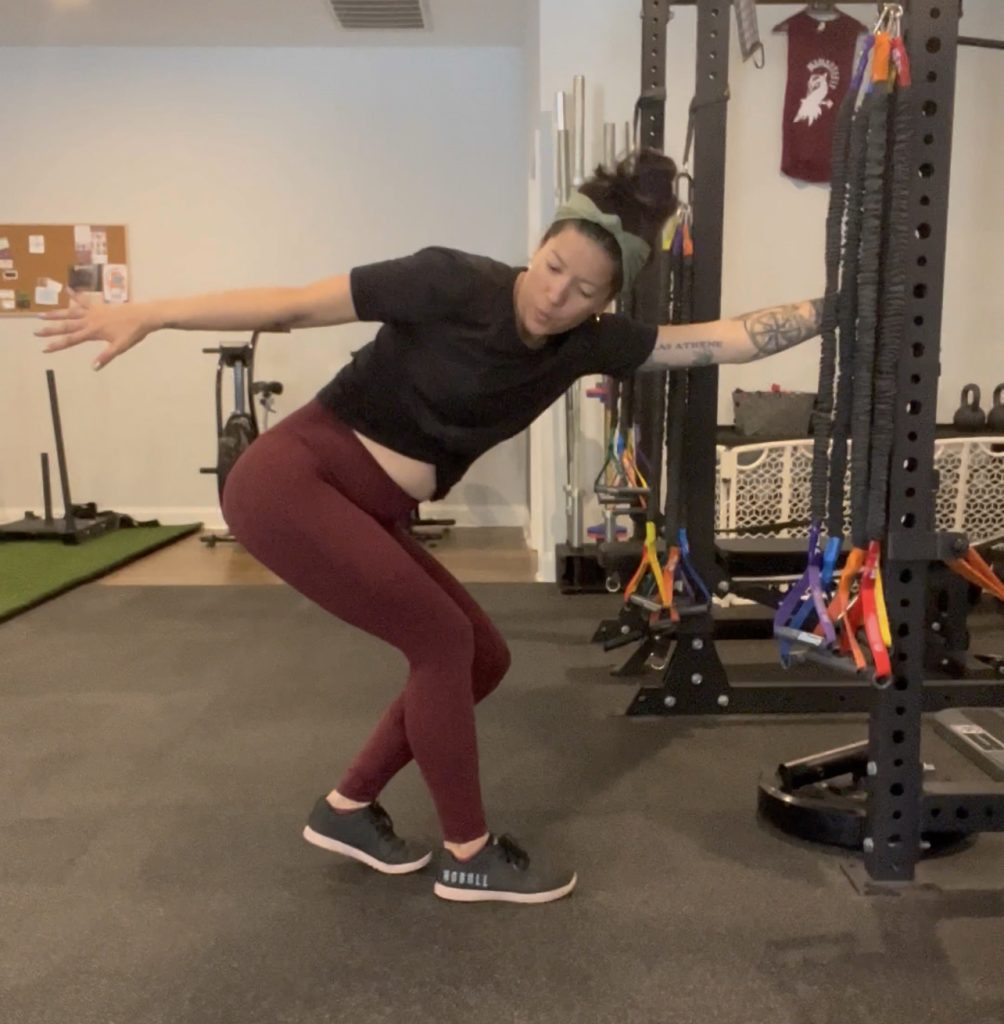
The standing hip shift (among other exercises, such as the step up, lunges, or staggered stance RDL) is one of my favorite internal rotation focused exercises that also releases the posterior pelvic floor.
In the standing hip shift, you will:
- Hold onto a supportive structure, such as your door frame, your partner’s hands, or a beam, with the opposite hand of the focus leg.
- Shift your weight into your focus leg, as you hinge back (hips to the wall behind you)
- As you hinge back, bring your belly to your thigh to find an internal rotation
- Starting from the foot, think weight in your big toe, rotate the knee in and feel a big stretch in the hamstring and glute.
- Round slightly in the back, and then inhale DOWN to feel the back and pelvic floor lengthen OUT
- Exhale to relax
Watch the video below for a better idea of HOW to do this breathing drill to find internal rotation AND release the posterior pelvic floor.
If you want more of a breakdown of WHAT to do throughout your prenatal workouts, check out our prenatal fitness programs! We offer it in two formats:
- 40-Week Prenatal Strength in the Teambuildr App (traditional delivery format)
- Prenatal On-Demand with full-length workout videos that you follow along as you workout
4. Balance the Uterine Ligaments to Support Baby's Position
Baby’s position also influences labor progress and could be a cause of a labor stall, which may or may not have been the reason for your previous c-section.
You may have been told that baby was too big, or your pelvis it too small. Our baby’s head can change SHAPE to accommodate our pelvis, as can our pelvis! It is unlikely that your pelvis is too small or your baby is too big.
The uterine shape (plus surrounding structures) can influence baby’s position! Baby fits where there is space available for them.

Releasing the uterine ligaments (broad, round, and uterosacral ligaments) can support a balanced uterine shape = a more optimal position for baby = a higher chance of a vaginal birth!
Some ways to release the uterine ligaments could include:
- Inversions (round and uterosacral)
- Pelvic tilts (broad)
- Belly sifting or lifting (broad)
- Plus releasing the posterior pelvic floor can be helpful too!
Watch the video below for a breakdown of the uterine release flow that we include in our prenatal fitness programs!
Prepare for YOUR VBAC
Preparing for a VBAC can be overwhelming! There are long lists of do all these things, that may or may not stress you out. Or you may not even know where to start. Focusing on finding the best provider for YOU and then prepping your body for birth (move the pelvis, release the pelvic floor, and balance the uterus) is a good start in preparing for your VBAC!