

There are a ton of exercises that you can do throughout your pregnancy, but there are some that may be worth prioritizing over others!
The things I focused on during my pregnancy and have included in our prenatal fitness programs include:
- Supporting the prenatal postural adaptations (countering the increased weight up and out to the front)
- Maintaining pelvic stability and comfort
- Preparing to open the pelvis for birth
- Staying strong and functional throughout pregnancy
Your baby’s arrival is a monumental moment.
Ensure it’s a positive one by enrolling in our Childbirth Education Course.
Join our community of expectant parents, gain insights, and make lasting memories.
Secure your place now, and let’s start this incredible journey together.
Let’s continue…
My Top 6 Prenatal Exercises
There are so many exercises that we can do to support the goals above, but my favorites include:
- Deadlift: strengthens the posterior chain and can counter the shift in the center of gravity forward.
- Bonus: it supports pelvic positioning with hamstring strengthening.
- Step Up with Banded Row: strengthens the posterior oblique sling, which supports pelvic stability.
- Bonus: adding internal rotation supports pelvic opening in preparation for birth
- Bulgarian Split Squat: strengthens the glute med and quad to counter pelvic asymmetry that may contribute towards pelvic girdle pain
- Copenhagen Plank: strengthens the adductor (inner thigh) to counter pelvic asymmetry that may contribute towards pelvic girdle pain
- Side Seated Side Body Opener: releases compression in the side body/rib cage to relief rib discomfort
- Bonus: supports pelvic position by releasing the thoracic spine
- Hip Shifts: releases the posterior pelvic floor
1) Deadlifts
Usually, when you see a list of the “best” prenatal exercises, squats are at the top of that list. So you may be confused why there are no squats on this top prenatal exercise list.
Squats are great–for strengthening, they are great for the legs, particularly the glutes, and quads. Plus, they help baby engage or enter the pelvis by opening the top of the pelvis.
But, squats favor external rotation and extension which are pretty common postural tendencies during pregnancy. AKA it’s easy for you to usually find this movement during pregnancy and birth.
Therefore, squats don’t necessarily need to be on the top of our list: we generally already do the things that squats support!
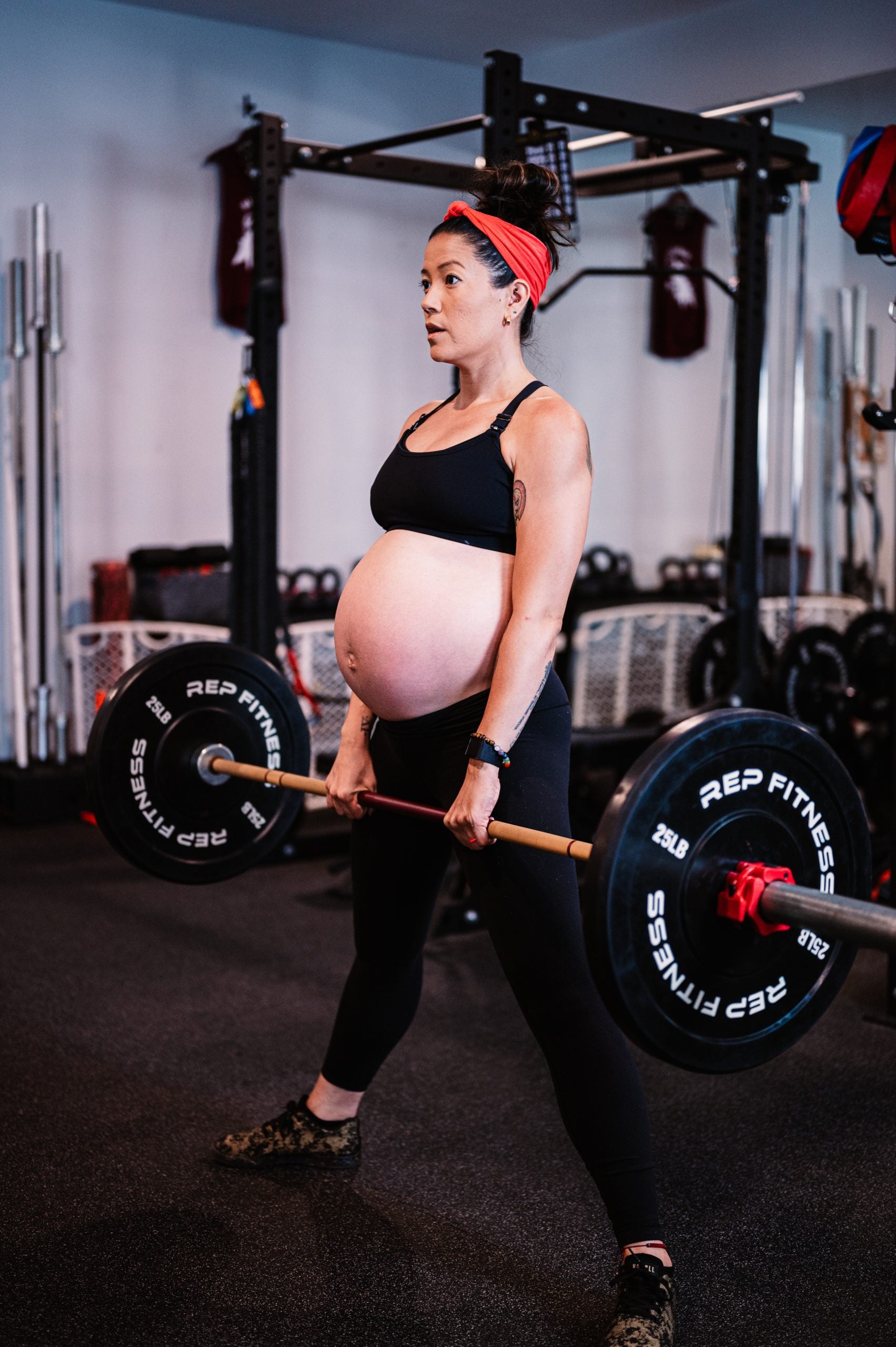
Enter the deadlift. The deadlift strengthens the posterior chain aka your backside! This movement strengthens the lats (your back), glutes, and hamstrings!
This means deadlifts can:
- Support your prenatal posture as your center of gravity shifts forward and out (helps you counter the weight distribution shift so you can stay upright)
- Plus, the hamstrings tend to be overlengthened (especially during pregnancy) so deadlifts can help bring the pelvis into a more neutral position.
Deadlifts support your posture and help you stay upright (which means you’re likely to be more comfortable) plus they can support HOW your pelvis is positioned. How your pelvis is positioned can influence HOW it can open for birth!
If the hamstrings are overlengthened or TOO stretched, it can result in the pelvis tilting more forward (anterior pelvic tilt). An anterior pelvic tilt can close the pelvic outlet (aka where baby needs to vacate the premise), so we may find that if we CANNOT shift the pelvic position, it could result in a labor stall (and potentially lead to more interventions).
Watch the video below for some ways to modify the deadlift throughout your pregnancy!
2) Step Up with Banded Row
Next, we have some more lower body exercises (you will notice that I love leg day): the step-up with a banded row.
The step-up with banded row is a posterior oblique sling exercise that strengthens the glute with the opposite lat. This exercise:
- Strengthens the myofascial sling that supports the SI joint and low back = decreased pain or discomfort in the SI joint and low back
- Adding in an internal rotation focus can:
- Strengthen the glute even more
- Prepare to open the pelvis for birth to prevent late labor stalls due to the passage

Internal rotation is commonly overlooked in fitness programs in general, and the importance of internal rotation for pelvic mechanics is rarely appreciated in prenatal fitness programming.
If you are feeling confused WHAT internal rotation even means, watch this youtube video for some ways to FIND internal rotation to prepare for your birth.
We can use single-leg exercises to focus on internal rotation. Internal rotation moves the glutes through a larger range of motion = more glute strengthening (say bye to “mom butt”). In addition, internal rotation opens the lower half of the pelvis = more space for your baby to finish their rotation for birth.
Watch the breakdown video for more on HOW to do the step-up with banded row to support your pelvic girdle comfort plus prepare for birth.
If you want more of a breakdown of WHAT to do throughout your prenatal workouts, check out our prenatal fitness programs! We offer it in two formats:
- 40-Week Prenatal Strength in the Teambuildr App (traditional delivery format)
- Prenatal On-Demand with full-length workout videos that you follow along as you workout
3 + 4) Bulgarian Split Squat & Copenhagen Plank
Next up, we have some pelvic stability-focused exercises!
These next two are focused on countering pelvic asymmetry that could be resulting in pelvic girdle pain. We can stay pain-free AND comfortable throughout our pregnancies. We do NOT need to be in pain as a part of pregnancy.
One common postural tendency that may result in SI joint pain includes:
- Right glute med and quad are weaker than the left
- Left adductor and hamstring are weaker than the right
- This uneven pull can result in difficulty stabilizing in the pelvic joints during movement
Find comfort and relief from pelvic girdle pain throughout your pregnancy and postpartum period! This program incorporates myofascial sling focused exercises to stabilize across the pelvic girdle joints.
- 3 Week Program, 9 Workouts
- On Demand Workout Videos to Follow
- Educational Videos on How to Approach Modifications
- E-Book
During my own pregnancy, I used the Bulgarian split squat to strengthen the glute med and quad (particularly on the right side) and the Copenhagen plank to strengthen my left adductor to help PULL my pelvis back into a more neutral position.
Watch the breakdown videos below on how to do each of these exercises + modifications if they are not currently accessible to you!
5) Side Seated Side Body Opener
The only focus is not the pelvis! We are connected, so the thoracic position also influences how the pelvis can position itself (and ultimately stabilize during pregnancy for comfort and open for birth).
For me, I tended to have more compression on the right side (and is a common compensation), and this eventually lead to right rib pain! These side body openers were crucial to keeping me comfortable throughout my pregnancy!
Plus, it helped me better position my pelvis for better stabilization during pregnancy and release during labor.
6) Hip Shifted Breathing Drills
And then finally: the pelvic floor! The pelvic floor plays a large role in our daily functions:
- Stabilization of the spine
- Support of the pelvic organs
- Sump pump to support lymphatic flow
- Sexual, including childbirth
- Sphincter control

Our pelvic floor attaches to our pelvis (which hopefully by now you realize tends to sit in an asymmetrical position). This means that the pelvic floor also tends to have asymmetrical tension, particularly of the posterior portion.
We may find more release of the pelvic floor in hip-shifted positions that force the pelvis to find its opposite pattern (for me left hip is elevated and forced into internal rotation, and probably the same for you).
Here are two of my favorite hip-shifted exercises: all fours and standing! Watch the videos below for a breakdown of how find a release in each exercise!

Want more exercises to prepare your pelvic floor for birth? Join our prepare your pelvic floor for birth course!
This self-paced, online course includes an education course to help you learn about your pelvic floor, mobility exercises for the thoracic spine and hips, and tons of pelvic floor relaxation exercises!