
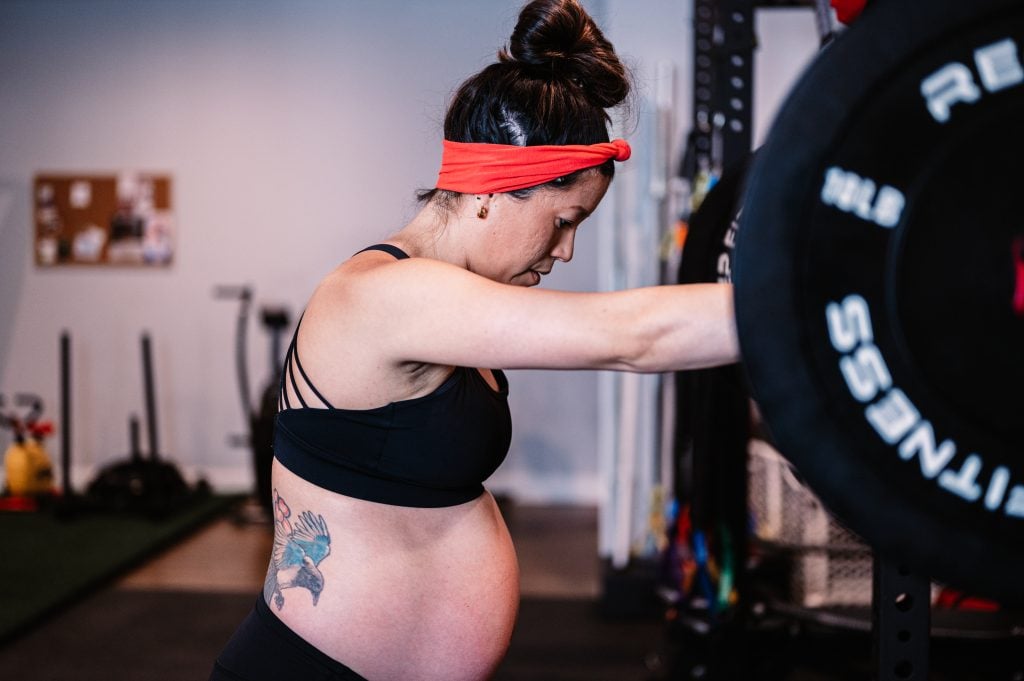
If you want to continue to lift throughout your pregnancy, you may be wondering HOW you protect your pelvic floor while lifting.
The pelvic floor sits at the bottom of our core canister and plays a big role in pressure management, or how much or little pressure is within our abdominal cavity. Intraabdominal pressure is the key way that we stabilize our spine, especially when under a load (aka lifting weights), so we want to be able to effectively increase pressure to stabilize WITHOUT doing TOO much pressure that negatively impacts our pelvic floor.
Throughout pregnancy, the abdominal wall stretches and thins as the load on the pelvic floor increases. This adaptation adjusts how we can manage pressure during pregnancy, so we need to adjust our breathing strategy to accommodate these shifts.
Let’s break down our top tips to help protect your pelvic floor so you can continue to lift confidently throughout your pregnancy.
If you’re feeling confused about HOW to approach exercise throughout your pregnancy–after all there is a lot of misinformation that can make it hard to feel confident to move your body–check out our online prenatal fitness programs! All of our prenatal fitness programs come with an education course to teach you HOW to approach exercise throughout your pregnancy + daily workouts to support you with movement during your pregnancy.
Want more?? Join our prenatal and postnatal fitness programs! We program pelvic opening exercises in each of our prenatal workouts, so you don’t have to guess at what to do! We have combined our experience as perinatal fitness trainers and birth workers to develop a prenatal program that not only supports a strong pregnancy, but also prepares you for birth!
Our prenatal and postnatal fitness programs are offered in two formats:
- Teambuildr App: list of exercises with demo videos with options to track your weights and progress within the app!
- On-Demand Videos: full length workout videos you follow as you workout at the same time
Sign up for our newsletter for free samples of each program!
How to Protect Your Pelvic Floor: Coordinating Breath to Movement
So, how can you protect your pelvic floor with lifts? You can learn how to coordinate your breath to movement! This means you inhale or exhale at certain parts of your exercise to either enhance stability with increased pressure or increase muscular activation to counter that increased pressure (a key thing that protects the pelvic floor).
When you inhale, the diaphragm (bottom of rib cage) moves downward which increases pressure down into the abdominal cavity. This downward pressure pushes the abs, the back, and the pelvic floor outward eccentrically–this means they gather energy as they stretch in response to the pressure.
Inhalations increase pressure, which stabilize the spine–and is more effective at stabilizing under heavy loads than only clenching your abs or muscular activation. If you watch someone lift heavy weight, you’ll see them inhale before they start their rep to expand their torso outwards (increase pressure) and then they’ll do their lift. You will likely not see someone trying to lift a heavy load by sucking their abs in to stabilize because muscular activation is not an effective stabilization strategy.
However, during pregnancy, the abdominal wall stretches and thins–which makes it more easily manipulated by changes in pressure--and the pelvic floor takes on an additional load from pregnancy (so it is already working hard just from existing). There will be a point where you will need some muscular activation to counter the increased pressure, and this usually happens with an exhalation.
When you exhale, there are two options. If you are in a restorative position, you can simply exhale to relax, and the abdominal canister will recoil back inward (remember, it gathered energy when it stretched out with the inhale) to push the diaphragm back up.
The second option, and more likely if you are exercising, is to exhale and increase muscular activation to counter the increased pressure with exertion. This will involve the pelvic floor actively lifting up and in (think like a Kegel or pelvic floor activation), the abs pulling inward as it increases in density, and the same for the back. There will be increased density of the tissue to counter the increased pressure.
Now, how to do you coordinate that breath to your movement?
Inhalations are the eccentric portion of our breath cycle–there is a lengthening and stretching occurring when we inhale. So, we want to pair the inhalation to the eccentric portion of our exercise–usually the portion that we are moving WITH gravity.
Example: Lowering in a squat–you can inhale before the descent or while you are lowering.
Exhalations are the concentric portion of our breath cycle–shortening and activation happen when we exhale. We pair our exhalation to the concentric portion of the lift, usually, the portion that we are moving AGAINST gravity and exertion.
Example: As you come up from the bottom of a squat, you exhale to lift the pelvic floor up and in.
Breathing Strategies for Your Lifts
There are a few breathing strategies that you can try for your exercises that will depend on how much weight you are lifting and how you are feeling in your pregnancy.
In the first two trimesters, you can usually lift around 70-80% effort level (feel like you could do a few more reps with good form, but not more than 2-3). So, usually, you can use one of the more advanced breathing strategies to support your lifts.
Breathing Strategy 1:
In this first strategy, you will inhale at the TOP then hold your breath as you lower. Then at some point during the ascent, you will exhale. This can happen at the beginning of the ascent or near the top of your lift.
When to modify:
If you feel heaviness or pressure DOWN onto the pelvic floor during the lift, you may want to exhale sooner in the ascent or lower the weight. If you feel lightheaded or dizzy, then a breath-holding strategy is no longer appropriate for you.
Breathing Strategy 2:
In this second strategy, you will need to lift less weight as there is less stabilization. In this strategy, you will inhale as you lower, and then exhale as you stand up. This will be more common with lighter weights (40-60%) or bodyweight movements.
Breathing Strategy 3:
In this final strategy, this will be the lightest weight option, but a great option if you are still feeling heaviness or a sensation of bearing down on the pelvic floor with your lifts. In this breathing strategy, you will inhale to lower, then start your exhale before you begin to stand up. This will prep the pelvic floor to activate before you begin to stand up where there will be more pressure downward with exertion.
What are some signs that you need to adjust your breathing strategy?
If you are feeling heaviness in the pelvic floor when your lift, such as this feeling of pressure downward or a sensation of bearing down (think like when you poop), then you need to adjust your breathing strategy and/or the weights you are using.
If you feel lightheaded or dizzy with a breath-holding strategy, you will want to opt for breathing strategy 2 or 3. It can be common in certain parts of pregnancy to feel more breathless, where the first strategy may cause symptoms for you.
If you are experiencing other pelvic floor symptoms such as incontinence (leaking pee). There may be too much pressure or we are not properly coordinating the breath to movement, so an easier strategy may be easier to do.
Protect Your Pelvic Floor as You Lift
The pelvic floor plays a large role in pressure management but also can be heavily impacted by pregnancy. It is common to suffer from some sort of pelvic floor dysfunction during pregnancy and postpartum, so the steps we can take during our pregnancy to minimize issues, the better!
Learning how to coordinate our breath to movement is key to alleviating symptoms from common pelvic floor issues such as prolapse and incontinence too!


Learn the science of pregnancy and birth to take the mystery of labor away! Understand why you are feeling what you feel, and learn strategies to confidently move through pregnancy and birth!
- 9h+ of Video
- Support Group
- Close Captioning

- 5 Workouts/Week
- Gym Workouts
- Self-Paced

Instructor
GINA
Workout on-demand with our prenatal fitness workout videos! Each workout is 30-40 minutes to follow along as you exercise at the same time!
- Birth Prep
- All Trimesters
- Mobility Work

Instructor
GINA
Find comfort and relief from pelvic girdle pain throughout your pregnancy and postpartum period! This program incorporates myofascial sling focused exercises to stabilize across the pelvic girdle joints.
- 3 Weeks
- On Demand Workout Videos to Follow