



Welcome to the MamasteFit Podcast! In this episode, Roxanne (certified nurse midwife), interviews Victoria about two very different births: her first, a 39-week elective induction with Cytotec and high-dose Pitocin, limited eating/mobility, epidural issues, frequent cervical checks, infection/fever, and a postpartum hemorrhage with painful clot removal—followed by postpartum anxiety and breastfeeding struggles due to her baby’s near level-four tongue tie. For her second pregnancy, Victoria re-took MamasteFit’s childbirth course, used our pelvic pain program, advocated more strongly, and aimed for an unmedicated birth. After being told in triage she wasn’t in active labor, her water broke at home, EMS took her to a different hospital, and she delivered quickly with the empowered experience she was wanting. She closes with advice to trust your body and set boundaries.
Read Episode Transcript
Roxanne: Welcome to the MamasteFit Podcast. On this episode, we have Victoria here to share her two birth stories; her first one where she had an elective induction and experienced a postpartum hemorrhage, and then the second one where she had an unmedicated birth where she felt very confident and empowered.
And she also shares a bit about her postpartum experience after her first baby, where she did experience some postpartum anxiety, as well as some breastfeeding issues because her baby had a tongue tie.
Roxanne: Welcome to the MamasteFit Podcast. On this episode, we have Victoria here to share her birth story. Thank you so much, Victoria, for being here.
Victoria: Thank you for having me. I’m excited.
Roxanne: Of course. Of course. So you’re gonna be sharing two birth stories with us today. So let’s dive into the first one. What did you do to prepare for your first pregnancy?
Victoria: So for my first pregnancy, I think at that point in my life- it was in 2021 is when I got pregnant with my first- and I felt like I was extremely healthy. I felt like that was like the healthiest I had been in a while. And when I got pregnant, I suddenly got hit with that major nausea, the bad morning sickness, like at six weeks, I think that’s when like it really hit. And so suddenly I couldn’t eat so healthy anymore and I was pretty much just like stuck with potato and egg breakfast tacos- that’s what I was like always eating with my first pregnancy.
But to prepare for that pregnancy, I actually found you guys. And I can’t remember how I found you if it was on YouTube or, I just found your birth course, but my husband and I completed that full childbirth education course for the first pregnancy. And I learned a lot through that course, but I think there is a difference, and I’ll mention this as I get to my second pregnancy, but I think for the first one, I was a little bit closed off and a little bit nervous about thinking about, “Oh, how is… how am I actually gonna have this baby? Like how is he actually gonna come out of me?” And so sometimes when we were watching y’all’s birth course, I started feeling I would close off to actually trying to imagine the reality of him coming out. While I learned a lot that first pregnancy, I felt like I, I had a lot of fear still about, just about birth, I think. And yeah, that was how I prepared at first. But I was a newbie, and I felt unsure about what to expect.
Roxanne: Yeah. So how did the end of your pregnancy into your birth show, like the birth story go?
Victoria: Yeah. So with my first pregnancy, I had that bad nausea, and then when I got to second trimester, I felt really good. This is when I felt, “okay, I feel really good.” And then the third trimester, I think it was about the third trimester, I started getting that pelvic pain, like, you know when you can’t really move side to side in bed, it really hurts. And, so I dealt with that a lot as I was getting closer to the end.
And I was quite fearful, with this first pregnancy. I was fearful about him coming spontaneously. I wanted my mom to be there, I wanted like the support. And whenever I was talking to my OB, she told me, “This one weekend I am on call when you turn 39 weeks. So if you want, we could induce you.” and I had already known, like, my sister had been induced, and so I was familiar with this process, I knew it. So I thought, okay, I could do that, because then I can have my parents come and they’ll be there for me. And so I thought, okay, I’ll do it, the 39 weeks elective induction- which some people love, but for me, it didn’t quite go that way.
I was scheduled to get induced on April 15th of 2022, and when that morning came, they pushed me back right to the end of the day because pregnant women who were like in labor were coming in, so.
Roxanne: Yeah.
Victoria: Eventually I went in. And this is when, when I went in, they gave me, when I first got there, I, I think it was Cytotec. Does that sound right? Yeah?
Roxanne: Yeah.
Victoria: Okay. So I got Cytotec, and that night, April 15th, that was the last, the last time I could eat. So that was actually the last time they told me I could eat, because they weren’t gonna let me eat after, after being, like, after the induction continued. So I, I ate that night and they gave me Cytotec, and they had me set up to the monitors, right? The monitors are on my belly and I remember all night long they would come in and they would have to adjust my belly monitors because my baby was moving all over the place. And, they would do the, like they would scrub on my belly, I guess trying to get the sticky off, or try to get the sticky… I don’t know. You’ll notice that once I start getting deeper into this birth story, I have less memory because a lot of this stuff that started happening to me is like a lot of different kind of interventions were involved. I started losing some of my awareness, I don’t know how to describe that. But yeah, so all night long, I had people coming in and touching my belly trying to move it because, “Oh, we lost him, we need to find him again.”
So the next day though, that’s when they put me on Pitocin, and that’s when the contractions started to get more frequent. And, I felt like I was having a harder time dealing with them because I couldn’t move, couldn’t really do anything with all the monitors on me. And I felt, again, like it’s weird looking back at this because I have so much more knowledge now, and after doing y’all’s course and everything, and even though I had done the course then, the reality of actually having it happen to me and being closed off to thinking about it during my pregnancy, I think affected that experience a little bit.
So, they did give me IV pain meds that day that they put me on Pitocin, and they helped my contractions a bit, but I will tell you this, I cannot remember. I really can’t remember much of anything when I was on those IV meds.
Roxanne: Yeah.
Victoria: Yeah, and so that’s why, if I’m looking down a little bit, I have some notes written down because I had to look back through my phone at text messages that my husband was sending my parents and my family at the time.
Roxanne: Oh!
Victoria: Yeah, because I couldn’t remember.
Roxanne: Yeah.
Victoria: I can’t remember now exactly all that stuff. I remember the pain kept getting worse, but I still made no progress. I will say, when I went in for the induction, I think I was, like, at a one. I think I was at a one.
Roxanne: Okay.
Victoria: So it was very, yeah, it was very small progress; and I know, of course, it could change, but I was at a one, and I was a first time mom. I got an epidural that day, like around 11:00, I think it was around 11:00. And then my doctor broke my water at 1:00 PM.
Roxanne: Okay.
Victoria: This was around 1:00 PM, that’s when she broke my water. And and I will say this, I love my doctor, my OB, she was my OB for both, and I really love her. And so she was trying to help me get to the point I needed to get to. But, when I look back at it now, everyone was kind, everyone was really sweet at the hospital, but I felt like I wasn’t an active participant. I felt like it was happening to me, and I was just agreeing to whatever was offered to me because I was in pain and I wanted to get the baby out. I really just was like, “I need to get him out.”
And, so they continued to check my cervix very frequently. So that was another thing, I just let that happen a lot, with this birth- I was like, “Okay, just check me. Just see, am I closer? Am I any closer?” So it looks like around, around 4:00 PM, I was at three centimeters and 70% effaced, so I really wasn’t dilating. So they had me on my side, flipping me back and forth with a peanut ball. And I remember this very specific thing about having an epidural is that I hated how my legs felt. They felt, I called them, “corpse legs” because I felt like if anyone, touched my leg…
Roxanne: Valid!
Victoria: Yeah! It felt like, that’s not me. That’s not my leg.
Roxanne: It’s not my body! Yeah.
Victoria: Yeah. It’s not me. And so they touched it and it felt … I didn’t feel it, but I felt gross. Yeah, so-
Roxanne: I’ve heard that before from someone. They’re like, “I don’t enjoy this. I do not like this at all.”
Victoria: Awful, yeah. So that night, that’s when I felt some of the worst pain, because I had an epidural, but I kept on wearing off. I couldn’t feel my legs, but I could feel everything in my torso, and I felt it in my back. My back was, yeah, my back was just, that, that’s where I was really feeling the pain, in my back. And the nurse was checking me, and I remember I was still at a three, and that was when I just, I was like, breaking down with my husband, I was crying to him. And I remember, he jokes about this now, but, I grabbed his throat, because I was just desperate. I was like, “Please, I need this to end.” And I thought, I made a big mistake having this induction. I felt like I made a big mistake, and I felt there was no way the baby was gonna come out of me. I thought they’re gonna have to just, cut him out of me because I can’t … I was just like, “Please, I don’t…” I couldn’t keep having this pain, and I couldn’t move, and nothing was helping me.
They had Pitocin up to the highest setting. They put it up to the highest setting, so I went from, a 15 to a 30. Does that make sense to you?
Roxanne: Oh, okay. Okay. Yeah.
Victoria: Cause the numbers are told to me, but to … I’m not a doctor, so I don’t know what those-
Gina: That is a lot of Pitocin.
Victoria: Yeah. Okay. So I went from, a 15 to a 30, and then they had me take a break completely. And so then around, 12:00 AM of April 17th, and that was actually Easter morning, because that was Easter Sunday, but I was finally at four, and my cervix was thin.
So they redid the epidural, and they gave me a sleep aid to help me sleep. I don’t know what it was, but it helped me sleep. And then at 2:00 AM I was near a five, and I felt a lot of pressure. And at this point, I didn’t know this, but I know this now because I looked back at the text messages, but I had a fever; and so I believe I had got the infection then or around that time because I did get an infection, but I know this because my husband sent that. So he knew that I had the fever, but I don’t recall anyone telling me- if they did, I don’t remember it. At about 6:00 AM, my husband texted for me for my mom to get to the hospital because I was gonna push soon. Yeah, so I finally got to this point. Yeah, it’s like at that point, it was like all this time, and then, okay, now you’re ready. Yeah. It’s like that nap, the nap I had, yeah.
The pushing now, this is when I can get to a positive part of my first story, is that’s when I felt most empowered. I felt like, finally I can, I’m doing something, finally. So, I was exhausted. I hadn’t eaten since April 15th and I was at the 17th now. All they gave me were like, you get ice chips, you get popsicles,
Roxanne: Yeah, not sustaining, at all.
Victoria: Yeah, that’s all I got. And so when I was finally getting to push, and I’m on my back, but that’s, I got the epidural, that’s where I am. There’s this nurse who is coaching me, and I got my husband on one side ,and my mom’s on the other side, and I’m pushing, and my son keeps on like coming down and going back in, coming out, going back in.
Roxanne: Yeah. As they do.
Victoria: Yeah, that’s what he’s doing. And, so I’m like, okay, just keep pushing. I feel like every time the nurse would tell me to push, but I could feel like my contractions at this point, even though I had that epidural and my legs were still numb, but I could feel when I needed to push and it felt like good. It felt like good to push. So I was pushing and I could see like my toes start to move, if that’s like, I started getting feeling back. And it took me about two hours to push, so it was about two hours. I know that’s not the longest time. Some people-
Roxanne: That’s still a long time.
Victoria: Yes, it was exhausting. And so like in between pushes, I feel like I would disassociate a little bit. I was not there. I could hear my mom and my husband talking to the nurse. I would like tell the, tell them like, “Stop talking, don’t talk.” And then they’re like, they were like, “Okay.”
But when he finally came out, that was so surreal. I felt, oh wow, okay, there’s, there’s a real baby! Because I had known this little, this person was in my body this whole time and then finally I get to see him. And I thought, oh, I just felt, wow, he’s so beautiful. I didn’t expect him to be so beautiful. He had… Oh! I hear yours! He had red hair and… Aww! I can’t, the baby noises just get me.
Roxanne: I know.
Victoria: But, what I didn’t expect was the like shaking, the violent shaking after birth. And so this part, it did… when I talk to people about this part, it hurts me a little bit because, it wasn’t what I had expected it to be. It was that I was shaking so hard, the nurses come over and they like take my bra down and they’re like, “Okay, nurse him.” I couldn’t physically hold him. I felt like I was just so weak. And again, this is almost three years ago that I had my son, so I feel like I’m separated enough from the moment to have a way to look at it now more clearly, but at that moment I felt just utterly exhausted. I had no energy. And I wanted to hold him, but I couldn’t, and some of these things that I feel like I regret. I don’t know why the nurses were so adamant he needed to eat right away, but they, so they gave my husband a little formula and so he gave him some formula. And I don’t know, again, I don’t know if that was because I had a fever, if they were worried about him. They had to get him checked out at, I don’t want to say NICU, but they had him checked out, before just to-
Roxanne: Yeah, just like in a special nursery.
Victoria: Just to make sure. He was very large-headed because my husband, he’s got a big noggin, so-
Roxanne: Yeah, same. We feel you.
Victoria: So it was like 90th percentile, those heads. But he was okay, like my little boy, he was okay. And, so I got transferred to postpartum and everything did seem okay at first. So like Nick, my mom, my dad came- sorry, Nick is my husband, my mom, my dad and my two little younger sisters came to see me in postpartum, which it was a surprise- my sisters, I didn’t expect them to be there. I went to the bathroom and I looked down, the nurse is like helping me in there and I’m pouring blood, like blood is pouring. I didn’t know if that was normal or not. and I just asked her, “Is this normal?” And this nurse, I’m just like, I’m so thankful for her because she was such a light, she was like a no nonsense, but not cruel, like she’s very… but she just like, “Okay, let’s get you out of here.” Like just got me out, and told my sisters like, “Oh, we need to clear out everyone who doesn’t need to be in here, you need to clear out like right now.” So my dad and my two younger sisters left, my husband, was holding Miles, our son, I can’t recall if he asked me like, “Do you need me …” he was holding the baby, he’s like “I got him, so I knew I was okay.” My mom was right by me and a ton of doctors were coming into the room suddenly. And, this was the worst pain, they pulled, she put her hands into me and was pulling out blood clots. And I was screaming, because I was worried she was gonna rip my stitches. Like I don’t know if that was like… I was very worried about that.
Roxanne: Yeah.
Victoria: And I felt everything and, yeah, and it was the worst pain. I was holding onto my mom. And this I think was why, I think a lot of these things just like building up into it, was why I had such a bad anxiety postpartum, and I had a really bad postpartum experience. My husband also he was traumatized from that moment because he thought I was gonna die, because he saw blood pouring out of me and just, to try to … it was bad. But I was okay eventually. Like they, they check you after that, they try to make sure like you push on your belly and everything and try to make sure you’re okay. So I went home, eventually, like we had to stay a bit because I had the infection. they wanted to check me and check my son.
But for my postpartum, it was difficult, right? My son had a level four tongue tie, almost a level four, it was close to a level four tongue tie. So nursing was very hard and I also did not prepare myself enough for what nursing really was. So I had to do a lot of pumping and giving it to him in the bottle. We nursed for a couple of months after he did eventually get his tongue tie released, because it was very hard for him to move his tongue. It was like that kind of tie, they called it like a whale tail, I don’t know. It was rough.
Roxanne: Oh, so it like went almost all the way to the tip?
Victoria: Yes. Yes, exactly. It was almost there. It like curved inward. But, we got the hang off stuff, right? We eventually got the hang of stuff. I did need to get some medication from my doctor because I was having extreme panics about his safety. I worried every night when I went to sleep, he’s not gonna wake up. I worried, I would wake up just in like gasping for air because I fell asleep and I thought he wasn’t gonna be okay. I would have to ask, either I couldn’t sleep or either I would make my husband stay awake. I had to make sure he was okay. My mom, of course, like stayed with us for a couple weeks and my dad would come, and they were holding him when I couldn’t hold him or when Nick needed to sleep. And it was, that’s not sustainable! We can’t do it like that, but that’s the way I felt at that time until like medication eventually helped me with what was going on, yeah. But I will say like this is, it was a hard moment that postpartum, but I did eventually find my groove and I eventually found okay, I’m his mother and I know how to be his mother, and, I got to a point like I couldn’t imagine being anything else. I had a hard time for a little bit like, thinking about how am I his mother and I’m also like this PhD student- because at the same time I was working on my PhD. And eventually like I, I found myself like as he grew and I found this balance. I think around four months maybe I felt like, okay, I’m gonna start, I start teaching again and I started working on my PhD, my dissertation, and I was able to find a groove. And I was able to pump and I was still able to feed him with my body and I found like this, this, this sweet spot. And I just adored like our moments like just being with each other. And I ultimately, my relationship with my firstborn and being a mom to him is what, like why I wanted another one.
So I guess that gets me into my next story, unless you have any questions or anything.
Roxanne: No, I’ll ask all my questions at the end. Hopefully I don’t forget them because I think that your first birth story, as well as your first postpartum, is probably something that a lot of people can resonate with and that also likely probably also felt in their first labor, birth, and postpartum; because that first baby could be such a transition, even if you like maybe have like in your mind, the perfect birth. Postpartum can still be so hard with that first baby because… so many things! But you also had a lot of things that could increase the likelihood of having that postpartum anxiety, to the point that it’s like, you had so much support, like your family was so supportive of you, but so many other things could contribute to that postpartum anxiety. And that is why medication is great when it’s available and it’s needed. So I, I don’t want you to feel like alone in that experience and that’s like a very unfortunately common experience. I wish it was rare because people are just supported in everything, but, I think other people will feel very heard and seen from your story. So I really thank you for sharing it with us.
But let us get into your second one, because I saw your baby! So cute! So I wanna see, I wanna know their birth story. So how did you prepare differently for that birth in pregnancy than you did for your first? So I know you took our childbirth education, but you were still like very… not very open, but like you were still very nervous and fearful of the birth process, so like maybe you didn’t take all of that information in- which totally fine, very common. So what did you do differently in your second pregnancy in preparation for pregnancy and birth?
Victoria: My second one, it was, it was very different, right? So I got pregnant in December of, of the year before his birth, and, I knew I wanted a different story. I just knew I wanted it to be different. I wanted to nurse and I really did want to deliver my baby without an epidural because I hated it. I, personally, hated my epidural, because I felt like it didn’t give me pain relief, I felt like it didn’t, all it did was like prevent me from moving. So, for me personally, I just didn’t want to. I was, of course, like, “I’ll probably change my mind.” In the back of my head I’m like, “I’ll probably change my mind, right? But I, I don’t want it.” But I did, I made it clear to my OB throughout that pregnancy that I didn’t want to be induced, even though I wasn’t forced the first time- of course, not at all, that was my choice. I made it clear to her that I didn’t want to do it this time, unless I had to, unless there was some sort of valid reason.
So throughout the second pregnancy, I followed actually your pelvic pain program to try to manage my SPD pain.
Roxanne: Yes. That front pubic bone pain.
Victoria: Yes. Like, you can’t spread your legs, right? So I actually started having that pain in the second trimester, and it just progressively got worse. And, my second son, Luke, he was measuring heavier and larger-
Roxanne: As they do.
Victoria: Yes, heavier and larger than Miles, and I felt it. I believed them, because I felt it. So I had to wear a belly band, just basically whenever I was walking. Most of the time when I was walking, I was like, “I need to wear this thing because I just felt it.” It was like my back was being pulled. I had to do that. But I, we did do your childbirth education course again, yeah, so it was the same childbirth course, of course, we just, we did it again. And I think y’all added stuff to it also since the last time-
Roxanne: We did.
Victoria: … Because I, at this point, my son, my first son, was about three, and so it had been a couple years since-
Roxanne: Oh, yeah, yeah.
Victoria: You definitely added way more.
Roxanne: Yeah, we re-filmed a lot, the audio was better.
Victoria: We got like new videos, new things to look at. And so even though I had been through it, I was listening to you guys talk about what questions to ask, the interventions that are necessary, or how you can say, “Maybe I don’t want this thing to happen to me,” or how you can refuse cervical checks if you don’t want them, it’s your body.
And so I was really listening to all of that with a different focus in my head. And I think I listened to y’all’s podcast, too. I listened to all of your podcasts, that’s why I was like your top listener for that last year because I was, I was very focused on, “I want to listen to every experience or like different people’s experiences with having natural births,” or sorry, unmedicated, I guess I could say, because it’s all natural. But, yeah, so I listened to a lot of that and I really resolved in my head, I told my husband, “This is what I want, I really want, ” and he was supportive of me.
So at about 38 weeks pregnant, I’ll start there, I was having that tons of back pain, on and off contractions, along with I was starting to get spotting and discharge. And this was all new to me, because with my first one, it was an induction and so I didn’t get these kind of like signs of labor, I didn’t ever have that. So this felt like a new first time again. So the night before I was gonna go see my OB for that 38 week checkup, I woke up at 3:00 AM, and this was August 20th of last year, so 2025. And I had this uncomfortable period like cramps- it felt like my period was coming on, that’s how I can describe it, right? And I had this brown and red I had discharge. And I don’t know what it was, but I called my mom and I just said, “You should come tomorrow.” My dad was gonna be coming to watch my firstborn while my husband and I went to the OB together, he was gonna just watch him because we thought it would just be our regular thing. Because, my parents live about two hours away, I don’t, that’s why I was like, “You need to come,” right, that kind of thing.
Roxanne: Oh yeah.
Victoria: That’s why, there’s a bit of a … so I told her-
Roxanne: Bit of a drive.
Victoria: Yeah, that’s also why my first pregnancy, I was like so eager. I want them to be with me, because they don’t live right down the road or anything, they’re a little bit away.
So I told my mom to come, and she’s like, “Okay, I’ll be there.” Because I called her and she picked up the phone because she had her volume up high, like she had her volume on because she knew, “She could be in labor any day, I’m gonna make sure. And she’s due in August! I’m gonna make sure.” And I went back to sleep, and I woke up in the morning, took my son to school because he’s in like half day school and my contractions seemed like they were done. I was like, “Okay, they’re over.” So I worried I called my mom for no reason, but they still came, my mom still came. She’s like, “I’m still gonna come.” So my mom and dad came, they watched my son. And at the OB, I did ask for a cervical check because this was my first one and I was like, “Okay, I just wanna see.” And so I was about three centimeters dilated and 60% effaced. So I was like, “Whoa, okay. So I’m doing something, right?”
Roxanne: Yeah.
Victoria: So that night was rough again. And this was August 21st. So I woke up at 3:00 AM again. I don’t know what it is about 3:00 AM, but it’s 3:00 AM.
Roxanne: Yeah. It’s always 3:00 AM.
Victoria: And I saw my mucus plug in the toilet. And I didn’t know what it was, of course, because I’d never had this happen to me, but I was like Googling, what is this? Is this…?
The pain was worse this night, though. It was like, it was worse. I felt this build and peak that you guys were talking about in your course, which I will say, I feel like I didn’t feel those build and peak contractions the same way with my induction. I felt like it was constant pain, I don’t know how to describe it. It was different this time, like the way it was happening to me on my own. So the pain would build and peak and it would start in my hips and my butt and then it would, then it would subdue, but it would start there.
But then by daylight, it would calm down, my contractions would calm down. And so before the sun came up, I was like, I was swaying with my husband, I was moaning, it was really painful. Like I have notes like reminding myself, “This was painful!” Because at this point, it fades, you forget the pain. Yeah, I forget, I’ve forgotten it now. I don’t remember it hurting that bad anymore, but I know it did at that time. But I remember that day I just felt… wrong. So my firstborn, he got fussy during lunch and I ran into the bathroom and I was crying. And I had contractions on and off throughout that day. But again, once I put my firstborn to sleep at night, it’s like then that’s when they would pick up again, my contractions would pickup.
So I remember that night, that was the last night I put him to sleep before he became a big brother. I sang him his songs and we prayed together, and I cuddled him and then I went back downstairs and watched TV with my mom, and then the contractions started again. And they were strong, strong contractions. And I would be like laughing and joking with my mom talking to her, and then all of a sudden I was like on the couch, unable to move. I was just like unable to move, because it would hit me and my mom was worried. Yeah, she was worried. She’s “Okay, are you okay?” So, my mom and my husband, they were worried about me and we, though I protested, I was like, “I don’t think I need to go to the hospital,” my mom was like, “I think you should go. ” And, my husband was like, “We need to decide what we’re doing, you know, because either I go to sleep or we go to the hospital.” So we went. But even trying to get to the car- and it was around 9:00 or 10:00 PM at night- trying to get to the car to leave for the hospital, I was unable to move. When the contraction hit, I couldn’t move, I was crying out in pain, so I was like, “This gotta be real, right? This gotta be it.”
Every bump in that car on our trip was painful, every bump. But I was, I felt like I was really coping well at this point, I really did, I thought. I was singing along to the songs in the car, and then I would pause and I had a contraction, okay, breathe through it, and like the low noises, and then I was okay, and we got there. So I felt like I was coping well. I felt like I was coping well at home too, like I thought, “I’m doing okay.” When we get to the the hospital, the triage, we had called ahead, and I get there and I’m like unable to really move. I’m crying out through contractions, “Oh, okay.” I’m pausing when get there, I have to pause to walk. When we get to the triage, they get me into a bed, and they strap me to a monitor on my belly, and I remember that was like, okay, no, now I can’t move. Now I’m stuck. And I started feeling like worse pain. I just felt worse pain. For me, that was really hard. I felt like I was coping so well and then being unable to move, I just, had a rough time.
They checked me and I was at a three still. I was still at a three. And so I was like, “…Okay.” I know what you guys say, it’s just like, your dilation’s just a moment in time. I remember you guys saying that, and that’s what I had in my head, but I was like, okay, I thought that pain meant like I was about to push him out or something. I thought we were getting there. This is where … So the nurse tells me, “You’re not in active labor, you’re basically having contractions that just aren’t making any cervical change.” That’s what she told me. And, I was just like feeling really defeated at that point, but what was worse is she found out- I don’t remember who said it, like me or my husband, or how it came out, like that I was planning to deliver unmedicated, I didn’t want medication. I think it came out because I said, “I should go home if … yeah, I should go home if I’m not there.” Like I was like, “I need to go back home then because I can’t be here this early. I don’t wanna have an epidural. I wanna do this unmedicated.” And she was like, “If you’re in this bad of pain at this point, you might wanna reconsider an epidural. If you’re having this much pain and you’re not even really in labor, then you might wanna have an epidural.”
Roxanne: Oh, I hate it.
Victoria: That really is awful to hear. It was awful to hear that. And I just thought … And I don’t know, I don’t know why she would say this. And she was trying to say, “Yeah, and I had my epidural, and I was good,” like trying to give her experience with it, that’s fine, but that’s not what I wanted to do.
Roxanne: Yeah. …
Victoria: And, also it’s invalidating the pain I was in, even though I’m only at a three, that was bad pain. I’m in bad pain!
But what was funny now, looking in hindsight, is I was sitting there and my husband’s like trying to comfort me a little bit- because they would leave, they kept coming back in “Oh, let’s check the baby,” they just wanted to check him, check how he was doing before they let me go. That was what they were saying, “We need to check before they let you go. ”
Roxanne: Yeah.
Victoria: Okay. And-
Roxanne: With the monitors?
Victoria: Yeah, they just wanted to see. And so I was just like, okay. But almost out of spite, I was just like blank faced through my contractions. They hurt so bad, but I was just like, “I’m not even gonna make a peep.” I was just so upset because of what she’s told me, and I thought, this isn’t real anyways,” so I was just like, I’m holding it in and my husband’s like, “Hey, are you okay? Do you need my hand? Do you need it? ” I’m just like, “Mmm-mmm!” Like, I’m not, I was so upset. But they monitored my baby for a while and he kept moving and eventually they were like, “Okay, I guess you can leave now.”
And I’ll tell you, I’m not quite sure if they wanted me to stay or leave. I’ve talked to my husband about this. I couldn’t really tell because they said I wasn’t in active labor, but they wanted me to stay longer. So I don’t really know why, to … Yeah, I’m not really sure. They were just like, “We just need to check. If you left now, it would be against our medical advice.” That’s what they were saying. But they, at a certain, it was like they had to check my son for so long, that’s what they were telling me. And by the time they were done, they’re like, “Okay, you can leave now.” And so I was like, “Okay, I’m gonna go then.” And on the way home, man, that drive home was the worst. It was the worst. I felt like my morale was just shot, the pain felt 10 times worse, and I think it was just because in my mental, my head was like, “I thought I was gonna be able to do this and then I can’t do it apparently.”
So I got home. I tried to get in the bathtub and I remember thinking, because before the bathtub helped my contractions slow down or be manageable, but it wouldn’t stop. The pain wouldn’t subside. So I got into bed, and laid on my side with the pillow between my legs, and my husband went to sleep because he’s like, “I gotta sleep for if we’re gonna go in the morning or if we’re gonna do anything, I need to sleep some, right?” So he went to sleep, and I kept thinking, “This pain has to end at some point. All the other nights, it’s ended and the morning comes, I’m gonna feel okay, so it’ll be fine.” So I kept on just trying to go to sleep, but I couldn’t go to sleep, because you can’t sleep through that pain. and I think I even took, I, I can’t remember if I got Tylenol or Benadryl, something- did nothing to me. So I was there and every time I would have a contraction, I just hum I would try to soothe myself in different ways. And, but I just kept thinking again, in the morning, I’m gonna take my son to school, it’s gonna be done. And then I was also like telling myself, “I’m gonna tell my OB, I just want an induction, I just wanna get this done with, because I can’t have this every night happen to me. I can’t just be in pain.”
So I laid in bed from about, like when we got home, from about 12:00 AM to 5:00 AM, I will say this was the time span that I was in bed. And I was mostly on my left side with the pillow between my legs. But I got up a few times and I did inversions, so like some of those moves that you guys do with your birth prep, I did inversions, I did a puppy pose, with like my butt in the air, my faces in the pillow. I thought I gotta get like pressure off my cervix. I thought maybe if I move, maybe his head will get off it. I don’t know what it was, I was just like, “I gotta get this off.” But I kept on having that feeling that would build in my hips and my butt and it would just like peak and then it would go, and I’m like, “Okay, I’m okay for now,” and then it’ll come back. Until I realized there is no break. I am not ever having a break from this. And I thought, how is that normal? Why am I not having a break? So I kept looking at the clock and thinking like it’s never ending. It’s not five minutes, and not three minutes, it’s like never ending. But again, I thought I wasn’t in labor. I thought I wasn’t in active labor, at least.
I went to the bathroom to pee because I thought maybe I just need to pee. And when I was on the toilet, I remember feeling like I feel okay right here, I like feel a little bit better. And I was like calling my husband, because the bathroom was in our bedroom and I was like, “Hey, Nick,” and then my water just broke, gushed out.
Roxanne: Oh, glad you’re on the toilet!
Victoria: Yeah, just gush. Sorry, what I forgot to say though, is that the reason I got up out of bed anyway to pee is because I noticed that when I was going through the contractions, I would, I felt myself pushing. And I didn’t realize like at first, but I started feeling this, like… that pressure in my perineum area, and I was like, “Oh, I think I’m pushing.” So that’s why I got up and when I got on the toilet, I felt like contraction came and I pushed. I don’t know if it was involuntary or like what was happening, but it was like, it just happened. I couldn’t really help it. And so my water broke and I screamed for Nick and I was like, “Oh, my water broke.” And he comes in, this was around 5:30, he says it was around 5:30, so I don’t know. I believe him, I can’t remember!
Roxanne: You weren’t looking at a clock.
Victoria: Yeah, exactly. So my mom came running in, or he went and got my mom, because she was still staying with us, and my dad had left actually because he had went home to take care of their pets, and so he wasn’t there, but my mom was. And my son’s still asleep, my first, firstborn. And, my mom comes in and I’m like, “I’m sorry, I’m just pushing. I can stop. I can’t stop pushing.” And she’s “Oh, baby don’t push. Maybe don’t push right now.” So we try to get myself down the stairs, which was just very hard to do. I could not move.
Roxanne: Yeah.
Victoria: My husband is asking me like, “Do I call our hospital to prepare them like that you’re coming?” I was like, “I don’t think I can get in the car. I don’t think I can sit.” I couldn’t, because I had this thought of what I had been through before in the car, I couldn’t sit down and, like, I don’t think so. So he was like, “Should I call 911?” I was like, “Call 911.” That’s all I can do. I didn’t know what to do, okay. This was, I thought the baby was coming out, because I couldn’t stop pushing. And so they called 911. My husband, just like his empathy for me, his love for me, he was like tunnel visioning and having… because he had gotten up so quick, he was worried about me, and so he like, when we got downstairs finally, he had sat on the floor and my mom had to talk on the phone to the operator, saying they’re gonna send EMS. And I’m like crouched down on the floor and voluntarily pushing still, I’m still pushing. And, I had, gotten into my, robe, birth, sorry, gown. I had gotten into a gown I had bought, so that way I was like, it was good just in case, I didn’t have pants on. I was in my gown. And so I was down there and my mom’s like, “Hey, but don’t push baby,” just trying to encourage me because she’s she thought, “Yeah, this baby’s gonna come here, right?” Which like looking back on, I’m like, “Yeah, I could’ve done it.” I could’ve done it, but we weren’t prepared for it and we still had this fear of like my past hemorrhaging that I wanted to be at the hospital. And so it just, that’s what we wanted to do because that, that hemorrhaging in my head too.
And EMS came and they got me on the stretcher, they took me to the ambulance and I was like, “Okay, but Nick’s gonna come behind me, he’s gonna drive in the van behind me.” I was worried about him because he had been lightheaded and everything and I was like, “He’s gonna get in a car crash.” Like I just thought that something’s gonna happen to him.
Roxanne: Yeah.
Victoria: But he was okay. So on the drive there, they, I think, yeah, they got me hooked to an IV in the ambulance. I was holding onto this man’s leg. I remember not thinking clearly, they were like, “Is the baby here?” They like … And I said, “You can’t check me. You can’t check me. My water broke and I don’t wanna get an infection.” Like I don’t know why, I was just like in my world, they’re like, “We’re not gonna check you, ma’am. Like it’s okay.” but, they-
Roxanne: They will not check you.
Victoria: Yeah. Yeah. I was like, I was not. I was just like, “Please, don’t touch me.” But, no, they were so nice. I was in the stretcher and I held onto this guy’s leg and I was like, “I am sorry,” he was the oldest of the guys that were there. And I said, “I’m sorry, I’m just in so much pain.” And he’s “No, you do what you gotta do. ” And so I held onto his leg through those contractions and I remember just being in the ambulance, they told me like, “We can’t, we have to take you to the closest hospital.” So we weren’t even gonna go to my hospital where my OB was. And I was upset about that, but they were like, “No, you’re gonna go to the closest hospital.” Which funny enough, St. Luke’s, that’s what the hospital is, which is my baby’s name. That’s not why we named him that!
But so they took me to the close hospital and they told my husband, “You need to go there.” So I get on the stretcher, they take me out, get me to a room, and I’m just asking, “Is my husband, is my husband coming? I need my husband. I need him to get here.” They get me hooked up to stuff, I don’t know, stuff? Hooked up to stuff like IV, I don’t know, fluid. Yeah, fluid, they’re gonna, they’re gonna be fluid, that’s what it was. And, in my head I was like thinking, “I’m gonna get an epidural,” I’m telling them, “I’m gonna get pain meds, I’m gonna get pain meds.” They’re like, “Sure, yeah, okay.” And I did let them check me, and they told me I was in an eight at that point, that I was at an eight. Don’t know if it was super accurate, because it was like a hard check, but that’s what they told me, and I kept on getting on my side- that was the side I wanted to, I wanted to stay on my side. And so my husband eventually got there, and when he got there, I really just, let my body do what I wanted to do. I sort of pushed, and I wasn’t telling them I was pushing because I thought they were gonna tell me to stop pushing, but I was like, “Yeah, it’s, happening.” And I was just like letting it happen and, all the grunting, all of this stuff. And, but the nurse was like, “I need to look. I need to check where you are now.” And I said, “No, you’re not checking right now.” because I was in a contraction, so I was very up, very … And my husband was like, “No, leave her alone! Like just leave her alone. And so the nurse was like, “Oh my God,” because she wanted to check and see where I was probably. But, I’m like, okay, after it passed, I’m like, “Okay, now you can check me, you can check now.” She’s like, “Oh, there’s the head. Okay.”
So he was coming out! And, he, like I was crying like, “Oh my God, like how am I gonna do this?” I’m actually, I had wanted to do this unmedicated, but I hadn’t thought I was l- like, it was finally here, and I was like, “Whoa, am I gonna do this? And one of the doctors or a nurse came to my face and she was like, “You’re gonna do this. You got this.” And, and I was pushing, I pushed on my side, that’s, I still was pushing on my side, I guess someone had my leg up. I don’t know, but I don’t even know, if, like I was opening my legs, I think. But he just was coming out on my side. He came out so fast. Like I can’t tell you, I felt the burningness more with my first son than I did with my second son and I was unmedicated, because like it just happened so fast. Like I pushed and they were just like, “Push!” And he was out. I don’t even know how many pushes it took, but he came out so fast. And, it was just from 5:30 to 7:00, my water broke at 5:30 and then he was born at 7:00. And so it was quick, happened quick.
And, I tell everyone, that moment, like when I look back at that, I just, I love that moment. I just felt like so grateful. It was so beautiful to me, because it felt like familiar, like I know this, like I know this, because I felt him and I smelled him and it’s that moment of feeling your newborn again, that moment; but also like it happened more in my time, even though that might, it might not sound like it, right? Because I had an ambulance come and everything was so fast; but it did, it happened the way I wanted it to happen. I got to stay home until the last moment! And so I got to do it the way I wanted to. and so I felt so grateful.
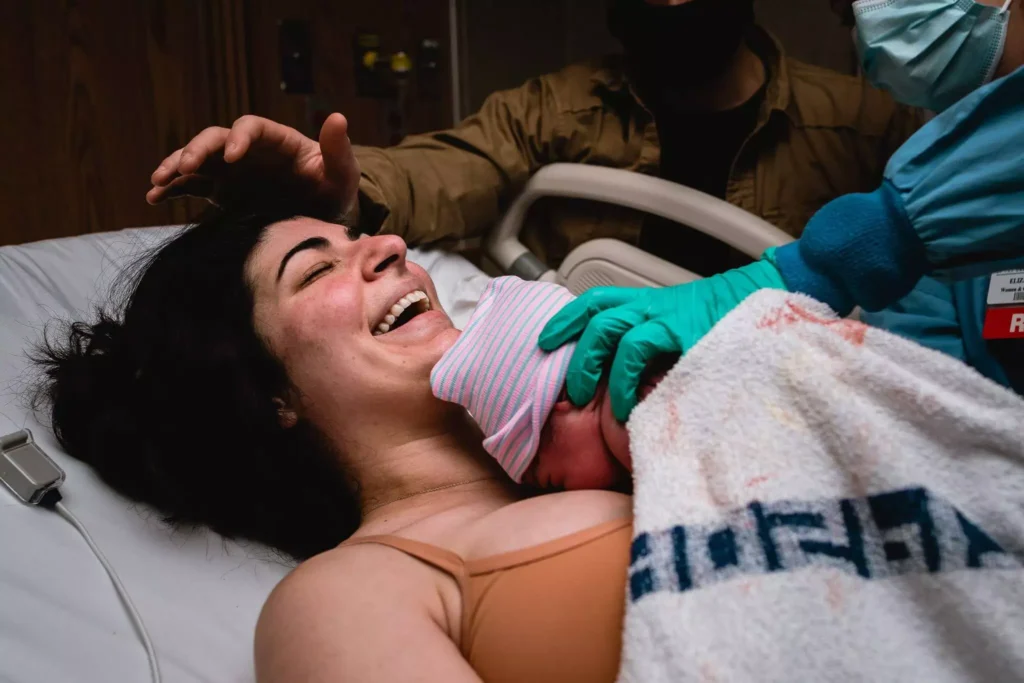
And so I got to hold him while they like pulled the placenta out. They took their time, too, they like, they didn’t push it on me. Like it took a little time and then they, she got it, tugged it out a little bit and it came out with pushes. I held him and they stitched me up, like I tore the same way I tore with my first. It was like second degree, so it was the same, but, I held him and it’s not comfortable, but it was not painful to me, when they’re like dealing with it. Because I just, I had him and I was so happy. I felt so accomplished and I just kept telling my husband like, “I did it. I did it.”
This baby, he was over eight pounds and he, his head again, it was 90th plus percentile, so a was a very big head. But he was very healthy, and they gave me time, too, to hold him before I finally was like, “Okay, let’s, try to nurse him.” And he latched, and it was just like so magical because it felt like, again, it was like on my time. I was shaky, yes, but it wasn’t like the shakiness that I had with my first. I felt it was controllable, like, I could hold my baby still. And, I think because of that whole part, like, he wasn’t taken away from me to given formula against my wishes, he was with me the whole time and I just nursed him- I continued to nurse, nurse, we’re gonna keep up, we’re gonna make this work. I used those silverettes to try to help.
Roxanne: Oh, they’re so magic.
Victoria: Yeah! I was prepared for a tongue tie, but he actually didn’t have one. So that really-
Roxanne: Awesome!
Victoria: To me it made a difference.
Roxanne: Yeah! No, that does make a difference.
Victoria: Yeah. But also like I had lactation come to the room and she just helped me like figure out how to hold him right for me. And my milk came in way quicker with this one- like it was like, I think it took a couple days for the milk to start really coming in, and this one it took, it was like a day I think. It came in fast.
So I will say for this postpartum though, while the first one, I think my pelvic pain went away pretty soon after I delivered, this one it stayed. I had to do pelvic floor therapy to figure out like, they were telling me like what was wrong with my, like what was going on with my pelvis.
Like I was on a, not a line and stuff and I had to strengthen it a lot, because that pain that I had in pregnancy was just like crying out. I couldn’t really move my legs. I couldn’t turn in bed. It was still there. So it doesn’t go away when you birth, right? But over time I feel a lot better now. I’m almost fi- I’m five months postpartum, almost six months and, I’ve gotten a lot stronger again, and so I feel a lot better. So I didn’t have hemorrhaging, I didn’t have hemorrhaging this time and I didn’t have as bad anxiety, either. I felt a lot better, of course had anxieties, right? I, of course, like postpartum is like for me, like I’m already an anxious person, I have OCD stuff and so my brain does do that kind of mean stuff to me, but it was not nearly like my first one. And, so seeing him, like seeing my older son meet his little brother, it’s been a transition, of course, because he’s kind of like, “Hmm, I don’t know,” sometimes, “Oh, I love you Luke!” And then, “I don’t like you, Luke.” It’s like on and off, but, having them together and seeing them, their brother relationship is so sweet.
So yeah, I feel really… I feel very happy with my second labor and I felt like there was a lot of healing that happened. And not like that he healed me because it’s not on my children to heal me with stuff, right? But it was that I felt like I was able to take agency over things that I wanted, things that I could control, and the things that I couldn’t control, I was okay with. So that’s how I felt, yeah.
Roxanne: Yeah. No, I love, so I love watching you tell your two stories too, because I could tell, I could feel the sadness when you were telling your first one that you have about it, and then with the second one, you couldn’t stop smiling the entire time. So like I could tell that you feel better about the second one, and healed almost. But also that you were such a badass, for lack of a better word. You took ownership of your entire body, what happened to it, and you were very empowered during the entire experience to be able to tell them what you wanted and what you didn’t want to happen to you, which is what we want. It’s not like unmedicated birth is never the goal- it is feeling like a total bomb ass mom after you have your baby that you were like, “I am so amazing. I am a birthing goddess. I got to tell the world what I wanted, and that’s what happened in my birth,” regardless of if it was what you wanted. Like you almost had your baby at home, maybe that wasn’t what you were wanting. And so you knew, there were people that would probably be like, “I can’t get into that car. We’re just gonna have the baby here.” But you’re like, “No, I don’t wanna have this baby here. We need to get to the hospital.” And so you made that happen even in the middle of your labor. So, boss! And your postpartum, a little bit better than your first! Didn’t hemorrhage, not shockingly, after your first experience, the fact that you didn’t hemorrhage because you didn’t have a three day induction with an infection, that’ll do it!
But thank you so much, Victoria, for sharing your two stories. I think that this would be an amazing story for people to listen to and learn a lot from, and also hopefully bring into their births to be able to empower them to make choices or feel confident in their bodies.
If there was one piece of advice that you could give our listeners or even like your past self, what would that one piece of advice be?
Victoria: This is gonna sound cliche, but trust your body. I would tell myself the first time around, trust your body. You will not grow a baby that’s gonna be too big for you. That’s what I was fearful of in the first time around because, because, I was very uncomfortable and I thought, oh, I need to do it at 39 weeks or he’s gonna get too big, that was part of my fear. And I clearly was able to birth a baby that was bigger than my first, even. And so I would tell myself, trust your body. And also, don’t be afraid to tell people what they can and can’t do to your body. So like with the cervical checks and stuff, with, the nurse really wanted to check me and I was having a contraction, “no, you’re not gonna check me right now,” and that’s okay. You don’t need to just roll over and let them do it. It’s your body still. So that’s what I would really recommend, trust your body.
Roxanne: I love that one. Love that one, because yes, you are still the controlling power of what happens to your body, even when you’re in a hospital and in labor. They can’t decide what happens to you, like you still have to say yes or no, and then they have to go along with it if you say no. It’s not refusing, it’s just declining. You’re not being, like, combative, you’re just being like, “Not right now,” or, “No, thank you.” So I love that one. Yeah. But thank you so much, Victoria.
Victoria: And I say trust your body because the nurses told me that I wasn’t in labor!
Roxanne: You were not in labor!
Victoria: That was one I was gonna ask you about, actually. Why do you think, like, why do you think it happened that way? Like, why do you think they thought I wasn’t in labor and I, it seemed I wasn’t, but I was. Like, I …
Roxanne: you were only three centimeters, which you were three centimeters at the clinic, so in their minds, because you had no cervical change, that indicates you were not in labor. But, as we know, cervical dilation is just a moment in time. I would be very curious what your effacement was, as well as what was baby station, because that’s … Dilation is not the only picture. Was baby lower in your pelvis? Were you more thinned out? Because those are signs you are in labor, and especially like someone who has had a baby before, you can go from three centimeters to a baby, real quick, which maybe is why they wanted to keep you longer, just in case, you shifted, maybe, while you were in triage. I’m not sure. But that’s probably why they told you that. It’s unfortunate. I do hate that she tried to tell you that if you’re only three centimeters and you were in this much pain, like you should probably just get an epidural because that’s not, it’s not very encouraging or empowering. But, you did it!
Victoria: Yeah, exactly. I felt very, wow, I did that. I wish they could know! But I know. Yeah.
Roxanne: I know. If only you could have gone back and be like, “I had him. I had him without an epidural. You were wrong.” But you didn’t go to that hospital! But it’s, oh, it looks like he’s hungry. Hello, little one! Oh my gosh, he’s so cute. They’re so cute.
Thank you so much for coming on the podcast and sharing your two beautiful stories with us. I know that our listeners will definitely take something out of this birth, so thank you for sharing your vulnerable stories with us and something that’s so special to you.
Victoria: Thank you for having me. I appreciate you guys so much. I think everyone who’s pregnant should listen to you guys because, gosh, like you’ve, you helped me so much. And postpartum, too. All your stuff postpartum, too, is really help, helpful for me.
Roxanne: Oh, thank you.
Victoria: So I can’t even count all the tips you’ve given me that’s gotten me through motherhood. Yeah, everyone needs to listen to you guys.
Roxanne: Oh, that’s why we do it, because we love to support people and not just birth, pregnancy, but also postpartum, and beyond, and preconception! Because this could be a very lonely time and there’s a lot of crazy stuff out there.
Victoria: Thank you so much.
Roxanne: Thank you so much for listening to Victoria’s two birth stories, and I hope you learn something from both of those birth stories and feel seen and heard if you had a similar birth experience as her.
An elective induction at 39 weeks is a very common recommendation, or offering that, a lot of providers will offer to people, and it can be a very valid choice that someone can choose for their birth. But knowing that there are risks associated with an elective induction, and these risks include a longer induction, depending on what your cervix is at the beginning. So Victoria herself had a two to three day long induction, and that is very common. So good questions to ask if you are leaning towards an elective induction are, “What is my cervix now?” Can tell you how long that induction potentially will take. If you are less dilated, it potentially will take longer. As well as, can I move during the induction process? How easy is it to move? So are there wireless monitors? Are there non-wired monitors? ‘Cause that can help you decide if you are wired into the machine and you can’t move around a lot, that will limit your mobility and potentially make it a little bit harder, versus are there wireless monitors and is it easier to be able to move freely during that induction process? As well as: am I able to eat? Because food is really important. Your uterus is a muscle, it needs fuel to be able to work appropriately, as well as the muscles within your body to be able to move and support you during labor. So if you’re able to eat more than just gusts of wind or ice chips, that can be very beneficial for your induction process. So asking, “Am I able to eat anything during labor?” Some hospitals won’t let you eat once you get an epidural, so asking these questions of, “When can I not eat and when can I eat?” Can be unhelpful to make that choice for that elective induction. As well as knowing cervical exams, yes, they are very important to make the plan for the induction, for your providers and the healthcare team, but always asking “What does this cervical exam do? What is it gonna tell us? How is this gonna change my induction process, or the plan of care? Or is this just like because we’re curious?” If you are also curious, then great, you can still get that cervical exam, but if the cervical exam is not going to change the plan of care, you can always decline it at that moment. If that cervical exam is not going to change the plan of care, you can always decline it and defer it to later because cervical exams do increase your risk for infection- and especially if you’re having a longer induction, the more that we can lessen those cervical exams to decrease that risk for infection, the better.
So while an elective induction is a totally valid choice, knowing that there are risks associated with the elective induction as well as waiting for labor to happen on its own, is important. You can discuss the risks and benefits of both options with your provider to ensure that you feel confident, as well as asking further questions of “Can I eat? Can I move?” And then as well as potentially what is on my cervix even at this point that can tell me what is gonna be likely happening during this induction, can be helpful for you to be able to make the decisions yourself and have yourself be more of an active participant in your labor to lead to a more confident and empowering experience; versus a passenger in the experience where things are just happening to you, but you’re not able to say yes or no to them.
So if you’re still pregnant and you’re looking to have a competent and empowering birth, check out our online childbirth education course where we discuss the science of labor and birth to help take away the mystery and fear surrounding labor and birth, as well as what to expect in labor and birth. We break down different laboring positions as well as different birth options available to you so that you can make confident decisions within your labor, as well as open the conversations between your provider and you who you chose to be a part of your birth experience that you feel safe and supported by.
And if you’re looking for ways to move your body throughout pregnancy or even postpartum, check out any of our fitness programs, our prenatal and postpartum. Our prenatal and postpartum fitness programs come in both an on- demand and an online self-paced program. Our on- demand are videos that you press and play and follow along with us, whereas our self-paced is a list of exercises with demo videos that you move through at your own pace. You can also bundle our childbirth education with prenatal fitness or even postpartum fitness to save an additional 15%. And as a thank you for listening to this entire episode, you can use STORY10 to save 10% off any of our programs and offerings. So you can head to mamastefit.com to check out any of our offerings, and thank you again for listening.
Please check out our podcast every Wednesdays for new episodes, as well as our YouTube channel. Please subscribe to be notified whenever we release new episodes.
Prenatal Support Courses

Learn the science of pregnancy and birth to take the mystery of labor away! Understand why you are feeling what you feel, and learn strategies to confidently move through pregnancy and birth!
- 9h+ of Video
- Support Group
- Close Captioning
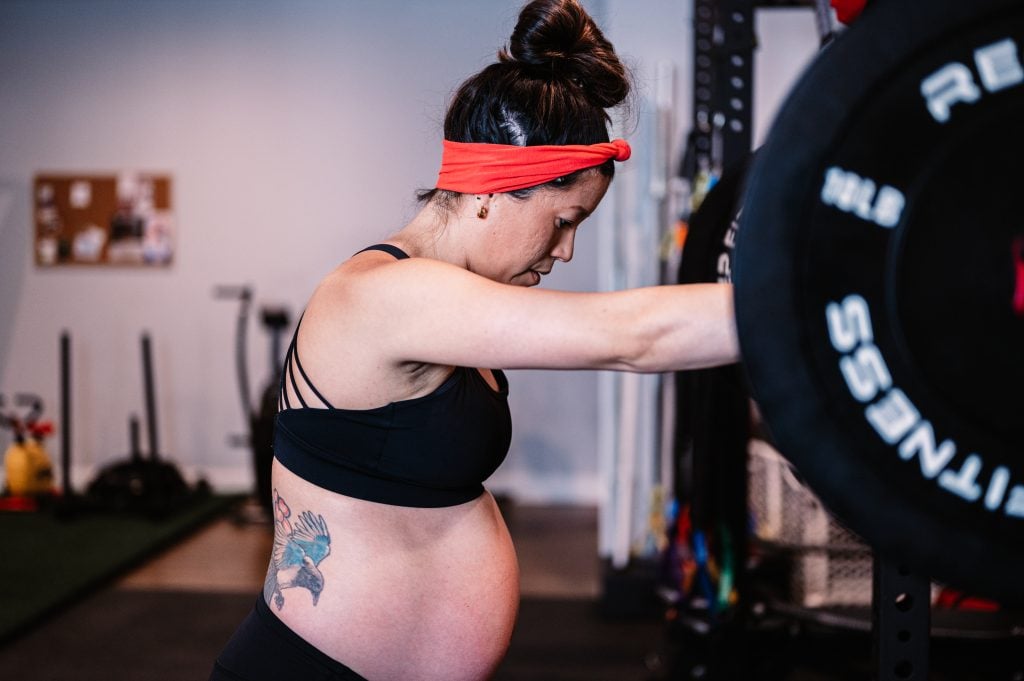

- 5 Workouts/Week
- Gym Workouts
- Self-Paced

Instructor
GINA
Workout on-demand with our prenatal fitness workout videos! Each workout is 30-40 minutes to follow along as you exercise at the same time!
- Birth Prep
- All Trimesters
- Mobility Work

Instructor
GINA
Find comfort and relief from pelvic girdle pain throughout your pregnancy and postpartum period! This program incorporates myofascial sling focused exercises to stabilize across the pelvic girdle joints.
- 3 Weeks
- On Demand Workout Videos to Follow