



You may have heard that OP is bad. But, what is OP? And is it really something you should panic about? Let’s break it down!
Before we continue… Elevate your childbirth journey!
Enroll now in our Childbirth Education Course and equip yourself with the tools for a confident and exhilarating birth experience.

What is Posterior and What Does OP Stand for?
OP means occiput posterior, and it is referring to your baby’s position in your pelvis. This means that baby is head down, and the back of their head is toward the back of your pelvis. The occiput is the back of baby’s head, and is the reference point we use in comparison to your pelvis. So, baby can be OP (occiput posterior), or back to the back. Your baby could be OA (occiput anterior), or back to the front of your pelvis.
And then towards either hip: LOT and ROT (left and right occiput transverse). And then they can be in diagonal positions, such as ROA or LOA (right/left occiput anterior) and ROP and LOP (right/left occiput posterior).
So, there are multiple positions that our baby could be in during pregnancy and labor–they are not inherently bad or good, but rather understanding their position and how it can influence labor is more important.
Before we continue, I have a question for you… Are you ready to embark on a transformative journey towards a confident and joyful childbirth experience?
Take the first step by enrolling in our comprehensive Childbirth Education Course. Designed to empower expectant parents like you, our course covers everything from prenatal care and labor techniques to newborn care and postpartum support.
Enroll in our empowering Childbirth Education Course today! Gain confidence, knowledge, and support for a joyful birthing experience. Join now and embrace childbirth with positivity and grace.
Ok, let’s continue…
But... why is there any panic on baby's position?
There are some positions that are thought to be more optimal than others–usually LOA is what you may commonly see as the “best” position.
But, it is important to note a few things:
- There is no one perfect position because babies will rotate through several positions as they navigate the pelvis.
- Not being in these “best” positions does not mean there will be an issue with your labor
- It is more important that your baby is tucking their chin than the position they are in (but some positions support a chin-tucked position better than others).
If baby moves through several positions, why does it matter if they are OP? Because for many of us, OP positioning can be harder for your baby to tuck their chin and enter into the pelvis.
In an OP position, babies tend to be more extended (which results in a larger head circumference being presented to the pelvic openings), and they tend to overlap the pubic bone (which can impede their entry into the pelvis).
OP positions can also result in more back labor, which can make labor much harder to cope with, especially if you were hoping for an unmedicated birth.
So, what can you do if baby is OP? Let’s explore some times when you may want to take some action and when worrying about OP is just going to stress you out for no reason.
Pregnancy: What Can You Do if Baby is OP?
During pregnancy, trying to force our baby into one position that WE think is best, is usually unnecessary and not helpful. Rather, we want to focus on ensuring that our baby’s path to rotate is clear of obstacles and restrictions/tension.
What can you focus on:
- Releasing uterine ligament tension with inversions and belly sifting/jiggling techniques
- Spinal and pelvic mobility (what position do you favor and can you easily move out of that position)
- Releasing tension in the pelvic floor, particularly the posterior portion

During pregnancy, we can ensure that we are releasing the uterine ligament tension, spinal/pelvic mobility, and releasing tension in the pelvic floor as we prepare for birth. These areas tend to be areas we have some restrictions that could inhibit baby’s position when labor begins.
1) Release Uterine Ligament Tension

During pregnancy, our biggest focus is to ensure that baby’s path to rotate is clear, as opposed to trying to force baby into a specific position. The uterine shape can influence your baby’s position, or impede your baby’s path to rotate.
Inversions can help to release the vertical running uterine ligaments and can be done daily! Try a forward-leaning inversions for 3 full breaths or around 20-30 seconds.
We include the forward-leaning inversions and a few other movements in our labor prep flow to help release tension in the uterus and posterior pelvic floor to support your baby’s position.
We include this sequence in our prenatal fitness programs in the third trimester.
2) Spinal and Pelvic Mobility
During pregnancy, we tend to favor an extended position. Think arching in the back positioning, This is a normal postural tendency, and then in pregnancy, we have increased curvature of the lumbar spine (low back) to accommodate for the biomechanical adaptions of pregnancy.
This usually results in tighter lats and hip flexors, so focusing on releasing tension in the lats and hip flexors so we can move more easily is important!
Some may promote finding neutral positions ALL the time, but MOVEMENT is more important than finding (or staying in) static positions.
So if you are seated, try to move your spine and hips around as opposed to slouching or arching, or even ALWAYS being neutral. MOVE your body!
Check out this thoracic mobility routine to move your spine in all three movement planes: flexion/extension, rotational, and side bending!
3) Release Tension in the Pelvic Floor

The pelvic floor plays a large role in our daily function and in our birth! We want our pelvic floor to be able to MOVE (see a trend?). The pelvic floor needs to lengthen and stretch, relax, and also contract/shorten.
For many of us, due to those common postural tendencies, the posterior pelvic floor is tighter. So, during pregnancy, we can focus on releasing that tension which can help to support baby’s position during birth!
Finding a release in the posterior pelvic floor involves finding internal rotation! We can use these hip-shifted positions to “force” or encourage hip shift as we bring the stance leg into internal rotation.
Watch the video below for a breakdown of one of my favorite posterior pelvic floor release exercises. We incorporate breathing drills and pelvic floor release in our personal fitness programs!

The pelvic floor plays a large role in our pregnancy comfort, birth, and recovery postpartum! Prepare your pelvic floor for birth with our online course!
This online course includes:
- Thoracic and hip mobility to move the spine and hips
- Breathing drills to connect the diaphragm and pelvic floor
- Pelvic floor relaxation exercises to release tension prior to birth
- Labor tips to release the pelvic floor tension so you can move easier through your birth!
Unsure if you’re ready to commit to our full course? Explore our free mini pelvic floor prep for birth course to gain a better understanding of our teaching style and what you will learn from us in our full course!
Labor: What Can You Do If Baby is OP?
But what if you’re in labor and baby is OP and their position is not changing? Or their position is causing a labor stall?
The first thing we can do is an inversion to adjust move baby a little higher so they can adjust their position. Sometimes the pelvic level they are in doesnt have enough space to support rotation.
An inversion can vary in set up, such as Trendelenbug (pictured) which can be a great variations for if you have an epidural. This needs to be done with the support of your medical team.
This can be done for 20-30 minutes, depending your comfort.


We can also do forward-leaning inversions in the bed. You can sometimes even with an epidural depending on your movement capability and medical team’s support.
In the inversion, you can hold it through three contractions and come up in between to rest as your partner jiggles or shakes your glutes and legs with massage.
The inversion allows baby to adjust their position to better rotate!
After we have inverted for the alloted timeframe, we can focus on creating space at the pelvic level baby is at. If baby was having trouble entering into the pelvis, we can focus on creating more space in the inlet or upper midpelvis with more external rotation emphasis or open hip positions.
This can be done with exaggerated side-lying with a peanut ball, elevated lunges, or even forward leaning with a yoga block under one foot.
These movements help to open the upper midpelvis that creates more space to support baby beginning their rotation into the pelvis.

Side-Lying: place a peanut ball under one leg, or you can use a pillow, as well. Then push the leg forward to create an open hip position as you rotate the belly towards the floor.
Another upper midpelvis opener is the fire hydrant! This can be done with an epidural if you can move yourself into an all fours position.
Place the peanut ball under one shin, and then rock the leg out to emphasize external rotation.
Learn more OP positioning tips in our childbirth education course and birth worker course.


Forward Lean with Block: Lean forward on a elevated surface and place one foot on a yoga block or small stool. We may want to favor the left side first, since this is where baby usually wants to begin their rotation into the pelvis.
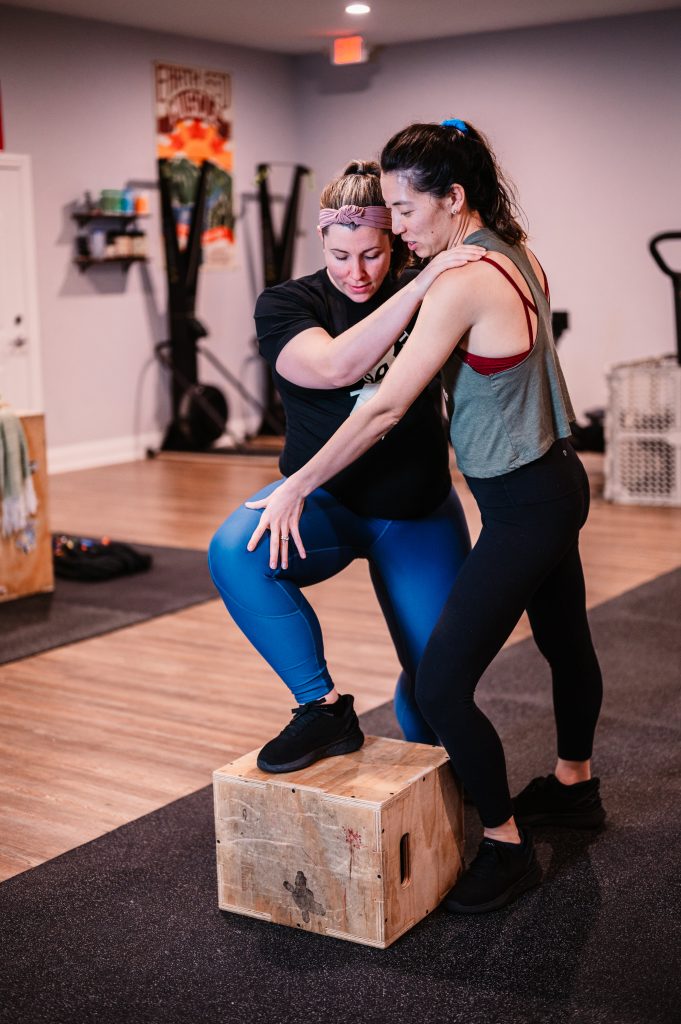
Elevated lunge: Leaning on your partner, place on foot on an elevated surface and rock back and forth into that leg as you partner pushes the knee out.
OP: Is it an issue? Not Always!
Is OP an issue? Not always! Especially during pregnancy–baby’s position during pregnancy is a non-issue and does not usually have an effect on labor onset nor labor progress. BUT what we can focus on during pregnancy is ensuring baby’s path to rotate is clear! We want to ensure that how our uterine ligaments, musculature, pelvis, and pelvic floor are release and mobile.
If baby is OP during labor, we can focus on inverting to help baby adjust their position and then open the pelvic level that they are trying to navigate to create more space!
Learn more about pelvic mechanics and labor positions to support your labor progress in our childbirth education course!
Learn the science of pregnancy and birth to take the mystery of labor away! Understand why you are feeling what you feel, and learn strategies to confidently move through pregnancy and birth!
- 9 hours of on-demand video
- Lifetime Access of E-Course
- Watch on Mobile Device