



If you are in your third trimester and Googling “how do I help my baby engage?” or “exercises to help my baby engage,” you are not alone. This is one of the top questions we get on Instagram and YouTube. What exercises can I do to help my baby engage into my pelvis?
First, it is important to understand this: Your baby engaging into your pelvis does not mean labor is about to begin. And if your baby has not engaged yet, that does not mean labor will not start.
Some babies need strong, consistent contractions to enter the pelvis. Engagement does not reliably predict when labor will begin. But that does not mean preparation is unnecessary.
I do believe it is beneficial to practice prenatal birth prep exercises that support your baby’s ability to change positions and eventually engage. Not by forcing engagement. Not by trying to manually “drop” your baby. But by reducing tension and improving pelvic mobility so that when your baby is ready, they have space.
Because engagement is not about pushing baby down. It is about creating space.
In this blog, I am going to break down:
- What engagement actually means
- What exercises can support baby’s engagement
- And how tension in the right anterior pelvic floor may be limiting space in your pelvis
Let’s start with what engagement really is and why pelvic balance matters.
What Is Baby's Engagement?
Before we talk about exercises to help baby engage, it is important to understand what engagement actually means. During labor, your baby makes a series of coordinated movements to navigate through your pelvis. These are known as the cardinal movements of labor. One of the very first of these movements is engagement.
Engagement occurs when the widest part of your baby’s head passes through the pelvic inlet and settles into the top portion of your pelvis. In practical terms, this is when a baby moves from “floating high” to sitting more securely within the pelvic brim. For this to happen, your baby must gently tuck their chin, a movement called flexion, while your pelvis provides enough space at the inlet to allow that descent.
Engagement can happen weeks before labor begins, during early labor, or sometimes not until contractions become strong and regular. There is a wide range of normal. The timing alone does not determine how your labor will unfold. However, regardless of when engagement occurs, the mechanics remain the same: your baby needs both flexion and adequate space at the top of the pelvis.
And this is where pelvic mobility and tension patterns begin to matter. If the pelvic inlet cannot expand and adapt because certain areas of the pelvic floor are holding excess tension, engagement may feel delayed or more difficult. Not because your body is failing, but because space is limited.
What Is the Pelvic Inlet and How Does It Open?
During engagement, the top of your pelvis, called the pelvic inlet, needs to open enough to allow your baby’s head to pass through.
The pelvic inlet is the upper opening of the pelvis. It is the first “gateway” your baby must move through during labor. When we talk about helping baby engage, what we are really talking about is improving space at the pelvic inlet.
The pelvic inlet does not open in just one direction. It changes shape depending on how your hips and pelvis move.
External hip rotation and abduction, which looks like widening the knees, increases the side-to-side diameter of the inlet. An anterior pelvic tilt, or gentle arch in the lower back, increases space in the front portion of the inlet. A posterior pelvic tilt, or tucking the tailbone slightly under into a rounded back, increases space in the back portion of the inlet.
It is the combination of these movements that allows the inlet to adapt and create space.
During pregnancy, it is usually easier to find wide knees and some degree of extension. Many pregnant bodies naturally shift into anterior pelvic tilt as the belly grows. What tends to be more challenging is finding a true posterior pelvic tilt and rounding through the lower back.
This is why the first portion of our MamasteFit Birth Prep Circuit focuses on helping you move out of extension and into a more rounded back position. These exercises are designed to create more space in the posterior portion of the pelvic inlet, which can support baby’s ability to engage either during pregnancy or when labor begins.
But pelvic positioning alone is not the full story.
To truly understand engagement, we also have to consider the pelvic floor.
The Pelvic Floor and Engagement
The pelvic floor attaches directly to the bones of the pelvis, which means that every hip and pelvic position changes tension within the pelvic floor.
The pelvic floor is not one uniform sheet of muscle. Different portions lengthen and shorten depending on how your hips are positioned. The anterior portion tends to lengthen more in wider leg positions and spinal extension. The posterior portion tends to lengthen more in closed leg positions and a rounded back.
There are also rotational patterns to consider. When one hip is more open and the other more closed, tension shifts unevenly across the pelvic floor.
This is where the right anterior pelvic floor becomes important.
The anterior quadrant of the pelvic floor stretches more with one-sided open hip positions, where the leg moves away from the midline. However, due to common postural patterns, tension between the right and left anterior quadrants is rarely equal.
Many people naturally shift more weight into their right leg when standing. This position often places the right hip into relative internal rotation, adduction, and a subtle posterior pelvic orientation. Over time, this can shorten and thicken the right anterior pelvic floor quadrant, making it more active and more dominant.

When that anterior quadrant is overactive, it can reduce available space in the posterior portion of the pelvic inlet. Instead of allowing baby to settle deeply into the pelvis, tension in the front can subtly push baby toward the pubic bone and make engagement feel delayed or more difficult.
This was the missing piece in our Birth Prep Circuit.
We already had exercises that supported posterior pelvic tilt to help open the back of the inlet. We already included movements to improve internal rotation and open the midpelvis. But we did not have movements that specifically offloaded the right anterior quadrant of the pelvic floor.
Once we understood how anterior pelvic floor tension was limiting inlet space, we updated our Birth Prep Circuit to intentionally address it. But more importantly, we built this approach directly into our prenatal fitness programs so you are not guessing which exercises to do or when to do them.
Our prenatal programs are designed to support pelvic mobility, balanced strength, and birth preparation in a progressive way throughout your pregnancy. You can choose between our self paced strength program or our follow along video based option, depending on how you prefer to train. Both programs automatically sync to your current week of pregnancy, so you can start at any time and immediately begin training in alignment with where you are.
We offer lifetime access for this pregnancy and future pregnancies, as well as flexible monthly plans if you prefer shorter term support. The goal is not just to help baby engage, but to create a pelvis that moves well, adapts well, and supports you through labor and beyond.
How to Offload the Right Anterior Pelvic Floor
The right anterior pelvic floor can be lengthened and offloaded with specific one-sided open hip positions that create a stretch through the inner thigh and groin.
Two of our favorites are:
- The lateral all fours hip shift
- The standing lateral hip shift
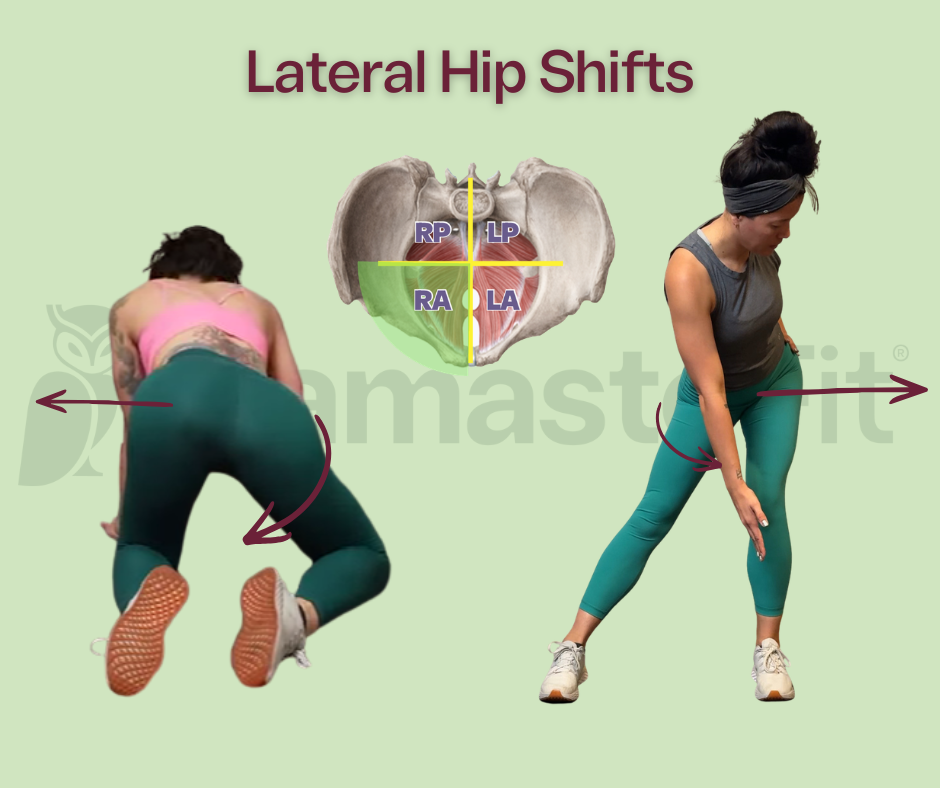
In both movements, you shift your weight toward the left side while gently guiding your right hip toward the left knee. This encourages the right side of the pelvis to open and rotate, creating a deep stretch through the right inner thigh and groin.
These two movements are now included in our Birth Prep Circuit.
If you suspect your right anterior pelvic floor may be overactive, you can also experiment with:
- Adductor rock backs
- Open knee lunges
- A 90-90 side body opener with the right leg in front
These positions help restore balance, improve rotation, and reduce excessive anterior tension.

Watch: How to Open the Top of the Pelvis for Baby to Engage
If you are more of a visual learner, we put together a YouTube video where we walk through practical ways to approach opening the top of the pelvis to support baby’s engagement.
If you want a structured plan, these movements are built directly into our Birth Prep Circuit and our prenatal strength programs starting at week 20. The goal is not just to prepare for engagement, but to create a pelvis that can move, shift, and respond throughout labor.
Final Thoughts on Baby Engagement
If your baby is not engaged yet, it does not mean something is wrong, and it does not mean labor will not begin. Engagement timing varies widely. Some babies settle into the pelvis weeks before labor, while others wait until strong contractions guide them downward, and both scenarios can be completely normal. Rather than focusing on how to push baby lower, shift your attention to creating space within your pelvis.
By improving mobility, restoring balanced hip movement, and reducing unnecessary tension, especially in the anterior pelvic floor, you give your baby more opportunity to move and adapt when the time is right. Engagement is not something you force. It is something you make room for.