



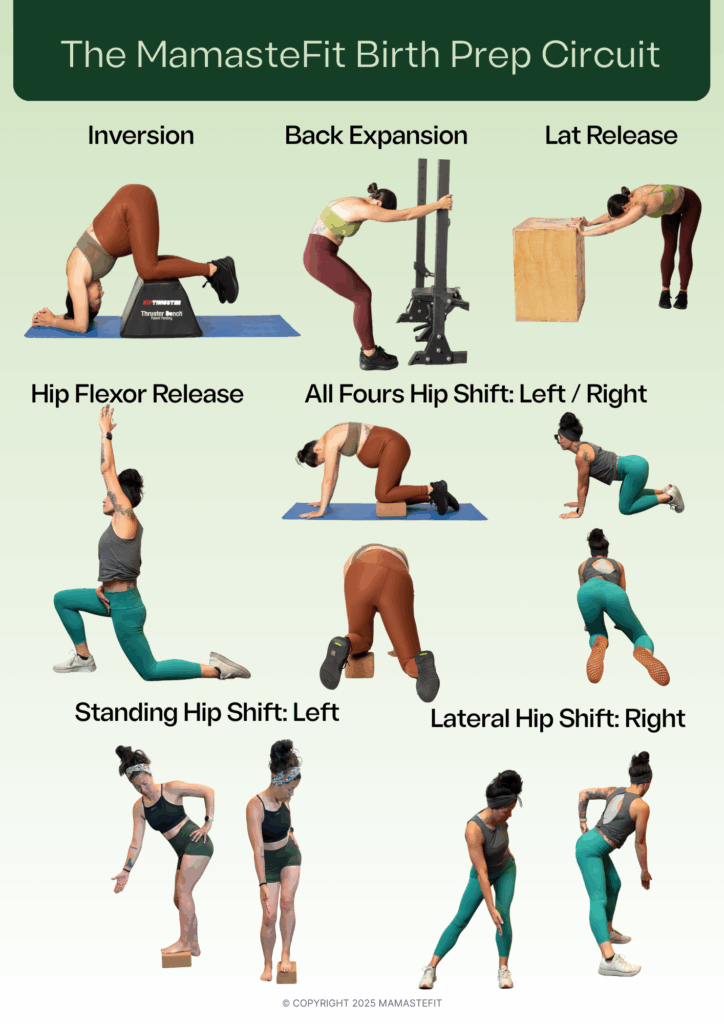
The MamasteFit Birth Prep Circuit just got an upgrade! We’ve added two new exercises—including one that specifically targets the right anterior pelvic floor, an area that’s often overactive during pregnancy.
These pregnancy exercises are designed to release common areas of tension that develop throughout pregnancy so you can move your pelvis more freely, improve pelvic floor mobility, and support your baby’s position. This isn’t about forcing your baby into a certain spot or trying to make engagement happen—it’s about making sure your body has the movement options available when labor begins.
Why Do Birth Prep Exercises During Pregnancy?
The MamasteFit Birth Prep Circuit is designed to address common areas of tension that develop during pregnancy based on normal postural tendencies. As your belly grows, your posture often shifts into an anterior pelvic tilt (arched lower back with rib flare) and increased external hip rotation (toes pointing out) to compensate for your changing center of gravity.
We also tend to favor more weight on the right leg, because it’s easier to stabilize there (thanks to organ density and diaphragm position). These changes create muscle imbalances that can affect your pelvic mobility and pelvic floor function, making it harder to change positions during labor.


How Pregnancy Posture Affects Pelvic Floor and Labor Prep
This pattern creates predictable changes:
- The back and hip flexors shorten, making a rounded position (posterior tilt) harder to achieve.
- The right pelvic half rotates backward, while the left shifts forward, increasing asymmetry.
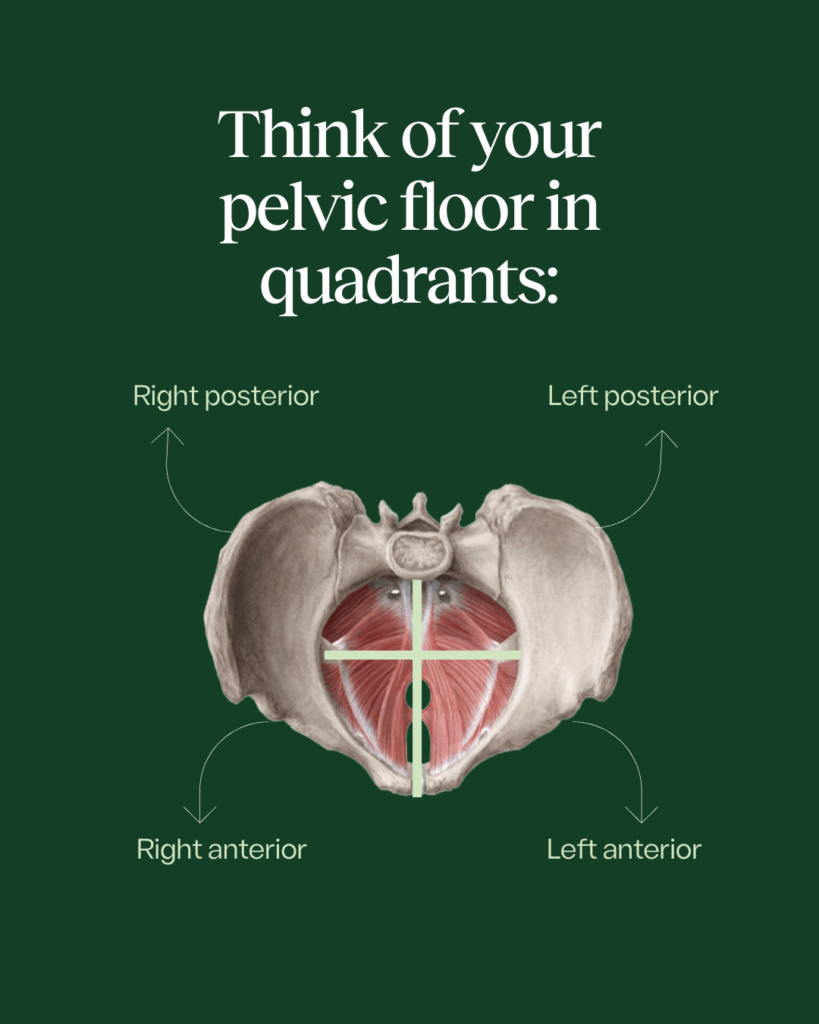
- The right anterior pelvic floor often becomes overactive, while the left posterior pelvic floor tightens.
This asymmetry isn’t inherently harmful—our bodies are never perfectly symmetrical—but if you cannot move out of these positions when needed, it may restrict pelvic mobility during labor. That limitation can make it harder to change positions, adapt to labor needs, and create space for your baby.
The goal of birth prep exercises is not to force your baby into a specific position but to give your pelvis and pelvic floor full movement capability for labor. Mobility creates options—so when labor comes, your body can adjust effectively and help your baby navigate the pelvis.
Understanding Pelvic Mechanics for Birth Preparation
Your pelvis is not one fixed ring—it has three levels, each requiring different movements to create space:
- Pelvic Inlet (where baby first engages)
- Midpelvis (rotation and descent)
- Pelvic Outlet (final phase before birth)
No single position opens all three levels! That’s why labor prep exercises should train multiple movement patterns.
The pelvic floor also has layers and quadrants (anterior, posterior, left, and right). Its fibers attach to the pelvis in different orientations, so no single stretch “releases” the entire pelvic floor. You need a variety of hip and pelvic positions for comprehensive release.
Key Pregnancy Exercises to Open Your Pelvis
To prepare for labor, you need four main hip movements:
- Bilateral External Rotation (wide knees)
- Unilateral External Rotation (open hip)
- Unilateral Internal Rotation (closed hip)
- Bilateral Internal Rotation (knees in)
Pelvic position matters too:
- External rotation pairs with anterior tilt
- Internal rotation pairs with posterior tilt
Thoracic mobility also plays a major role in creating space during labor.
Lat and Hip Flexor Releases: Improve Pelvic Mobility Front to Back
These releases help you find a rounded position, counteracting pregnancy’s natural arching tendency. Many of us have tighter lats and hip flexors that pull the pelvis forward, and then restrict the ability to round in the back. This compresses the posterior pelvis adding more length to the anterior pelvic outlet!


Step 3: Hip Shifts – Addressing Pelvic Asymmetry
After the initial releases, we move into hip shifts:
- Part 1: Elevated Hip Shift (All Fours and Standing):
- Targets left posterior pelvic floor, which often becomes tight as the left pelvis shifts forward.
- Expect a deep hip stretch sensation in this variation.
- Part 2: NEW Hip Shift Without Elevation (All Fours and Lateral Standing):
- Specifically targets the right anterior pelvic floor, which is frequently overactive in pregnancy.
- In all fours: keep knees level; in lateral hip shift: feet wider to bias the anterior fibers.
- You’ll feel this as a stretch in the right groin and adductor.
The right anterior pelvic floor can pull the sacrum forward, reducing space in the posterior pelvis (where baby needs to rotate and descend). Overactivity here can:
- Limit space for baby to move back and down.
- Increase bladder pressure and urgency symptoms.
- Contribute to labor stalls if pelvic mobility is restricted.
By adding this focused release, the MamasteFit Birth Prep Circuit now addresses all four pelvic floor quadrants, giving you a more complete approach to labor preparation.
Hip Shifts: Right Anterior Pelvic Floor Release
We’ve added two new exercises to the Birth Prep Circuit that specifically target the anterior pelvic floor on the right side. While these movements can be performed on both sides, our circuit focuses on the right because this is the side that typically becomes overactive during pregnancy due to common asymmetrical loading patterns.
All Fours Hip Shift (Right Anterior Focus)
Start in an all fours position with both knees level. Shift your weight toward the left side, which will create a deep stretch through the right groin and adductor. As you shift, rotate your belly toward your left thigh—this rotation will intensify the stretch and better target the right anterior pelvic floor.
Once in position, arch through your back to move even deeper into the release. This arch encourages an anterior pelvic tilt, which supports external rotation—an important component for pelvic mobility during labor.
Hip Shift Variation: Targeting the Left Posterior Pelvic Floor
On the left side, we focus on releasing the posterior pelvic floor, which often becomes restricted and can contribute to the tailbone or sacrum shifting toward the left. This imbalance can reduce space in the pelvis and impact baby’s ability to rotate during labor.
Elevated Hip Shift (Left Posterior Focus)
This variation is particularly important because internal rotation pairs with a posterior pelvic tilt, creating the space needed in the midpelvis and outlet during labor.
Start in an all fours position and elevate your left knee on a yoga block. This elevation helps bias the left posterior pelvic floor. From here:
- Shift your weight to the left, allowing the pelvis to glide toward the elevated side.
- Rotate your belly toward the left thigh to increase the stretch.
- Once in position, find a rounded spinal position (posterior pelvic tilt)—this encourages internal rotation and deepens the release in the posterior quadrant of the pelvic floor.
Progression to Standing Hip Shifts: Deepen the Release
Once you’ve completed the all fours variations, you can progress to a standing position for a more intense release. Adding activation in standing often increases your ability to connect with and sense the pelvic floor, compared to restorative positions like all fours.
Standing Hip Shift (Left Side – Posterior Focus)
Start with your left foot elevated on a yoga block and your right foot on the ground. Shift 80–90% of your weight into the left leg, maintaining a slight bend in the knee. From here:
- Rotate your belly toward your left thigh to amplify the stretch.
- Keep weight centered through the left big toe to maintain foot engagement.
- Add a slight rounding in the back (posterior pelvic tilt) to feel the release deep in the left hip pocket—this targets the left posterior pelvic floor.
Standing Lateral Hip Shift (Right Side – Anterior Focus)
For the right side, bring both feet to the floor and set them slightly wider than hip-width apart. As you shift your weight toward the left leg:
- Rotate your belly toward the left thigh to position the pelvis for the stretch.
- Maintain pressure through both big toes for stability.
- Add a gentle arch through the back (anterior pelvic tilt) to deepen the release through the right anterior pelvic floor.
These standing variations not only increase mobility and awareness but also mimic the functional weight-bearing demands of labor positions.
Why These Birth Prep Exercises Matter
The MamasteFit Birth Prep Circuit can be done daily during pregnancy. It:
- Improves pelvic mobility
- Supports baby’s position
- Releases pelvic floor tension
- Prepares your body for an easier, more comfortable birth
Want More Than Just Free Exercises?
If you love this free content, imagine the depth of our prenatal fitness programs. Our programs:
- Go beyond generic advice like “just do deep squats”
- Are designed by perinatal fitness trainers AND birth workers
- Keep you strong, pain-free, and prepared for labor
- Include daily workouts with intentional birth prep