



Table of Contents
Leaking during workouts (aka postpartum incontinence) is incredibly common after pregnancy and birth, but it is not something you simply have to accept. Whether you leak during running, jumping, strength training, or even while chasing after your kids, it is often a sign that your body needs more support—not that your pelvic floor is “broken.”
Many women assume they need to do endless Kegels to stop leaking, but the reality is much more complex. Your pelvic floor does not work alone. It relies on your rib cage position, breathing mechanics, hips, glutes, lower legs, and even your ankle mobility.
When those surrounding muscles are not doing their jobs well, the pelvic floor often becomes the “victim” of those compensations.
This workout is designed to help you address both sides of the equation:
- Releasing uneven tension in the pelvic floor
- Strengthening the muscles that support your hips, pelvis, and lower legs
The combination can help you feel more supported during workouts and reduce leaking while running, jumping, or exercising.
Subscribe to our YouTube Channel for more weekly workouts and educational videos! We publish one new workout video and 2-3 educational videos a week on our channel.
Why Postpartum Incontinence Happens During Exercise
Stress urinary incontinence—or leaking with exercise, coughing, sneezing, running, or jumping—is often related to pressure management and pelvic floor coordination.
After pregnancy and postpartum, many women tend to stand with an extended posture:
- Rib cage flared upward
- Lower back arched
- Pelvis tipped forward
This position places more stretch and pressure on the front half of the pelvic floor. When the tissues around the urethra are too stretched, they may not contract effectively enough to keep urine in during impact activities.

In addition to posture, uneven tension throughout the pelvic floor can also contribute to leaking. Certain areas of the pelvic floor may be tighter, shorter, or more active than others.
For example:
- The left posterior pelvic floor often tends to be tighter
- The right front portion of the pelvic floor often tends to be more active and shortened
If one side of the pelvic floor cannot lengthen or relax appropriately as you shift from leg to leg, it can affect how your body handles the impact of running and jumping.
That is why mobility work can be such an important first step.

Part 1: Pelvic Floor Mobility and Balance
Before strengthening, it is helpful to improve the alignment and mobility of the rib cage, pelvis, and hips.
Back Expansion Breathing
Start by placing a pillow in front of you and rounding your upper body around it.
This position encourages your rib cage to move out of the extended posture that is common during pregnancy and postpartum. As you breathe into your back and sides, you can begin to restore mobility through the rib cage and reduce pressure on the front portion of the pelvic floor.
Focus on:
- Inhaling deeply into the lower back and ribs
- Exhaling fully
- Gently pulling the belly toward the spine
- Allowing the body to round slightly more with each exhale
This breathing pattern can help reposition the rib cage and improve the relationship between the diaphragm and pelvic floor.

Left Hip Shift for the Posterior Pelvic Floor
Using a yoga block under the left knee, shift your weight toward the left side while gently tucking the pelvis under.
You should feel a stretch deep in the back of the left hip, where your back jeans pocket would be.
This exercise helps target the left posterior pelvic floor, which is often tighter and more restricted.
To deepen the stretch:
- Shift more weight into the left side
- Slightly activate the right glute
- Think about bringing the inner right knee into the floor
You can also repeat this same concept in standing by placing the left foot on a yoga block and gently rotating the pelvis toward the elevated leg.


Right Inner Thigh and Groin Mobility
The right front portion of the pelvic floor often becomes short, tight, and overactive.
To release this area, use a lateral hip shift position in all fours by driving the right hip toward the left knee. You may also externally rotate the right leg and lower the right forearm for a deeper stretch.
You should feel the stretch more through:
- The right inner thigh
- The right groin
- The front of the pelvis
You can also repeat this stretch in standing by widening your feet and shifting toward the left hip while bringing the right hip and left knee toward each other.


Dynamic Weight Shifting
Once you have explored the static positions, the next step is learning how to shift from side to side.
Running is a series of single-leg positions. Your body has to transfer weight smoothly from one leg to the other, and your pelvic floor needs to adapt to those shifts.
Practice moving from:
- Left hip shift to right hip shift
- Side-to-side weight transfer
- Lateral lunging positions
As you shift, focus on:
- Keeping weight in the big toes
- Feeling the stretch deep in the hip pockets
- Maintaining pelvic rotation
- Moving slowly and deliberately
This helps prepare the pelvic floor for the constant side-to-side demands of running.


 App program · 64 days
Postpartum Return to Running
Sixty-four training days, four sessions a week, with plyometrics and running programming beginning at week seven — a structured way back to your first run.
Learn more
App program · 64 days
Postpartum Return to Running
Sixty-four training days, four sessions a week, with plyometrics and running programming beginning at week seven — a structured way back to your first run.
Learn more
 App program
Train for a Marathon After Baby
Progressive run workouts and strength training from 5K to the marathon finish — long runs, tempo work, easy miles, and a weekly pelvic stability session.
Learn more
App program
Train for a Marathon After Baby
Progressive run workouts and strength training from 5K to the marathon finish — long runs, tempo work, easy miles, and a weekly pelvic stability session.
Learn more
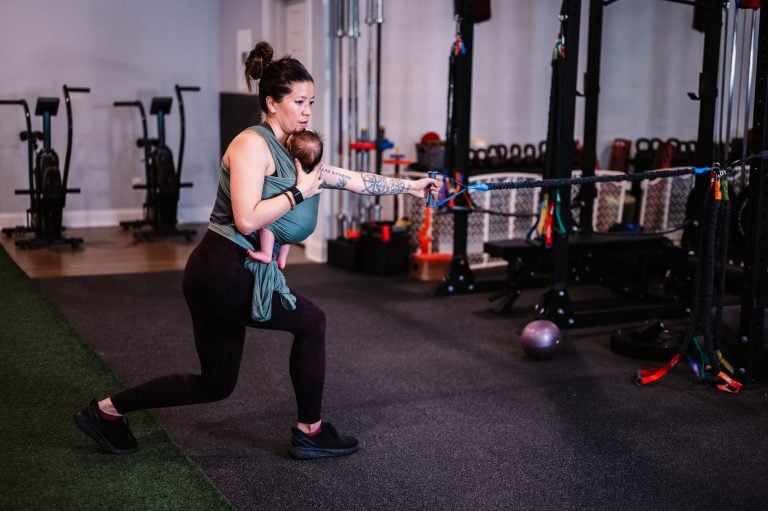 App program · 16 weeks
Postpartum Return to Fitness
Sixteen weeks of rebuilding, four strength sessions a week, with a vaginal or cesarean recovery track and follow-along videos for the first six weeks.
Learn more
App program · 16 weeks
Postpartum Return to Fitness
Sixteen weeks of rebuilding, four strength sessions a week, with a vaginal or cesarean recovery track and follow-along videos for the first six weeks.
Learn more
Part 2: Strengthening the Muscles That Support the Pelvic Floor
Mobility alone is not enough. The pelvic floor also needs help from the surrounding muscles.
When you run, jump, or move from leg to leg, your body needs:
- Hip extension
- Hip flexion
- Internal and external hip rotation
- Abduction and adduction
- Strong calves and shins
- Good ankle mobility
When those systems are weak, the pelvic floor often has to compensate.
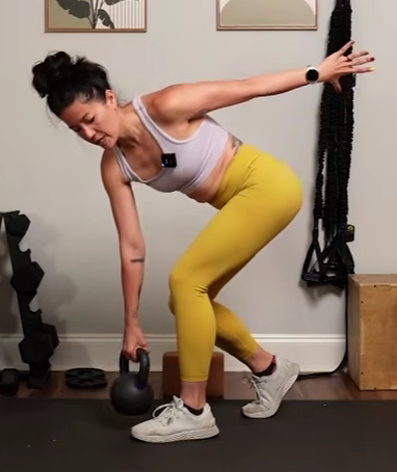
Staggered Stance RDLs
Staggered stance Romanian deadlifts strengthen the glutes and hamstrings while teaching pelvic rotation.
Place most of your weight into the front foot and hold the weight in the opposite hand.
As you lower:
- Shift slightly into the standing hip
- Allow the pelvis to rotate gently
- Feel a stretch in the hamstring and glute
As you stand:
- Push through the standing foot
- Squeeze the glute
- Return to upright
Over time, you can progress to a full single-leg deadlift for more balance and stability.
Staggered Stance Squats
Next, move into a more upright squat pattern.
Place the weight in the same hand as the front leg to encourage more glute activation and external hip rotation.
This movement helps strengthen:
- Quads
- Glutes
- Hip stabilizers
Eventually, you can progress toward single-leg squats or box squats.

Marches for Hip Flexion
Hip flexion is essential for running mechanics.
Practice standing marches by shifting onto one leg and lifting the opposite knee.
Focus on:
- Driving the knee up with control
- Maintaining balance on the standing leg
- Keeping the pelvis stable
If balance feels difficult, use a step or lightly hold onto a wall.

Standing Hip Shift with Open Rotation
This exercise combines multiple hip actions into one movement:
- Internal pelvic rotation
- External pelvic rotation
- Hip abduction
- Hip adduction
Start with the knees together, then drive the hip upward and open the top knee away from the body.
As you lower, return to the starting position and repeat.
This exercise is especially helpful for strengthening the glutes while improving coordination through the pelvis and hips.


Tibialis Raises
Your lower legs matter more than you may think.
The muscles in the front of your shin help control the ankle during running and landing. Weakness in this area can increase impact forces through the body.
Lean against a wall and lift the toes toward the shins.
Pause briefly at the top, then lower slowly.
This strengthens the front of the lower leg and can help improve ankle mobility.

Single-Leg Calf Raises
Strong calves are essential for absorbing force during running and jumping.
Practice controlled calf raises on one leg at a time.
As you rise onto the ball of the foot, focus on:
- Maintaining balance
- Moving with control
- Lowering slowly
Improving calf strength can help decrease the amount of force that travels upward into the hips and pelvic floor.

Why Ankle Mobility Matters for Leaking
One of the more surprising contributors to leaking during exercise is poor ankle mobility.
When the ankles are stiff, the body cannot absorb force effectively during running and jumping. That force has to go somewhere, and often it travels upward into the knees, hips, and pelvic floor.
Improving ankle mobility and lower leg strength can reduce impact and help the pelvic floor function more effectively.
Your Pelvic Floor Is Not Always the Problem
One of the most important takeaways is that your pelvic floor is not always the culprit.
Sometimes leaking is happening because:
- Your rib cage is stuck in an extended position
- Your hips are not moving well
- Your glutes are weak
- Your ankles are stiff
- Your lower legs are not strong enough
When the surrounding systems are not doing their jobs, the pelvic floor has to work overtime.
By improving mobility, strength, and coordination throughout the body, you can often reduce leaking and feel more supported during exercise.
Final Thoughts
Leaking during workouts may be common, but it is not something you have to accept as your “new normal.”
A combination of pelvic floor mobility, hip strength, lower leg strengthening, and better pressure management can make a major difference in how your body feels during running and jumping.
Start by incorporating this mobility flow before your workouts, then gradually build strength through the hips, glutes, and lower legs.
With consistency, you can create a body that feels more supported, more stable, and more capable during exercise—without worrying about leaking every time you move.
Membership · ongoing
Beyond Postpartum Strength Training
An ongoing subscription with a new training cycle every 6 to 10 weeks — strength endurance, max strength, then power, with deload weeks and running add-ons.
Learn more
 App program · 16 weeks
After C-Section Recovery Workout
Sixteen weeks of cesarean-specific rebuilding with scar mobilization included — developed with physical therapist and two-time c-section mom Casey.
Learn more
App program · 16 weeks
After C-Section Recovery Workout
Sixteen weeks of cesarean-specific rebuilding with scar mobilization included — developed with physical therapist and two-time c-section mom Casey.
Learn more
 Video course · 3+ hours
C-Section Scar Mobilization
Over three hours of video on scar mobilization technique and movement for recovery, plus a live webinar every other month you can attend or watch back.
Learn more
Video course · 3+ hours
C-Section Scar Mobilization
Over three hours of video on scar mobilization technique and movement for recovery, plus a live webinar every other month you can attend or watch back.
Learn more