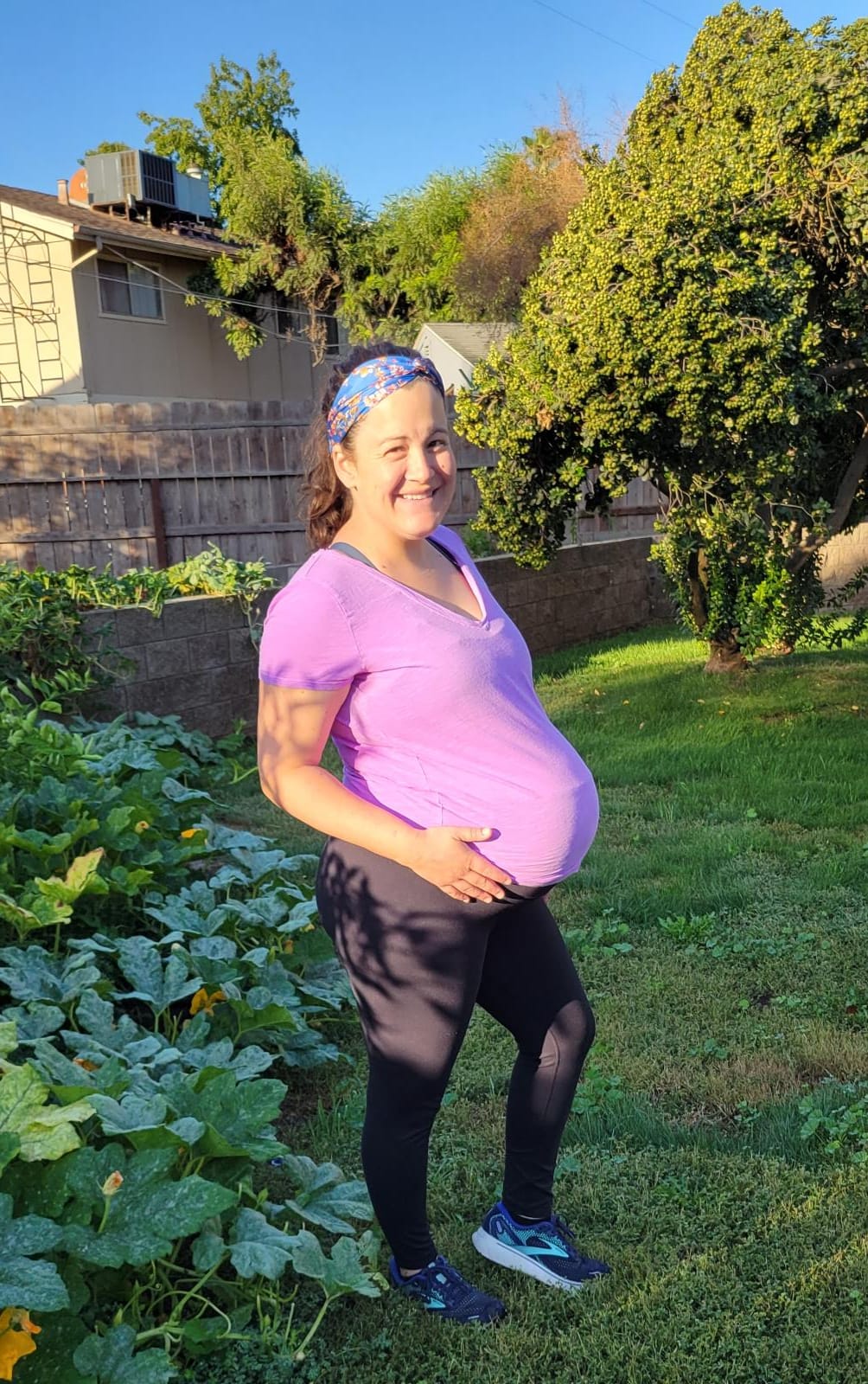
During early labor, we want to balance rest, nourishment, and movement to facilitate the labor process. If you are tired or feeling fatigued, rest! Take a nap, and head to bed. If you are feeling energized and rested, get up and move!
It’s a balancing game! Early labor can last hours or days! All of my previous labors have had long early labors. My first labor’s early labor lasted almost 24 hours, while my second and third were about 13-15 hours each.
During my early labors, I have done a short pelvic opening workout to prep for birth!
Pelvic Opening: No One Movement Opens the Entire Pelvis
The pelvis is dynamic and MOVES. We can change the pelvic level diameters with movement, but there is no one movement that opens the entire pelvis at once!
Each pelvic level opens with different movement patterns:
- Inlet: external rotation of the femur with pelvic tilting (primarily posterior pelvic tilt)
- Upper Midpelvis: external rotation of the femur on one side (open hip positions)
- Lower Midpelvis: internal rotation of the femur on one side (closed hip positions)
- Outlet: internal rotation of the femur with a slight posterior pelvic tilt but mostly neutral, favoring hinge type movements.
Each level of the pelvis opens with different movement patterns, so during pregnancy we want to ensure that we can find these different movements with ease as we prepare for birth!
Prepare for Birth:
Prenatal Fitness Programs
Pelvic Opening Workout: What to Include
During my early labor, I incorporated a short circuit focused on each pelvic level. My baby was already engaged before labor began, but I still incorporated inlet opening movements since she could still move around!
The inlet of the pelvis is where your baby enters or engages into the pelvis. This level of the pelvis opens more with wide knees and pelvic rocking or tilting front to back.
Movements focused on prepping the inlet to open include:
- Strength: Deep squats, with a pause at the bottom (either air or supported)
- Mobility: Hip flexor/quad release with posterior pelvic tilting
The midpelvis is where your baby rotates during labor! This level of the pelvis can be broken up into two levels: the upper and the lower midpelvis. Each level opens slightly differently to support rotation.
The upper midpelvis opens more with asymmetrical external rotation emphasis. While the lower midpelvis opens more with asymmetrical internal rotation emphasis.
Movements focused on prepping the midpelvis to open include:
- Open Hip Positions: Cossack Lunges or side lunges
- Adductor Rock Back
- Closed Hip Positions: Staggered Stance RDL
- 90/90 Hip Opener
The outlet of the pelvis is the bottom of the pelvis, where your baby exits the pelvis during pushing! This level of the pelvis can be opened more with internal rotation of the femurs, or knees in ankles out, and a slight posterior pelvic tilt can make internal rotation easier. But, we generally want to maintain more a neutral spine position with hinge-type movements.
Movements focused on prepping the outlet to open include:
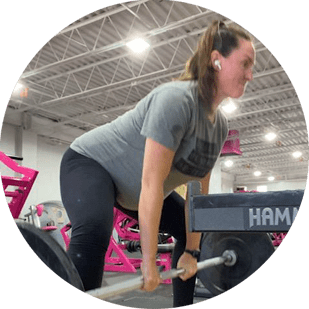
- Hinge-type movements such as deadlifts or hamstring focused exercises
- Internal rotation emphasized breathing drills to relax the pelvic floor
As you can see, each pelvic level opens in a different way, so we need to include A LOT of movements to prepare for birth! We incorporate all of these movements and more in our prenatal fitness programs!
Opening the Top of the Pelvis
The top of the pelvis is where baby first ENTERS or ENGAGES into the pelvis. We can create more space in this level of the pelvis with external rotation of the femurs, or wide knees, and pelvic tilting or rocking front to back.
As we prepare for birth, or move through early labor, we want to ensure that these movements are accessible to us!
So, can you find a deep squat or wide knee positions?? Is this accessible to you? If not, it may be something we want to work on during pregnancy so that we are not limited in how we move during labor.
Movements that could open the top of the pelvis include deep supported squats! When doing the support squats, focus on DEPTH. You can pause at the bottom to take a full cycle of breath, as well.
The second part of opening the top of the pelvis is pelvic tilting. The diameter of the inlet increases with a posterior pelvic tilt, but external rotation of the femur is easier to do with an anterior pelvic tilt. So being able to move the pelvis from front to back is really important.
This mobility drill can help you find more of a posterior pelvic tilt!
Opening the Upper Midoelvis
The midpelvis opens with asymmetrical and side to side type of movement patterns.
The upper midpelvis this is where baby begins the rotation into the pelvis, and opens more with extra rotation of the femur or an open hip position to one side.
Movements that can help prepare to open the upper midpelvis could include side lunges or Cossack lunges.
These movements emphasizes external rotation to one side, while also stretching the adductor of the opposite leg which can aid in finding external rotation when you switch to the other side.
Mobility exercises that can help us find more external rotation include releasing the adductor, or inner thigh, and hamstring. These two muscles aid in internal rotation, so releasing them will make external rotation easier.
Opening the Lower Midoelvis
The lower midpelvis is where baby FINISHES their rotation in the pelvis, and is commonly where a labor stall may occur.
Lower midpelvis opens more with internal rotation of the femur, or a closed hip position, to one side. Think belly to thigh!
The staggered stance RDL variations are some of my favorite to emphasize finding internal rotation as a part of birth prep.
The midpelvis opens with asymmetrical movement, so the 90/90 hip mobility exercise can help to increase this range of motion in preparation for birth.
Opening the Bottom of the Pelvis
The outlet, or bottom of the pelvis, opens more with internal rotation of the femurs, or knees in, ankles out. We tend to favor hinge-type movement patterns for the outlet too!
Movements that prepare to open the outlet can include hinge type movements, such as deadlifts! There are so many variations that you can do to prep for birth!
As we prep for pushing, we want the pelvic floor to be able to RELAX and RELEASE!
We can prepare our pelvic floor for birth with breathing drills that shift our pelvic floor into different positions and states of tension.
The standing hip shifted breathing drill incorporates internal rotation and a release of the posterior pelvic floor! Watch the video for a breakdown.
Open the Pelvis for Birth
The pelvis is dynamic and can change shape with different movement patterns. We can incorporate certain exercises and mobility drills to prepare for birth.