



In this blog, we will be sharing the transcript from Danielle’s two birth stories.
Her first birth was an unmedicated vaginal birth at a hospital and her second was a Cesarean birth, after planning a home birth, due to Placenta Previa
Gina: We’re going to start by talking about what are the different positions that our placenta can be in and what those positions may mean for your birth options. And then we’re going to finish the episode with Danielle, one of our former clients, coming to share her birth stories of an unmedicated vaginal birth and then a scheduled Cesarean birth due to placenta previa, after she was originally planning a home birth.
Listen to the MamasteFit Podcast and empower yourself as a mother! With two new episodes every week, we bring you educational insights on Wednesdays and captivating birth stories on Fridays.
Subscribe now to never miss an episode and stay up-to-date with the latest insights, stories, and advice from our expert hosts and guests.
Gina: So Roxanne, what are the different positions that your placenta can be in and which type of positions can have an impact on your birth options?
Placenta Positions
Anterior:
Roxanne: There are different places that your placenta can implant in the uterus. When you conceive, it could be in the front of the uterus, this is called an anterior placenta.
Differences with an anterior placenta is you may not feel baby’s movements as early, so you might feel their movements later in pregnancy and they may feel a little bit different compared to other placental placements.
Other things is that any impact to the belly could potentially cause injury to that placenta.
And sometimes if your baby is breech, they may not want to do an ECV, an external cephalic version, where they attempt to turn baby from head up to head down if you have an anterior placenta.
So there are some considerations with an anterior placenta that may affect potentially birth, but otherwise it’s just a normal variation.
Posterior:
The other option is your placenta can implant in the back, so it could be a posterior placenta. And with a posterior placenta, some say that this is the ideal placenta location. It helps facilitate baby being in an optimal position, but it’s really just kind of dependent on the study that you read.
With a posterior placenta, though, you don’t have that worry of hitting your abdomen and having injury to the placenta because it isn’t in the front and you’re able to feel those baby movements, like fully, pretty much, because the placenta is not blocking or dampening the movements of baby.
Gina: So for my two girl pregnancies, my placenta was posterior or to the back. And so these girls were like rolling all over the place. I could see them moving and rolling around and I could definitely feel them moving a lot earlier in comparison to my son’s pregnancy, where I had an anterior placenta, so it was to the front and his movements were like almost muted and so it seemed like he was like a really calm baby. But I think it was just because of my placenta positioning. And all three births were pretty much the same for me. I didn’t have any issues with position. They all engaged really well. So my placenta position didn’t affect my baby’s position or how labor progressed with my first pregnancy with my daughter.
Roxanne: My first two pregnancies, my placenta was anterior for both of them. And so I never knew what a different placenta location felt like with baby movements. I didn’t feel their movements till like almost 20 weeks. And if I did feel a movement prior, it was like very, very slight movements that I was feeling. And then with this pregnancy, my placenta is posterior, so I’m feeling like every movement possible, way more than I have been used to. And then I can feel like limbs more clearly when I touch my belly, I can see the limbs moving way more clearly, way earlier than with previous pregnancies. And this is a new experience for me because it is posterior this time.
Other variations of placenta location have to do with where in the uterus from top to bottom it’s located. So sometimes you can have a uterus that’s in the fundus. So this is like the way top of the uterus, but you can also have it at the bottom, which is when it is concerning.
Placenta Previa & Low Lying Placenta
You can have Placenta Previa, which is when the placenta is implanted at the bottom of the uterus and covering the cervix, either partially or fully covering the cervix.
And then you could have low lying placenta, which just means it’s not covering the cervix, but it is less than 2 CM away from the cervix.
So both of those are concerning because that increases risk for vaginal bleeding due to the placenta detaching from the uterus early. And this is concerning if you are bleeding during pregnancy or that the placenta is detaching earlier in pregnancy than intended, especially before 37 weeks, that this can cause harm to baby.
Usually with placenta previa, the recommended mode of delivery is C section. And it kind of depends on when they recommend the C section on your provider. It can be as early as 36 weeks, sometimes later towards like 39, 40 weeks. Again, just dependent on your provider. And then if you have any sort of vaginal bleeding during pregnancy, they may recommend it earlier just because if they can’t get that to stop or control it, that would be an issue for baby and for you as well.
With a low lying placenta, this becomes an issue. If that placenta doesn’t move greater than 2 CM away, it does not necessarily mean that you cannot have or attempt a vaginal birth with a low lying placenta, but there are more risks involved with that low lying placenta because it is low. If it gets in front of baby’s head in a way that could prevent baby from descending.
Also, With low lying placenta when labor is attempted, sometimes it can have an increased chance of leading to an emergency C section. That studies have just shown that there is a higher risk of an emergency C section with someone who has a lower lying placenta compared to other placental locations.
This pregnancy, my placenta is low lying. It was like 1.5 CM away from the cervix at my 20 week anatomy scan. And this is when you normally will find out about where your placenta location is, whether it is placenta previa, low lying, or anterior or posterior. If you already can’t feel baby’s movements, most likely it’s that anterior. If you’re feeling the baby movements, most likely it is posterior. But it’s kind of nice to find out at that 20 week anatomy scan.
At the 20 week anatomy scan, if it is low lying or it is placenta previa, the good news is, as the uterus grows, usually the placenta will move out of the way. And this is due to the top of the uterus growing and expanding quicker than the lower portion of the uterus. And so as the baby continues to grow, that lower portion of the uterus will then start to expand and it will move the placenta away from the cervix. And I think the statistic is like 90% of these placentas will move, so they will just kind of recheck it later in your pregnancy. Timeline of when they will check it kind of depends on your pregnancy and your provider.
For me, they will recheck my placenta if it moves around 32 33 weeks, usually they are very optimistic that the placenta will move. Most of them will move and you will have no issues. But if they do that and check on it in that 32-33 weeks and it has not moved, this is when they start to discuss the alternative options of potentially scheduling a c section or having to do other talks about whether or not a vaginal birth is likely due to the position of your placenta.
With placenta previa, there is a lesser chance that the placenta will move if it is completely covering the placenta or if it is completely covering the cervix. But if it is a low lying, most of these will resolve on their own.
Gina: For my second pregnancy. I had a low lying placenta as well at my anatomy scan, but I had got my anatomy scan when I was like 18 weeks. I don’t know if it was actually low lying and within that like 2 CM, but that’s the notes on the ultrasound and so that I got to rescan like a week or so later and it had moved super far away from the cervix. And so just know that if you are given any sort of restrictions like your anatomy scan due to where your placenta is, you can ask for a repeat ultrasound before the time frame that they may recommend so that you can see where your placenta is.
Placenta Previa and exercise considerations
Gina: Typically for placenta previa or low lying placenta, we don’t need to modify our exercise until 28 weeks.
Now we should still have an in depth conversation with our providers on what their recommendations are based on their experience. But generally we don’t need to modify until 28 weeks because the majority of placentas will move away.
When it comes to exercise modifications for low lying placenta or placenta previa, we generally want to avoid super deep hip flexion or, like, really deep squats or movements that are going to put a lot of pressure onto the cervix. Because, again, we don’t want there to be any sort of contractions because we want to avoid any sort of placental abruption or dilation of that cervix that could cause hemorrhage. And so typically for modifying workouts, for all our leg based movements, we want to avoid deep hip flexion, so avoiding going below parallel or 90 degrees, so doing box squats instead, like being mindful of how low you get in your lunges. And again, these are things that we can bring up to our provider as well.
You can focus more on upper body movements when it comes to cardio activities or more like hit type training. We may want to lower intensity if you’re feeling any sort of like cramping or Braxton Hicks during your workouts, increasing hydration, especially with like electrolyte salt, some of our personal favorites are like LMNT or Needed hydration support. And so we want to ensure that we’re staying hydrated during our workouts because if we’re having any sort of like cramping from our cardio or more hit type activities, that could also cause some dilation or pressure on the cervix. And again, we don’t want any sort of cervical change to be happening.
So my biggest tips for exercise modifications due to low lying placenta or placenta previa is one, decrease hip flexion.

Gina: And so now we’re going to bring Danielle on to share her two birth stories.
Danielle’s first birth was a unmedicated hospital birth, and she was actually advanced maternal age. She was 38 during her first birth. So super old, very geriatric, which is obviously us joking. It’s not that old. But that was something that she kind of dealt with during her first pregnancy.
And then for her second birth, she was planning a home birth, but then, due to placenta previa, ended up having a scheduled C section. And she’s going to talk about how she advocated for her options during her birth.
Danielle was one of our very first fitness clients in the gym, was one of my first doula clients. So I was able to support her through two pregnancies, two postpartums, and one of her births because she was moving somewhere else for her second birth and had hired a virtual doula because of the pandemic.
And so we’re really excited to have Danielle come to share not only how Mamastefit supported her perinatal journey, but also to share her birth experiences and how she advocated to have two really positive births.
Thanks for being here with us, Danielle. Can you share more about yourself for our listeners?
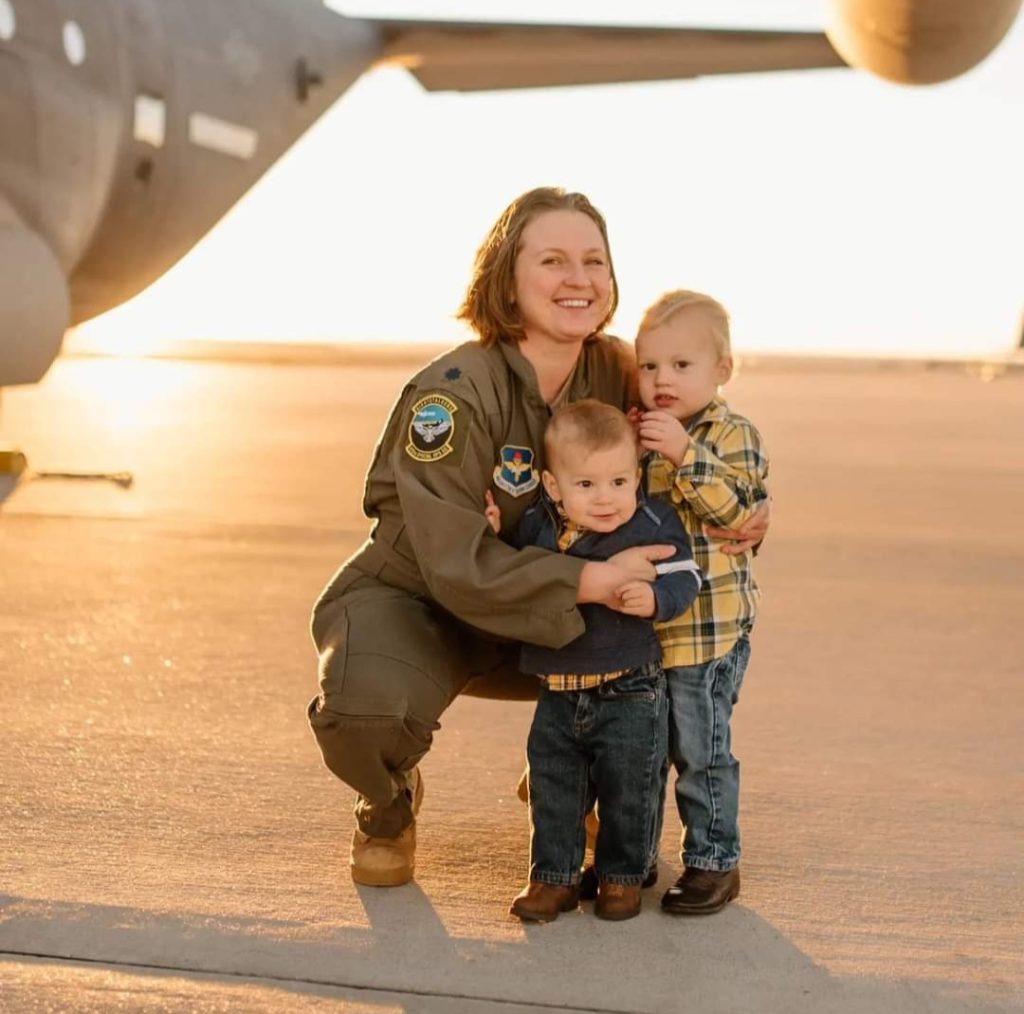
Danielle: Thanks for having me. I am an Air Force military pilot. I’ve been flying since about 2003, and I’ll be retiring this next year to go work for, hopefully one of the major airlines. And in my spare time, I am a DONA trained Birth Doula, and I’m hoping to do more of that work with my company, New Heights Birth and Beyond.
Gina: Awesome. So Danielle is now a moonlight birth worker. She’s about to retire from the Air Force, and she supports births in Albuquerque, New Mexico. Is that where you’re going to continue to support births?
Danielle: I’m going to continue in Albuquerque unless we end up moving to another part of the country. I’m also considering doing travel doula work, because I know enough people who are looking for travel doulas that actually might make sense for me.
Gina: That’s awesome. So Danielle was one of our original moms at the Mamastefit gym back when we were in our very first location, and so she’s worked with us through both her pregnancies births and postpartum. So what made you want to get into birth work in addition to being a pilot?
What Made You Want to Get into Birth Work in Addition to Being a Pilot?
Danielle: So I decided to get into birth work, really after my first birth, because I had a doula. I actually had three doulas for my pregnancy. I had hired you guys, and I was really fortunate because I remember calling you up and thinking, hey, I’m looking for a prenatal yoga studio. And you were like, okay, that’s great. We’re more of a strength training and workout studio. And as I learned more about it, I realized how beneficial it was. Because, really, at that time in my life, I thought that when you were pregnant, you really had to stop exercising and mostly just, I don’t know, woosah and grow, I guess, during that prenatal period where I was able to work out with you guys and feel strong and feel prepared and feel educated.
And then through my birth experience, I was 38 when I had my first kid. So that was advanced maternal age. So there were a lot of things that I was worried about, a lot of things that could happen. And having a doula and having you around to bounce ideas off of and ask questions to was super helpful and super calming.
And then my actual birth experience, I had a different doula because you were out of town. So I worked with Doris Ann for my first birth, and just having her there was absolutely amazing. I felt supported and strong the whole time. And I was able to do an unmedicated vaginal birth for my very first kid at advanced maternal age. And at that point, that’s when I decided, well, I really want to get in on this because I feel amazing, and if I can help other women and other birthing people feel this way, then that feels like something I’m called to do. So that’s when I decided to get into it.
And then through my second birth, I used a doula again. This time it was more virtual support because it was 2020 when I had my second child. So COVID had shut everything down. I was planning on doing a home birth so that I could experience that, but I was unable to because with my second pregnancy, I developed placenta previa, so we had to transition to a hospital birth.
And then because of COVID it was just a really scary time. And having that virtual doula support really made all the difference in getting through a birth, especially a required hospital birth during COVID So that’s kind of a long winded way of explaining how I got into birth work, really. It’s just learning how valuable it was for me and how valuable it could be for other people.
Do you think your experience would have been different without a doula?
Danielle: Oh, God. Absolutely. I’m a wimp. I would not have been able to. Birth is tough, right? No matter how it happens, whether it’s vaginal birth or a belly birth, planned or unplanned, whether it’s a home birth or medically assisted birth, it’s hard. Although I felt like I spent a lot of time in my first birth learning and learning to advocate for myself and getting educated, I think that once the rubber met the road and I was in it, I don’t think I could have gotten through without a doula there knowing exactly how to support me. Doris Ann, she anticipated my needs and she just made me feel really strong. So I think it was essential to have her there.
How was it being a geriatric pregnant person?
Gina: I remember you said you were going to make a shirt that was like, geriatric and pregnant.
Danielle: Yeah. The first time I heard that, I was like, excuse me, ma’am. I was offended because geriatric to me means, like, way older than I was. So I kind of got annoyed at all the medical people referring to me as a geriatric mom. And at the time, I was unmarried as well. So I made myself a T shirt that said Unwed Geriatric Mom, and I wore it to all my appointments after that. And the best part about it is that the nurses loved it. Like, every time a nurse saw me, she was like, yes, girl. The doctors, they thought it was funny, too, but I think they were trying to be a little more straight laced and a little more, quote unquote, professional. But I was getting high fives from everybody else.
I kind of mentioned it a little bit. I felt like there were a lot of things to be concerned about. I felt like there was a little bit of fear mongering, maybe. And I don’t think anybody in the medical profession sets out to be a fear monger. I think that they want what’s best for the baby and for their clients and for the family. I just felt like, as with everything in pregnancy, anytime I had a question or it seemed like every time I had an appointment, it was, oh, we found this new thing, and it could be nothing, or you could be about to die. Roxanne just gave a little double take. I don’t know. I guess that’s what happens when you wait till you’re almost 40 to have babies, but it worked out in the end.
Gina: So fast forward to baby number two.
What were you planning for this birth? And how is your preparation different for your second pregnancy compared to your first?
Danielle:Yeah, so baby number two, I just had 18 months prior. I had had an unmedicated hospital birth, and I was like, you know what? I’m going to do this at home. I’m thinking it’s going to be great. Then it was COVID times, so then everything was up in the air. What a crazy time to be alive, right? We didn’t really know anything and nobody knew anything, so everybody was being uber cautious and as cautious as they could possibly be. I mean, we were Cloroxing our mail before we brought in our Amazon packages, so being pregnant in a COVID time was kind of wild.
But I was very happy about my decision to have our home birth because I was like, that protects us. That protects us from being out amongst people that we don’t need to see. That protects us from potentially getting COVID at the hospital. And then, more importantly, in my mind, a home birth was going to protect us from me and the baby being separated. Because at the time, and you’ll remember this Roxanne, a lot of hospitals had the policy where if birthing person or baby had tested positive for COVID, they were automatically separated. I was not about that. I was really terrified of that. So I was really happy about my home birth plan.
Fast forward to 20 week anatomy scan, and I have Placenta Previa. So then the plan started. It needed to change a little bit. We were hoping that it would resolve, but in the end, it did it, and we had to transition to a hospital birth, and we had to transition to a planned Caesarean.
I don’t know if you know this about me, but I’m a really type A person, and I’m very much, I don’t like not being in control. So to go from being in the ultimate control in my house, having my little home birth, to trusting people that I knew were competent, but that I didn’t know to keep me and my baby safe, it was very scary, especially in COVID.
So I kicked into, like, research mode. I got onto all of my grad school library, and I looked up all of the things about Placenta Previa. And I went to one of my doctor’s appointments with, like 50 printed out pages about Placenta Previa. And I was like, here are 17 peer reviewed articles that say when we should have a C section because they wanted me to have an elective C section. And I think it was 38 weeks. And I was like, no, I don’t think so. So I brought a few studies, and I remember one had a graph that was like, this is your Gestational age, and this is your incidences of NICU stays and yada, yada, yada. And we elected to go. I think it was 39 plus four or 39 plus five where we agreed to have my Caesarean. And once I accepted it, once I wrapped my mind around it, the stress and the terror and the anxiety mostly kind of left at that point.
My only concern was really them taking the baby from me if one of us tested positive. But even that, I remember La Leche League and DONA and all the birth places, they were putting out these sample forms that were like, here’s how you can deny separation. And I also printed out like 30 of those and put them in the birth bag. I feel like I taped one to my forehead and taped one to the door, and I was like, you’re not separating me and the baby.
Scheduled C-section Day
Danielle: When the day came for the actual Cesarean, it was really calm. I did my thing, took my bath with the crazy soap, made sure I didn’t have the nail polish on. I still did makeup because I was like, I want pictures and I don’t want to look busted. Which that was against rules, but I did it anyway because pictures, we got there super early. Priorities, man. You got to be ready for the instagram.
We got there early, and I think there was one person who came in who was in labor. So we got just bumped a little bit. But once things got rocking and rolling, I felt really calm.
And I think the difference there is that I had doulas that I was texting with. So I had that virtual support. And also I had a nurse, Nurse Lisa. I don’t know her last name, but she’s an angel on Earth because she was like the coolest person I ever met. She came in. She was keeping me calm. If you know her, I would love to tell her. She came in and she answered all of our questions. She came in right after the anesthesiologist came in. And they have to give their schpeel about this is the worst case that could happen. So it’s like she knew, well, this is the point at where you’re going to be panicing. So I’m going to come in and tell you everything’s going to be fine.
And then we were good to go all the way up until they came to get us. And we walked into the OR. And then I remember walking in there. There were these giant lights and this table and all this equipment. And I was like, I’m about to freak out again. But then there she was, nurse Lisa. Hey, how you doing? Let me just walk you over here. Let me take your hand. Everything’s going to be fine. So she sat me down and then she let me lean on her during the epidural. And I get a little, like, emotional about this because that was the scariest part for me. But she was awesome.
So we got through that. And then at that point, we’re rocking and rolling. I remember laying back, and even though we’re in the middle of this thing and I’m going to meet my baby soon, my pilot brain kicked in because I heard the medical staff, they were doing like their pre flight briefing. They were like, this is who she is. This is what we’re doing. I remember them saying our goals are to go from incision to baby on the warmer in X amount of minutes. And I don’t remember what the minutes were, but I remember thinking, even though I’m paralyzed from the waist down, oh, they really know what they’re doing.
So at that point, I was just like and I was super calm. The C section proceeded normally. I mean, I remember the funniest part about it was I asked the anesthesiologist to hold my hand. And he was like, let’s get the father in here. Because he was like, not about holding my hand, but it’s because he was trying to make sure my drugs were right.
So Cortis came in, and then the next thing I remember was feeling the doctor bouncing up and down on my ribs or what felt like it, and then hearing my baby cry. So that was pretty cool.
Yeah. So they didn’t have to take him away. Neither of us tested positive for COVID. And Nurse Lisa told me, like, hey, listen, we’re not going to take your baby. You don’t have to wear a mask. Everybody else will be masked up. You’re like the one person who can breathe freely and normally and I’m not going to let anybody take your mask or take your baby.
Sorry. I mean, even after that, she knew that seeing my placenta was important to me just because placentas are cool, right? So she saved it and then she was like she brought it in afterward and was like, do you want to poke at your placenta? I was like, yeah, let’s do that.
So, yeah, that was my COVID birth. We had to stay in the room and then we had like an extra day in the hospital and then they sent us home. It was great. Couldn’t have asked for a better outcome.
Fitness Programming Adjustment
Gina: So you were doing the Mamastefit programming because you’re like one of our most loyal clients. How did your workouts have to change during your pregnancy after you found out that you had placenta previa?
Danielle: Yeah, I am one of your OG clients and I’m so happy to be so and I feel like the Mamastefit programming, it kept me healthy and kept me active and it really helped not only with birth, but especially with the recovery, both during my vaginal birth and my Caesarean birth.
I think I really saw the difference in the second birth when I was more disciplined about working out during the recovery phase. That’s when I saw the difference. When I found out that I had placenta previa. They told me, you can continue to work out. Our biggest concern here, of course, is a placental abruption and we don’t want you to go into labor on your own. So they said to avoid over exerting myself. And then I remember texting you and being like, okay, how does this change what I’m doing? And I think I remember your advice being, listen, just don’t do as deep squats, really listen to your body. But it didn’t really fundamentally change what I could do. I just had to even be even more conscious about like, hey, how am I feeling today? And then for the rest of it, I still did the workouts. I think I just quit with the cardio because at one point I was like, no, I’m going to just be fat and eat all these cookies.
Roxanne: I feel like 90% of people don’t do the cardio conditioning. Even the in person gym clients, I would say 90% of them are like k bye as soon as they’re done with the strength portion. Yeah, I’m not getting on the bike. Sorry. Yeah, I don’t want to do that. I don’t know.
Danielle: I did a lot of walking for my second one during COVID because, you know, that was how we got outside. But I didn’t really have to fundamentally not there. I couldn’t not do anything. There weren’t any forbidden exercises. It was just like, maybe don’t go run a marathon, maybe don’t do snatches with body weight. And I wasn’t going to do that anyway. I can’t do that.
Gina: Now, were there any signs and symptoms you had to look for with placenta previa to let you know that there was an issue or that you should stop exercising and call your provider?
Placenta Previa: signs and symptoms to monitor for
Gina: Now, were there any signs and symptoms you had to look for with placenta previa to let you know that there was an issue or that you should stop exercising and call your provider?
Danielle: Yeah, so the big thing that the OB told me was, watch out for spotting, watch out for cramping, and if you start contractions, like, if you go into labor and delivery, even if you’re not quite sure if they’re Braxton Hicks or labor, call me. Because that was the thing. They were like, we don’t want you to go into labor and have your cervix start to efface or dilate, because that’s what they’re worried about, is placental abruption with the placenta previa. So, yeah, just look for spotting and don’t let yourself go into labor. If you do go into labor, get to the hospital. Just don’t go into labor. Just don’t do it. That’s super easy, right? Best advice.
Do you have any advice for folks who might be pregnant unexpectedly or navigating an unexpected change in their birth plan?
Danielle: Yeah, my first baby was unexpected, and so was my second baby, but
Gina: that Mamastefit programming, just making your butt too nice.
Danielle: It is, man, you do those squats, and they’re like, hey, girl. Hey.
My advice if you are unexpectedly pregnant or if you’re navigating a change in your birth plan, it kind of sort of centers around acceptance, right? You got to do what you got to do to wrap your brain around accepting this new plan. And for me, that meant, like, mourning my old plan. I wanted this super hippie, like, woosah birth at my house, and I wasn’t going to have it. So my advice for anybody who has to deal with mourning your old birth plan and accepting a new one is to really knuckle down on the aspects of the birth plan that you really wanted.
So, like, for me, I realized that what I really wanted out of a home birth was immediate skin to skin and for my baby to stay with me. And those are things that I could take into a hospital birth. Those are things that I could make clear to the providers in my birth plan. Like, this is what I want. This is the most important thing to me. So if you find yourself navigating a change in your birth plan, understand it’s okay to be upset, it’s okay to mourn, and it’s okay to accept a new one. Really get yourself educated on the things that are going to happen in your new birth plan, and then advocate for yourself for the things that you really, really want. And I was able to do that and have a really satisfying birth with my second child, just as satisfying as with my first. So that’s my advice.
When did you start advocating for yourself?
Danielle: So I know some folks, their providers might tell them, we’ll talk about this later. We’ll talk about this later.
Gina: When did you start initiating the conversation with your provider on the things that you were wanting for your pregnancy and for your birth.
Danielle: So I started from my very first appointment. At the first appointment, I walked in and I was like, hey, I want a home birth. And of course, the OB’s eyes got really wide. She was like, okay, I understand. And the thing about me is I was active duty at the time, so I was covered under TRICARE, and TRICARE doesn’t quote, unquote, allow home births. And she told me that in a very respectful and very cool way. I responded, well, I don’t care. You’re not not going to cover me if I accidentally give birth at home.
So I started at my first prenatal appointment and then at every prenatal appointment after that, I had one thing that I wanted to talk about and I made a list because you’re going to forget. I made lists of these things and I brought them in with me. They were really cool about answering my questions, especially after I got diagnosed with placenta previa.
There was one appointment I remember. I think they made it for 15 minutes. I mean, that OB sat with me for an hour because I walked in with a list of like 30 questions and she was really cool about it.
So I think you should advocate for yourself at every OB appointment, even if it’s just restating your birth preferences, even if it’s just saying making sure that your provider and your birth team are on the same page as you early and often is the key. And don’t leave with questions like they’re not going to physically pick you up and move you out of the exam room. I promise won’t kick you out when the 15 minutes is up. You don’t have to go home, but you can’t.
Advocating for Birth Wishes
Gina: So besides Lisa just being an amazing nurse, was there anything that you did to help advocate for your preferences with her that kind of prompted her to do all these things that she probably already normally does?
Danielle: Yeah, like you said, she probably already normally is an amazing nurse. But when she walked in, I did hand her a copy of my birth plan, which had changed, obviously from the beginning of my pregnancy. And I just told her this is what I’m most afraid of. And for me, it was like, I am terrified of somebody putting a spinal in me. And I just want to warn you now, like, I don’t know how to handle it. I don’t know how I’m going to handle it.
So she knew going in what I was going to be afraid of. And I think that’s why she was so able to affect coach me through what was to me a really scary part of the birth, was completely giving up control and letting somebody just take the feeling away from the bottom half of my body.
And in retrospect, I’m not traumatized by it. I laugh about it all the time because I was like I was bawling. And she was like, okay, we need you to breathe calmly now so you can stop shaking because they can’t get the needle in. And she was so cool.
But, yeah, I think open and early and honest communication with your birth team, but I think it’s better to over communicate than under communicate. I mean, everybody in that room knew that I was scared of the epidural by the time it happened. So, yeah, communication.
Gina: So you found it helpful to voice the things that you were most afraid of and then also what your main priorities were with your birth or what you felt was most important to you.
Danielle: Yeah, definitely. And that’s one of the things I carry into my birth support work, is I always ask my clients, what are your biggest fears? Like, what are you most excited about and what are your biggest fears? And then we play this game where they tell me about their ideal birth, and then they tell me about what their top three priorities are. And, like, for my last client, her top three priorities were immediate skin to skin, the ability to move around, and the ability to eat during labor. And because of the way her birth went, she had some medical interventions. She ended up not being able to move a bunch because she got the epidural. She ended up not being able to eat as much as she wanted. Like, they were still letting her drink clear fluids and stuff, but she was able to get that skin to skin. So I think having those conversations with your provider and with your team early and often about, like, this is what I’m afraid of, and these are my priorities. It allows them to support you in a way where maybe you don’t get exactly what you wanted, maybe you don’t get the ability to move around, and maybe you don’t get the ability to eat your steak dinner during labor. But I know that your third priority was immediate skin to skin, so we can make sure that you have that. So, yeah, again, it comes down to communication and advocating for yourself.
Yeah, that makes sense.
Danielle: Like, my last client, she wanted to be informed. She wasn’t afraid of pain. She wasn’t afraid of a long labor. She was afraid of not knowing these are her words, not knowing where my baby is. And I was like, oh, okay, so we just have to make sure that you know what’s happening to you and to your baby at all times. So she had the medical interventions, but she was able to give birth vaginally because we did a bunch of moving in the bed, even with the epidural, which she didn’t know you could do. But I was like, no, girl, we’re going to move you. We’re going to move that baby down. But even after she pushed the baby out and they took the baby over to the warmer for some he needed some deep suction. Her husband and I were both very conscientious about telling her what’s going on. You’re like, okay, now they’re dressing him. Now they’re rubbing him. Now he’s crying. When her husband walked over to meet his son, I was like, now they’re looking at each other. Your husband’s crying. Like baby. It’s awesome. And she told me later, afterward, that that made her feel like she was still in control, like she was still informed about what was going on. So you’re right. Finding out your clients priorities and making sure that that happens, that’s what doulas do, right? That’s what we help with.
Roxanne: That’s awesome.
Conclusion
Gina: Well, thank you so much for sharing both your birth stories with us and kind of your unique journey through motherhood from your first pregnancy, being just old, so old at 38, just ancient. And then also your birth plan changing the second time because it can be really hard to go from this home birth, very specific environment for a specific birth experience to a cesarean birth, which I feel like is probably the 180 from a home birth. And be able to do both of those really unique experiences and have a positive outcome and a positive view on it is really awesome, and I think it’s going to really support you as you navigate the birth world as well.
So how can our followers connect more with you? If they want to follow your Instagram or if they’re in Albuquerque and they want to work with you?
Danielle: Sure, they can go to my website, it’s www.newheightsbirth.com. Or they can follow me on Facebook or Instagram. My handle is at @newheightsbirth. And they can reach out to me either via those avenues or via email. And all my contact information is on my website.
Gina: And we’ll link all your social media and website in the show notes as well.
So thank you so much, Danielle, for being one of our very first clients and trusting us for however many years you’ve been with us now. And thank you for sharing your story with us. Anytime. My pleasure. Thanks for having me.