Pregnancy Sleeping Tips: Get Comfortable and Relieve Pain!
Pregnancy
Pregnant and struggling to get a good night of sleep?? In this blog, we are going to be breaking down several sleeping positions, sleeping aids, and how to move in bed pain-free!
Pregnant and struggling to get a good night of sleep?? In this blog, we are going to be breaking down several sleeping positions, sleeping aids, and how to move in bed pain-free!
Pain and discomfort are common during pregnancy–over 50% of us will report pelvic girdle pain during our pregnancy, which is a culprit of why moving around in bed can be painful! However, pain is NOT a requirement of pregnancy, and there is a lot we can do to relieve prenatal discomfort.
During the day, you can incorporate strengthening and mobility exercises to find relief from pelvic pain, such as mobility exercises to improve pelvic pain and strengthening exercises to increase pelvic stability. You can read more to prevent and relieve pelvic pain in this blog.
Here is an excerpt from our book, Training for Two, with tips on how to get a comfortable night of sleep! A big portion of our book is to help you stay comfortable throughout your entire pregnancy–because pain is NOT a requirement of pregnancy–so we address things like tailbone pain, pelvic girdle pain, and more in our book!
“Sleep can feel elusive in the third trimester due to pregnancy insomnia, needing to pee more often, or discomfort. Sleep is crucial for your health, but up to 78 percent of pregnant women complain of sleep issues during the third trimester. Poor sleep quality may be associated with an increased risk of prenatal and postpartum depression, as well as adverse pregnancy outcomes.
If you are experiencing pregnancy insomnia, cognitive behavioral therapy with a perinatal mental health specialist may be helpful. Other options, such as prenatal yoga, prenatal massage, and meditation, can also support your sleep throughout pregnancy.
If you’re waking up more than twice a night to pee, it could indicate a pelvic floor issue. Working with a pelvic floor physical therapist may be helpful. Pelvic floor physical therapy can also help if you have hip pain or pain shifting your position in bed.
If you are experiencing hip pain, pain while rolling or shifting your position in bed, or even reflux and heartburn, you can first focus on your sleeping position. An easy way to do this is to place a pillow between your knees and ankles to keep the hips in a more neutral position.”
In this blog, we break down some sleeping positions and tips for changing positions in bed! Watch our YouTube video for more on HOW to find these positions and move.
Sleeping Positions: Use External Support!
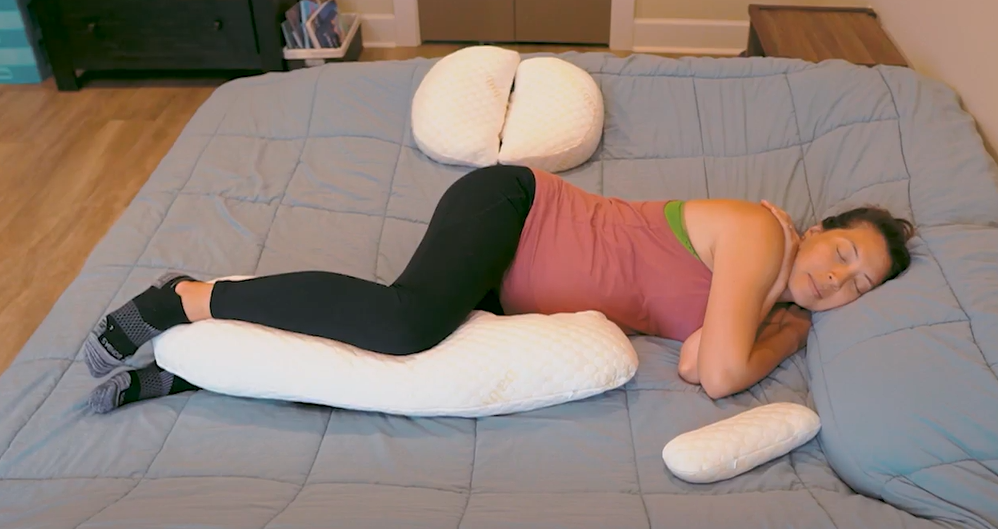
1) Pillow Between Knees AND Ankles!
When trying to find a comfortable position during pregnancy, we need to find alignment for the hip which includes supporting both the knee AND the ankle. This even support will help the hips stay in a more neutral position which can decrease the strain on your external rotators (a common reason for hip pain after sleeping).
In this position, you’ll place a long pillow between the knees and ankles and sleep on your side. We love the Baby Bub pillowbecause of how easy it is to switch positions.
You can also do this with a more traditional pregnancy pillow, such as a C or U shaped pillows, but the same concept applies–place the pillow between BOTH your knee and ankle. Check with your provider, because these pillows may be covered by your insurance!
2) Side Body Support: Small Pillow
Another thing that may help increase your comfort while you sleep is to add some support under the waist, in between the hips, and the rib cage! You can do this by rolling up a small towel or use a small pillow to place in between your rib cage and your hips.
This can help you find a more neutral spine position! Sometimes when we prefer sleeping on one side, it can compress the top side body and lead to discomfort throughout the day, such as rib pain!
If you are experiencing one-sided rib pain, you may find relief by incorporating some side body openers. In the video below, we break down the side seated side body opener! Try this on the side that feels “tight,” which may be the opposite side that you prefer to sleep on.
3) Belly Support!
Next, you can add some support under the belly! There are wedges you can place under your belly, or you can roll up a small towel to place under your belly to add support.
Changing Positions: How to Stay Pain-Free at Night!
If you are experiencing discomfort from your sleep positions and you have been doing all of the tips above, it could be that you are staying in the same position for TOO long. But, it can be hard to flip and change positions, especially if you have pelvic pain!
Try these movement tips to find relief as you switch positions.
1) Squeeze Pillow and Roll
First, you can increase pelvic stability by squeezing something between your knees. This activates the adductor muscles (inner thigh) that attach to your pelvis and play a BIG role in pelvic stability.
Before you begin to roll, squeeze a pillow between your knees and then maintain the squeeze as you change positions.
The next step is to add a hip shift as you roll. Most of us favor a certain pelvic position, which is left hip more forward and right hip more backward. This causes a torque in the pelvic girdle that could become problematic during pregnancy with all the extra joint laxity.
With this pelvic position in mind, we can find the opposite position to help stabilize as we roll.
Place a pillow between your thighs, then squeeze the pillow as you shift the left hip BACKWARD and drive the right knee FORWARD. This will apply regardless of which side you are lying down on.
Then begin to roll from one side to the other.
2) Side to All Fours
If rolling on your back is still painful, you can come to all fours to switch sides! This would be a bit more labor intensive but can be a pain-free option if rolling on your back even with the pillow squeeze is not helping to relieve the pain.
Stay Strong and Pain Free Throughout Your Pregnancy!
Learn the science of pregnancy and birth to take the mystery of labor away! Understand why you are feeling what you feel, and learn strategies to confidently move through pregnancy and birth!
Find comfort and relief from pelvic girdle pain throughout your pregnancy and postpartum period! This program incorporates myofascial sling focused exercises to stabilize across the pelvic girdle joints.