



If you want to help your baby get into their best position for birth, you need to focus on ensuring their path to rotation is clear! There is a lot of pressure to FORCE your baby into the “best” position, usually OA or LOA (back of the head towards the front or slightly to the left of the pelvis). These positions are common positions that your baby will rotate through during labor, but they are not necessarily the “best” position for all of labor.
Your baby will move through several positions as they navigate each pelvic level! So, there is no one best position for your baby—and trying to force them into one specific position is a waste of time and just produces anxiety. We break down your baby’s positions and HOW they move through the pelvis in our online childbirth education course!
But, what do we mean when we say ensure their path to rotate is clear??
We mean that the layers supporting and surrounding your baby are what we want to focus on releasing tension in so when you have strong uterine contractions your baby can easily rotate to their best position without obstacles or restrictions!
This includes:
- Balancing the uterine ligaments (a key part of the workout video in this blog)
- Balancing tension in the surrounding musculature (this includes the abdominal wall, back, and pelvic floor)
- Creating more space in the pelvis
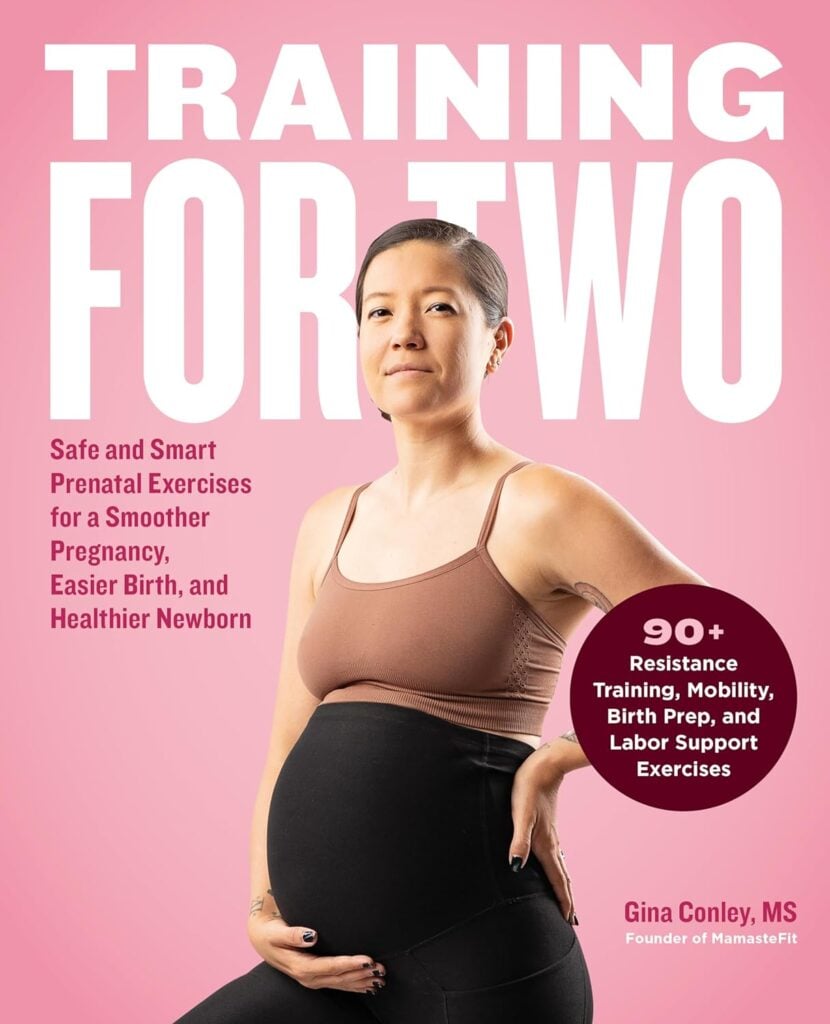
Want to learn more on how to use prenatal fitness to support a strong and pain-free pregnancy, plus exercises to release tension in the pelvic floor and open the pelvis for birth? We also break down how to use prenatal exercise and labor positions to support your baby’s position!
Pre-order our book Training for Two! This book includes 90+ exercises to build your confidence as you navigate fitness throughout your pregnancy and prep for birth, plus a whole chapter on early postpartum recovery!
Prenatal Exercises for Optimal Birth Positioning
Balancing the uterine ligaments is the foundation of supporting your baby’s position for birth! The uterus has several ligaments that attach it to the surrounding structures and tissues:
- The round ligaments run vertically on the front of the uterus to the labia
- If these are tight, you may feel a sudden sharp pain towards one side of the lower abdomen, especially when extending in your hip. You may also feel a sudden electric-like feeling deep in your vagina, known as a lightening crotch!
- The broad ligament runs horizontally across the front of the uterus
- If this ligament is tight, your baby’s movements are usually uncomfortable or painful. If this ligament is tight it could create a speed bump making it harder for your baby to move deeper into the pelvis.
- The uterosacral ligaments run vertically on the bottom of the uterus to the sacrum.
- If these ligaments are tight, you may have more SI joint or lower back pain. If they are tight, it can restrict or decrease space in the bottom of the uterus potentially contributing towards a breech position or making it harder for your baby to find a good head position.
Starting at 20 weeks of pregnancy, you can incorporate this uterine release circuit 2-3 times a week (or daily if you feel up to it) to help release tension in the uterine ligaments. This will help you feel more comfortable throughout your pregnancy and support your baby’s position when labor begins too!
This circuit includes:
- Forward Leaning Inversion to release tension in the uterosacral and round ligaments
- 90/90 side camel to release tension in the round ligaments with a side body opener and hip flexor release
- All fours hip shift with pelvic tilts to release tension in the posterior pelvic floor and broad ligament as you pull belly to spine
We include this circuit and more exercises to prepare you for birth in our prenatal fitness programs! Our programs are designed to keep you strong throughout your pregnancy with trimester-by-trimester lifting modifications, plus prepare for birth with pelvic opening and pelvic floor release exercises. Explore our programs here!
Prepare for Your Birth with MamasteFit Prenatal Fitness Programs
If you want more daily workouts to support a strong pregnancy as you prepare for birth, join our online prenatal fitness programs!
MamasteFit is unique in that we are one of the ONLY prenatal/postnatal training facilities in the United States. We develop our workout programs from our experience of working with in-person pre/postnatal fitness clients and work closely with physical therapists to refine our programming. In addition, we are birth workers, so we combine our experience as perinatal fitness trainers and birth professionals to ensure that our programs actually support your birth preparation and recovery!
Our prenatal fitness programs are offered in several formats:
- 40-Week Prenatal Strength Program in the Teambuildr App:
- This program is a self-paced workout with shorter demo videos. This is ideal if you like to workout in a gym setting and prefer a traditional workout delivery format.
- This program syncs to your current week of pregnancy, so you can start anytime, with one-time payment or month-to-month payment options.
- This program has a full and mini version, depending on how much time you have to dedicate to workouts!
- Prenatal On-Demand Fitness Program:
- If you prefer to follow a video as you workout at the same time, this workout program will be the best option!
- This program syncs to your current trimester, so you can grab the trimesters you need!
- Prenatal Yoga Classes:
- If you want prenatal yoga, join our prenatal yoga program! This also syncs to your current trimester.

Learn the science of pregnancy and birth to take the mystery of labor away! Understand why you are feeling what you feel, and learn strategies to confidently move through pregnancy and birth!
- 9h+ of Video
- Support Group
- Close Captioning

- 5 Workouts/Week
- Gym Workouts
- Self-Paced

Instructor
GINA
Workout on-demand with our prenatal fitness workout videos! Each workout is 30-40 minutes to follow along as you exercise at the same time!
- Birth Prep
- All Trimesters
- Mobility Work

Instructor
GINA
Find comfort and relief from pelvic girdle pain throughout your pregnancy and postpartum period! This program incorporates myofascial sling focused exercises to stabilize across the pelvic girdle joints.
- 3 Weeks
- On Demand Workout Videos to Follow