



Table of Contents
The pelvic floor is a sling of muscles that sits at the bottom of the pelvis. Common recommendations for the pelvic floor often fall into one of two categories: stretching exercises, such as deep squats, butterfly pose, and other wide-leg positions, or strengthening exercises, such as Kegels, where you tighten and squeeze the pelvic floor.
These exercises can absolutely be helpful, but they are often not looking at the pelvic floor deeply enough. Most advice starts with how to tell if your pelvic floor is tight or weak, but the answer is often not one or the other. If you’ve been spending a lot of time stretching your pelvic floor with wide-leg positions or doing pelvic floor contractions and still finding yourself struggling with pelvic floor symptoms, we may need to take a deeper look at how the pelvic floor is functioning.
One of the biggest concepts we teach in our Pelvic Mechanics workshops is that the pelvic floor is not perfectly symmetrical. Just like the rest of your body, the pelvic floor has normal asymmetries. Different portions of the pelvic floor may have different amounts of tension, different movement capabilities, and different strength demands based on how you stand, move, breathe, exercise, and even how your body adapts during pregnancy.
Rather than focusing only on making the entire pelvic floor stronger or more relaxed, we can look at creating better balance throughout the pelvic floor. When we improve that balance, we often find improvements in symptoms because the pelvic floor can create and manage tension more effectively.
In this blog, we’re going to break down the most common pelvic floor asymmetries, why they develop, and how you can better design your workouts to support the different quadrants of the pelvic floor through both strengthening and mobility exercises.
There Is No One Exercise That Stretches or Strengthens the Entire Pelvic Floor
When it comes to the pelvic floor, one of the key concepts that is an overarching theme throughout everything we teach in our education courses and Pelvic Mechanics workshops is that there is no one movement that is going to stretch the entire pelvic floor, and there is no one movement that is going to strengthen the entire pelvic floor.
We need a variety of movements to stretch different portions of the pelvic floor and a variety of movements to strengthen different portions of the pelvic floor. It’s not just about finding a stretch or finding a squeeze. How we position the pelvis, hips, and spine can all influence which portion of the pelvic floor we are targeting.
Want These Concepts Built Into Your Pregnancy Workouts?
One of the biggest mistakes we see during pregnancy is relying on a handful of stretches and pelvic floor exercises while ignoring the bigger picture of how the pelvis, hips, spine, and pelvic floor work together.
That’s why every workout inside our Prenatal Fitness Programs includes pelvic mobility, pelvic floor, and birth preparation exercises designed to improve movement options throughout the pelvis. Rather than guessing which exercises you should be doing, you’ll follow a structured program that combines strength training, mobility work, and birth preparation throughout your pregnancy.
We offer both self-paced strength programming and follow-along video workouts, all synced to your week of pregnancy. Choose between a one-time purchase with lifetime access or flexible monthly payment options.
Preview a free workout and explore our Prenatal Fitness Programs here.
Understanding the Four Quadrants of the Pelvic Floor
The pelvic floor has four quadrants. There is an anterior portion and a posterior portion. There is also a left and right side. Together, these create four different quadrants of the pelvic floor.
The pelvic floor attaches directly to the pelvis, so changes in hip position can influence the orientation of the pelvic bones, which then changes the tension within the pelvic floor.
You may have heard that there is very little movement at the pelvic joints. While the movement is small compared to a shoulder or hip joint, it is still significant enough to change the tension within the pelvic floor, which is only a few millimeters thick.
Because of this, different pelvic and hip positions will place different portions of the pelvic floor into a more shortened position while placing other portions into a more lengthened position.
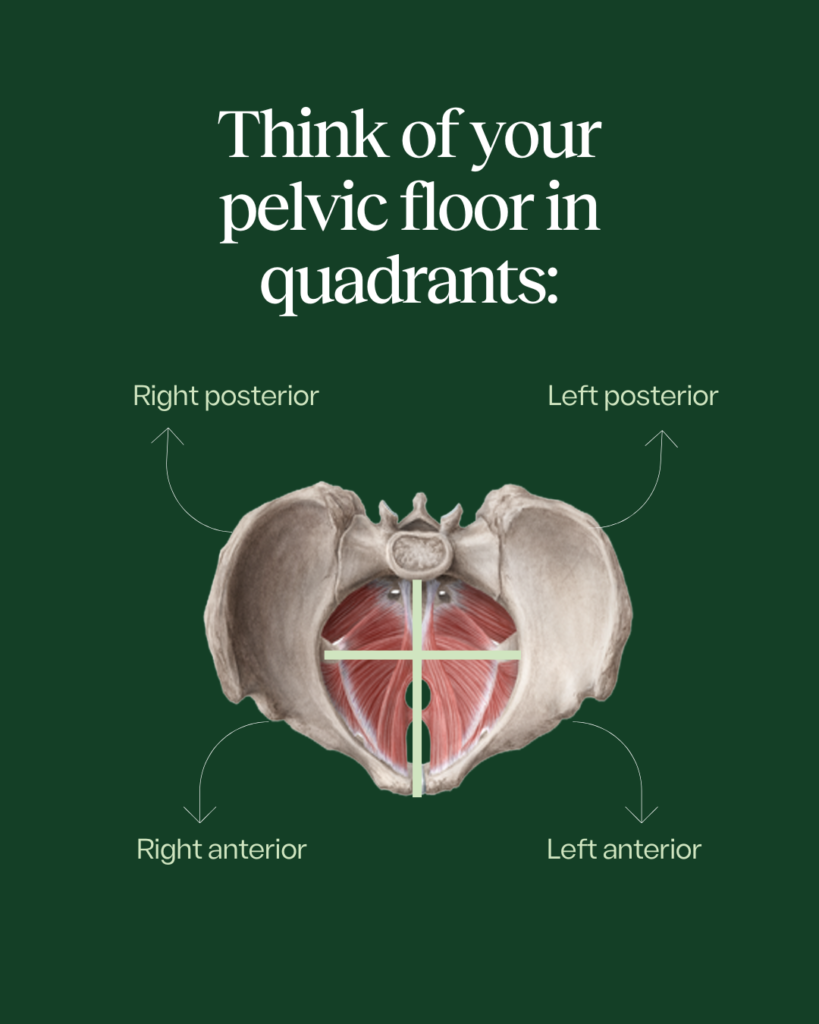
How Different Quadrants Lengthen and Shorten
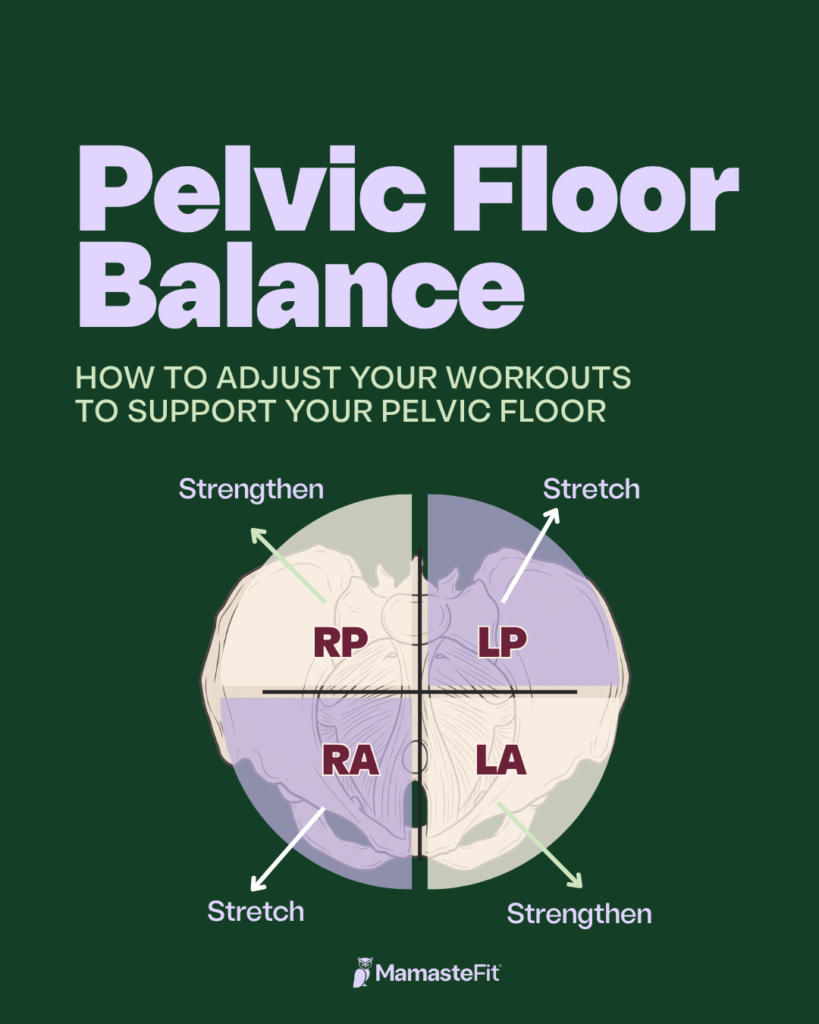
Anterior Quadrants: Stretch and Strengthen The Front of Your Pelvic Floor
The anterior quadrants tend to lengthen more with open hip positions that emphasize external rotation, abduction, and anterior pelvic tilt. These are positions commonly seen in groin and adductor stretches, deep squats, butterfly stretches, and lateral lunges.
If we want to strengthen an anterior quadrant, we need to think about what would help that quadrant shorten. This means emphasizing movements that bias more internal rotation, adduction, and hamstring-driven activities that place the hip into a more closed position.
Posterior Quadrants: Stretch and Strengthen the Back of Your Pelvic Floor
On the other hand, if we want to stretch a posterior quadrant, we would use movements that create a similar pelvic orientation. When an anterior quadrant shortens, the posterior quadrant is lengthened.
Movements such as hip shifts, which emphasize internal pelvic rotation, are examples of exercises that can create length through portions of the posterior pelvic floor.
To strengthen a posterior quadrant, we need movements that pull us out of that internally rotated position. These movements generally emphasize external rotation, abduction, and activities that recruit the glutes and quadriceps. Exercises such as split squats, lunges, and B-stance squats can all be modified to emphasize the posterior pelvic floor by incorporating same-side loading and abduction strategies.
Now, that may feel a little overwhelming, which is why we created the chart below to help simplify which movements tend to lengthen and strengthen each quadrant.
Why Would You Target One Quadrant Over Another?
At this point, you may be wondering:
“How do I know which quadrant I should be targeting?”
The answer is asymmetry.
The Pelvic Floor Is Not Perfectly Symmetrical
We all have normal asymmetries within our bodies. Our organs are not perfectly symmetrical. Our diaphragm is not perfectly symmetrical. The way we breathe is not perfectly symmetrical. Because of these differences, the way we naturally stabilize and stand is not perfectly symmetrical either.
These asymmetries influence the pelvis, which then influences tension within the pelvic floor. This asymmetry is not bad. It is a normal part of being a human being.
However, sometimes we can become too stuck in our asymmetrical patterns, which may contribute to discomfort, movement limitations, or pelvic floor symptoms.
The Most Common Pattern: Left AIC
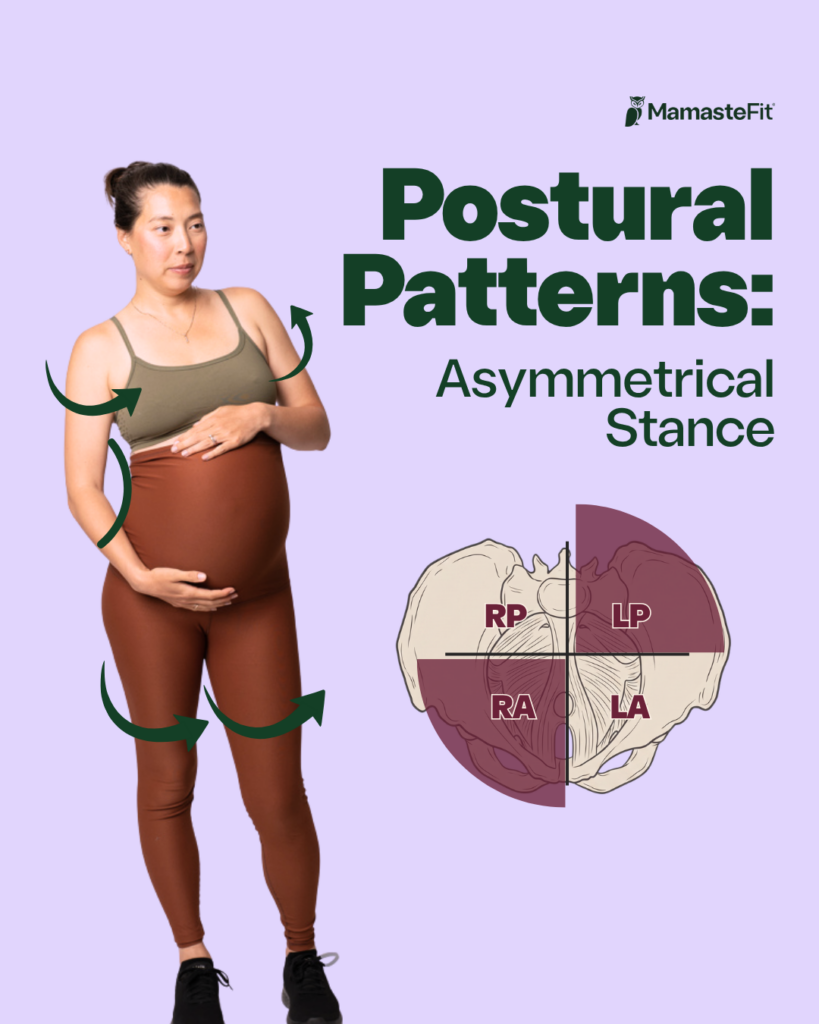
One of the most common patterns we discuss in our workshops is known as the Left AIC pattern.
In this pattern, people tend to place more weight through the right leg. The organs are denser on the right side of the body, and the right side of the diaphragm is larger as well. Because of this, many people naturally feel more stable loading into the right side.
As we spend more time loading the right leg, we often find more internal rotation on the right side of the pelvis. This internally rotated position tends to create a shorter, tighter right anterior pelvic floor quadrant.
At the same time, we often see increased tension in the left posterior quadrant.
This creates one of the most common pelvic floor asymmetries:
- Right anterior quadrant becomes more compressed and overactive
- Left posterior quadrant becomes more compressed and overactive
- Right posterior quadrant becomes relatively underloaded
- Left anterior quadrant becomes relatively underloaded
Again, this pattern is not bad. It is simply a common human pattern.
Want to learn more about this concept?
The concepts discussed in this article are a simplified overview of what we teach in our in-person Pelvic Mechanics workshops and online self-paced education courses. Understanding how asymmetries influence the pelvis, pelvic floor, and movement patterns can completely change how you approach birth preparation, pelvic floor training, and exercise programming.
If you’re a fitness professional, birth worker, healthcare provider, or movement specialist looking to dive deeper into pelvic mechanics, check out our upcoming in person Pelvic Mechanics workshops and online self-paced education courses.
Applying Pelvic Balance Strategies
With this asymmetry in mind, we can begin applying movements that help create better balance throughout the pelvic floor.
Our goal is often to:
- Release the right anterior quadrant
- Strengthen the right posterior quadrant
- Release the left posterior quadrant
- Strengthen the left anterior quadrant
Pelvic Floor Balance Relaxation Workout
Understanding pelvic floor asymmetries is one thing, but applying them is another.
If you’re dealing with tension, discomfort, pelvic pressure, or simply want to explore movements that help create better balance throughout the pelvic floor, try this free pelvic floor balance workout. This workout focuses on movements that help release common areas of tension, particularly the right anterior and left posterior pelvic floor quadrants that are commonly overactive in the Left AIC pattern.
Want more workouts like this?
Our YouTube channel includes free prenatal, postpartum, pelvic floor, strength training, mobility, and birth preparation workouts designed to help you move better and feel stronger throughout pregnancy and postpartum recovery.
Be sure to subscribe to our YouTube channel so you don’t miss future workouts, educational videos, and pelvic floor training resources.
Right Side Strategies
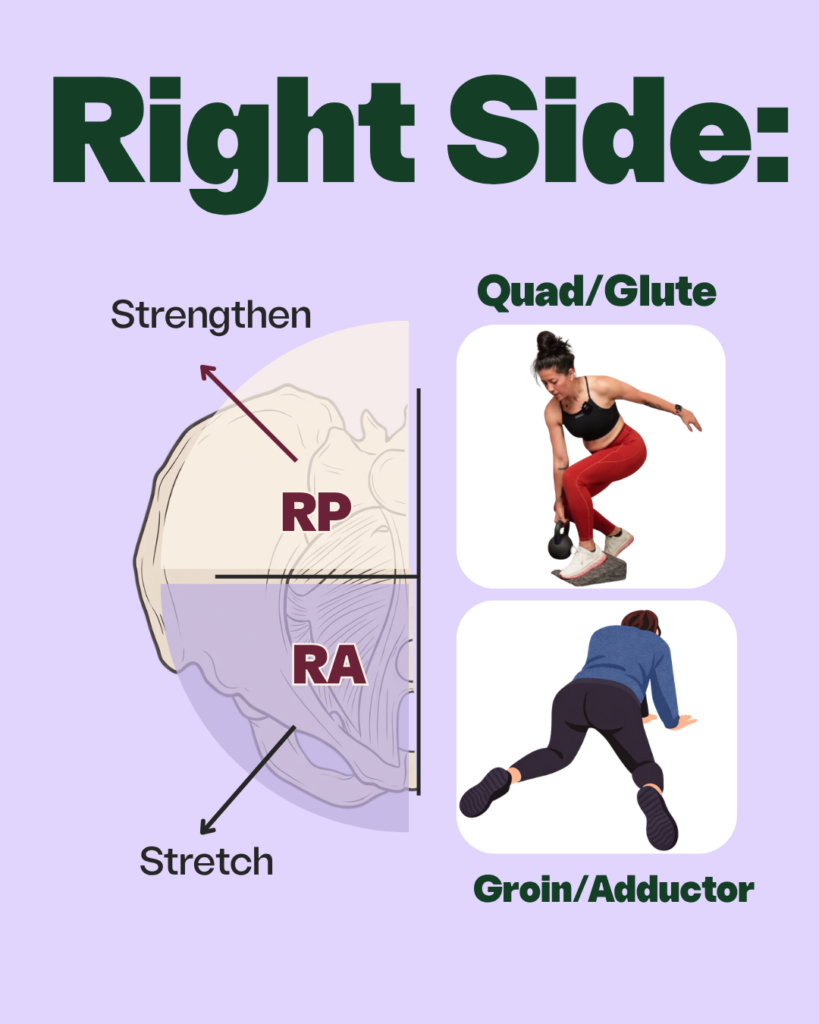
To release the right anterior quadrant, we can use lateral hip shifts and movements that emphasize length through the groin and inner thigh.
To strengthen the right posterior quadrant, we can focus on glute- and quad-dominant exercises such as B-stance squats, split squats, and lunges. To further bias the right posterior quadrant, we can hold the weight in the same hand as the working leg. This same-side load encourages more external rotation. Adding a band around the outside of the knee to create abduction can further emphasize glute recruitment.
Left Side Strategies
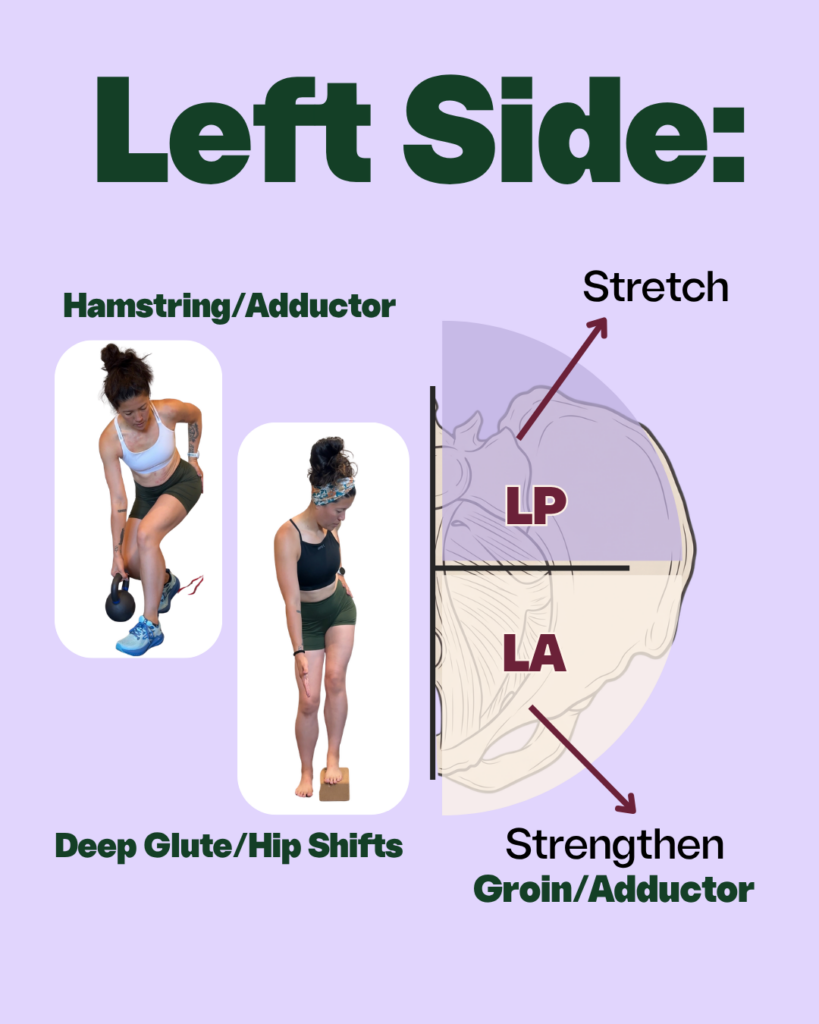
To release the left posterior quadrant, we can use hip shifts and movements that create a stretch through the posterior hip. Many people will feel this stretch deep in the hip pocket or glute region.
To strengthen the left anterior quadrant, we can use hinge-based exercises that emphasize hamstring and adductor recruitment, such as staggered-stance RDLs or single-leg deadlifts.
Holding the weight in the opposite hand, known as a contralateral hold, helps encourage more internal rotation and allows us to access the left hip more effectively. Adding a band that encourages adduction can further increase inner thigh recruitment and help support the left anterior quadrant.
How We Program Pelvic Balance Exercises
When I am programming exercises to incorporate pelvic balance, there are a few consistent strategies I use.
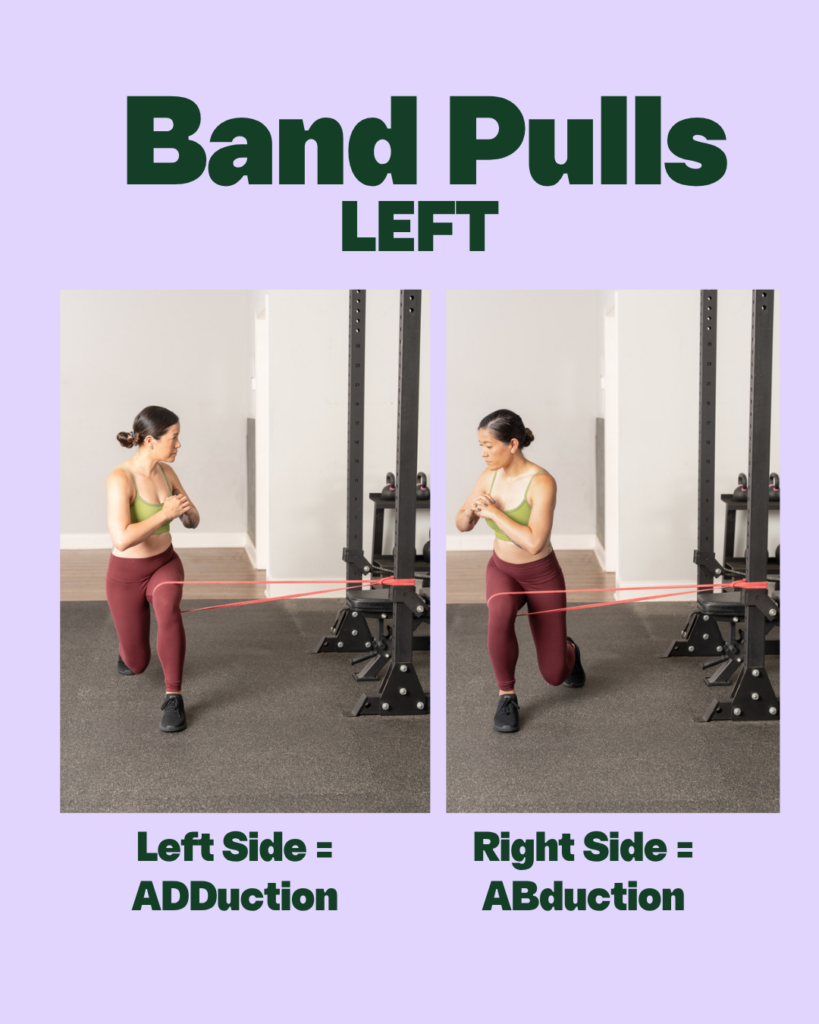
Band Pulling to the LEFT
The band is almost always pulling the left leg outward to encourage more adductor activation on the left side, while the right leg is often being pulled inward to encourage more glute activation on the right side.
Weight in RIGHT Hand
The weight is often held in the right hand. When working the left leg, this creates a contralateral load that biases more internal rotation. When working the right leg, it creates a same-side load that biases more external rotation.
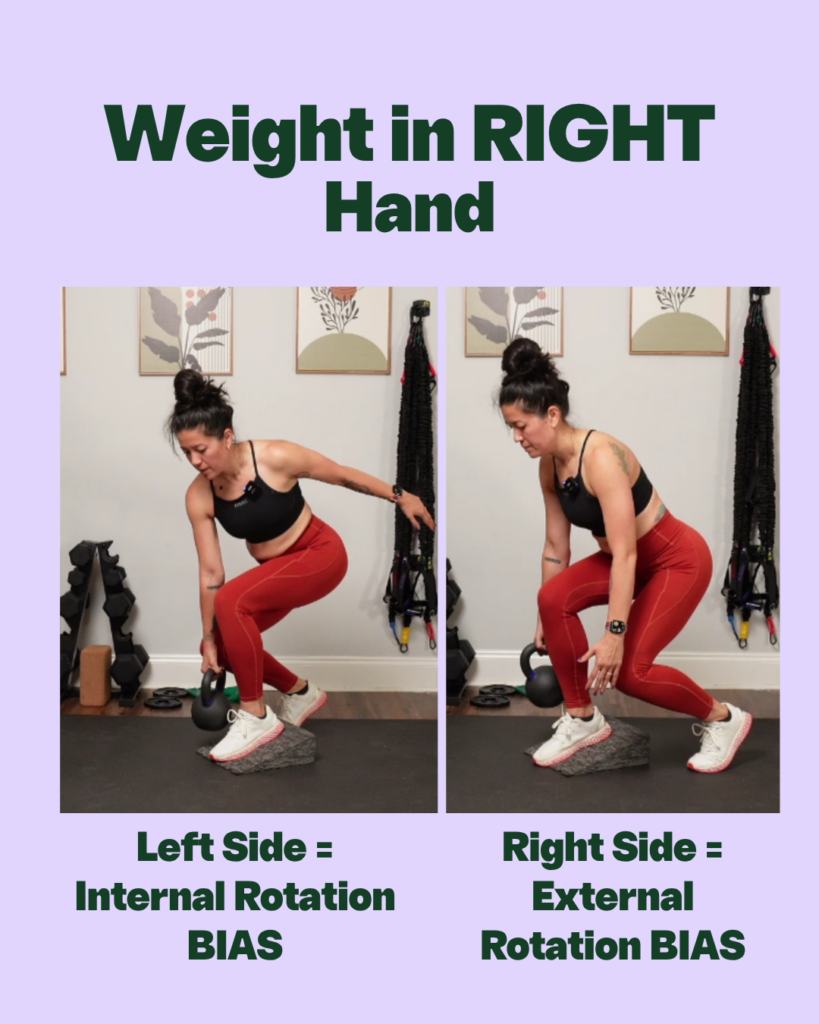
These small changes can significantly alter which portions of the pelvis and pelvic floor are being challenged. The overall exercise may remain the same. You might perform a B-stance squat, split squat, lunge, or staggered-stance RDL on both sides. The difference is in the setup, loading strategy, and intent behind the exercise.
These subtle modifications are what transform a standard exercise into a pelvic balance exercise. If figuring out the right modifications feels overwhelming, that’s exactly what we’ve done inside our Prenatal, Postpartum, and Beyond Postpartum Fitness Programs, where pelvic balance principles are built directly into the workouts and programming.
Pelvic Floor Strength Workout
Pelvic floor strengthening doesn’t have to mean lying on your back doing Kegels.
Instead, we can use exercise selection, loading strategies, band placement, and pelvic positioning to target different quadrants of the pelvic floor during full-body strength training.
This workout demonstrates several of the concepts discussed throughout this article and includes movements designed to challenge each quadrant of the pelvic floor through different movement patterns.
Looking for more than just random pelvic floor exercises?
On our YouTube channel, we share full-length workouts, birth preparation routines, pelvic floor balance exercises, postpartum recovery workouts, and educational content to help you better understand how your body works.
Subscribe to our YouTube channel and explore our growing library of free workouts and resources.
Ready to Build Strength Without Guessing?
Pelvic floor balance isn’t just important during pregnancy. These same concepts can help support postpartum recovery, returning to running, lifting heavier weights, managing prolapse symptoms, and building long-term strength.
Our Postpartum Fitness Program helps you rebuild strength, core function, and pelvic floor function with a step-by-step progression designed specifically for postpartum recovery.
For women who are ready for more advanced strength training, our Beyond Postpartum Program includes ongoing strength programming plus running programs designed to help you continue building fitness for years after birth.
Whether you’re six weeks postpartum or several years postpartum, our programs help take the guesswork out of training so you can focus on getting stronger.
Explore our Postpartum Fitness Program for a structured return to exercise (see a free preview here), or join Beyond Postpartum for ongoing strength and running programming. New Beyond Postpartum members can start with a free 7-day trial.
Tight or Weak?? Why Better Balance Means Better Function
When most people think about pelvic floor training, they think they need to either strengthen their pelvic floor or relax their pelvic floor. But in many cases, the answer is not simply more strength or more stretching.
The pelvic floor is a complex group of muscles that responds to the position of the pelvis, hips, spine, and rib cage. Different portions of the pelvic floor experience different amounts of tension based on how we move, how we stand, how we breathe, and how we train.
By understanding the common asymmetries that exist throughout the body, we can move beyond a one-size-fits-all approach and begin supporting each quadrant of the pelvic floor more intentionally. This doesn’t mean asymmetry is bad. In fact, asymmetry is normal. The goal isn’t to become perfectly symmetrical. The goal is to have movement options.
When we have the ability to move in and out of different positions, we create a pelvic floor that is more adaptable, more resilient, and often functions better during everyday life, exercise, pregnancy, birth, and postpartum recovery. Whether your goal is preparing for birth, reducing prolapse symptoms, returning to running, lifting heavier weights, or simply feeling more comfortable in your body, improving pelvic floor balance may be the missing piece.
Instead of asking whether your pelvic floor is weak or tight, it may be more helpful to ask:
“Is my pelvic floor balanced?”