

It is important that you can find a hip shift, where the pelvis rotates on the fixed femur into internal rotation. Why? Because a hip shift is crucial for hip stability! If you are having pelvic pain, finding a hip shift could decrease or completely alleviate the pain!
Hip shifting is also important for pelvic floor function. A hip shift adjusts the tension in the pelvic floor, which can enhance its function–especially if certain portions are really tight! If you are having bladder or prolapse issues, you may find that a hip shift helps you relieve incontinence and feelings of pelvic floor heaviness.
Additionally, a hip shift helps the hip move into internal rotation which lengthens the glute more than maintaining a neutral position. This increased length means that the glute is moving through a larger range of motion and will be strengthened more! If you want stronger (and larger) glutes, adding internal rotation with a hip shift is crucial!
And finally, beyond the functional reasons, a hip shift is important to open the pelvis for birth! The hip internal rotation creates more space in the lower half of the pelvis. The inability to find internal rotation is a common reason for late labor stalls and could lead to a cesarean birth.
So, hip shifts are important to support hip stability, optimizing pelvic floor function, glute strengthening, and opening the pelvis for birth! That is a lot!
In this blog, we are going to break down four ways to find a hip shift!
Hip Shift Mechanics: Internal Rotation with Adduction and a Posterior Tilt
First, let’s break down what a hip shift even means! When you have a hip shift, the weight is being shifted into one hip. This shift prompts the hip to move into internal rotation with adduction (closed hip position) where the pelvis rotates to the femur bone. Additionally, the pelvic half will rotate into a posterior position, or slightly tuck underneath.
A hip shift should happen whenever you place weight into your foot, such as while walking. But, depending on your compensation pattern, you may NOT hip shift at all which can be problematic.
When you hip shift, this changes the positioning of the pelvis to optimize stability of the pelvic joints (allows them to better form close during movement to decrease pelvic pain). Additionally, it changes the tension of the pelvic floor to optimize function–such as preventing leaking while jumping or running.
Hip shifting also lengthens the glute muscle, which will help it generate power to response to the demand–when the glutes are clenched, it can cause the pelvic floor to become overactive as they try to “help” the glute work. Hip shifting can help the glute work better, which can allow your pelvic floor to focus on its own job (which means the pelvic floor will work better).
And then, for birth preparation, a hip shift creates more space in the lower midpelvis. This is important, as we want to create space in the lower half of the pelvis to help your baby finish their rotation under the pubic bone. If you have difficultly finding internal rotation, it can result in a labor stall.
As you can see, being able to find a hip shift is really important not only for your comfort and function throughout your pregnancy and postpartum, but also to open your pelvis during birth! If you want a series of exercises to do that focus on helping you find a hip shift, grab our free MamasteFit Birth Preparation Circuit guide by signing up for our newsletter below! You’ll get emailed a our PDF guide with videos!
1) Foam Roller Supported Hip Shifts

One of the first ways you can find a hip shift is to add some external props! This can be helpful to “force” you into a hip shifted position so you can FEEL what a hip shift feels like in your body to replicate that in other positions.
With the foam roller support, you are actively pressing into the foam roller with your outside leg. This is turning on the adductor and going to keep your leg in a static position–which we want! This will allow your pelvis to rotate ON your stationary leg (which is a hip shift).
Start by pressing your knee into the foam roller:
- Then rotate your inside hip forward toward the outside knee.
- You should feel more a stretch in the outside glute and hip area. This is a hip shift!
- Rotate back to open the hip.
- Then repeat 5-10 times per side.

Another variation of the foam roller support is to maintain the same position, but step the inside leg in front of the foam roller as if you were taking a step. Then shift into the hip to feel the same “hip shift” sensation in your hip.
You can then add movement by stepping forward and backward over the foam roller to find a closed (hip shifted) and open hip position. Repeat 5-10 times per side.
Watch this YouTube video for a break down of how to do this exercise! Subscribe to our YouTube Channel for new educational videos posted every week about pre/postnatal fitness, childbirth, and more! If you like this video, be sure to like and leave a comment on what video you want us to make next!
Want more?? Join our prenatal and postnatal fitness programs! MamasteFit is unique in that we are one of the ONLY prenatal/postnatal training facilities in the United States. We develop our workout programs from our experience of working with in-person pre/postnatal fitness clients and work closely with physical therapists to refine our programming. In addition, we are birth workers, so we combine our experience as perinatal fitness trainers and birth professionals to ensure that our programs actually support your birth preparation and recovery!
Our prenatal and postnatal fitness programs are offered in two formats:
- Teambuildr App: list of exercises with demo videos with options to track your weights and progress within the app!
- On-Demand Videos: full length workout videos you follow as you workout at the same time
2) Partner Supported Hip Shifts
The next hip shift you can try is a partner-supported one! If you are having a hard time “feeling” a hip shift, your partner “forcing” your hip into a shift can help you feel it!
In these two variations, you are in a side-lying position as your partner pushes your top leg back into a hip shift. These variations can be done during pregnancy and postpartum to help you feel a hip shift, and also during labor to help open your pelvis if your baby is low in the pelvis.
2a) Single Knee Press


In the single knee press, your partner is manipulating the top leg in your side-lying position into a hip-shifted position, or closed hip position.
Starting with their arm routed underneath your lower leg:
- Bring the hand on top of the thigh
- Lift the forearm to prop your leg into internal rotation (ankle higher than the knee)
- Place your hand on the knee and press the knee directly back into the hip socket
- You should feel a hip shift! If you do not, bring the knees closer together and ensure the upper leg is in a 90 degree angle with the torso.
2b) Push/Pull Hip Shift

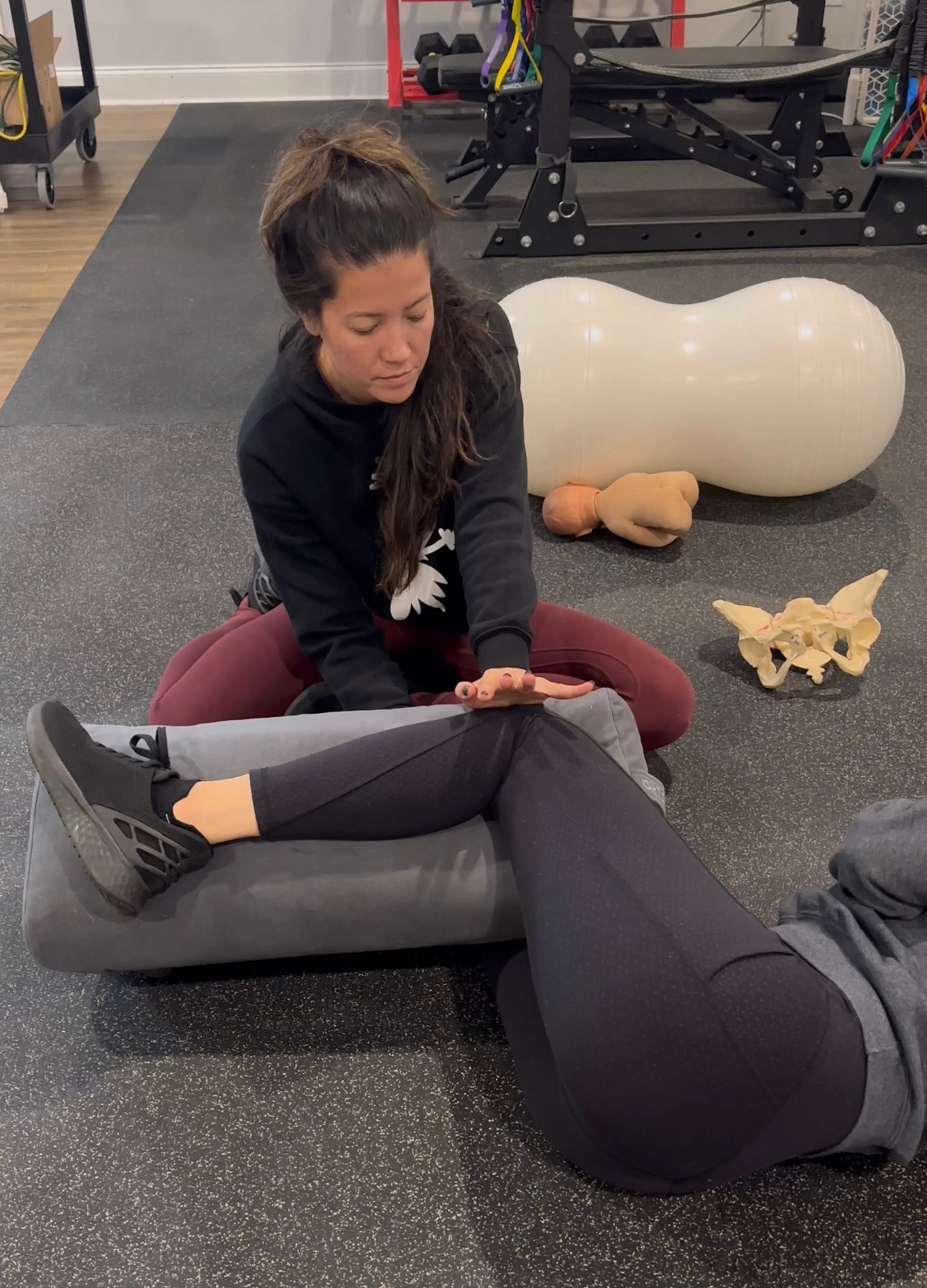
Another partner supported hip shift is the push/pull hip shift. In this position, your partner will pull on the bottom leg as they push the top leg back. This will pull your bottom leg into an open hip position (external rotation) and the top leg into a closed hip position (internal rotation and a hip shift).
You can place a pillow between the knee and ankle for support. Hold the position for about 10 full breaths.

Here is a visual of what it looks like without the pillow. The bottom hand is on the lower leg, pulling it forward, as the top hand is pushing the upper leg back. The pillow adds support, and we recommend using it for this technique!
Both of these techniques can help you FEEL what a hip shift should feel like, so you can replicate it in more upright positions!
3) All Fours Hip Shift with Pelvic Tilts
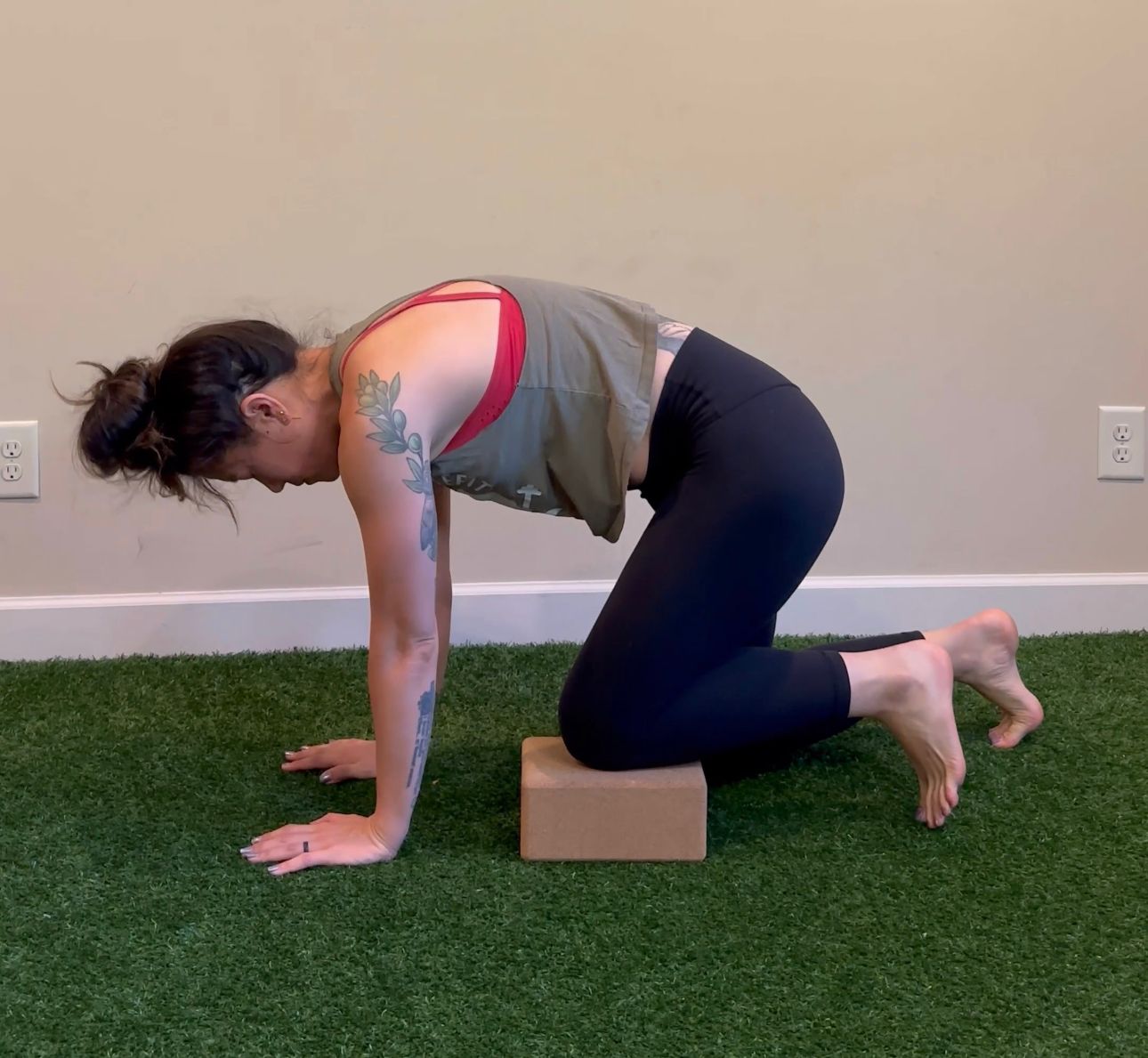
Another hip-shifted position is an all-fours position with a yoga block. The yoga block will prop the elevated hip into a hip shift, with internal rotation and adduction (closed hip).
In an all fours position, place one knee on an elevated surface such as a yoga block:
- Shift your weight over the elevated knee to feel your hip shift. You will feel more of a stretch in the elevated hip area.
- If you need to add more, press the lower knee into a wall (keeping it lower than the elevated knee), or add a mini band (see breakdown video below).
- If you want to add more movement, add in some pelvic tilts where you round and arch in the back 10 times. Then switch sides.
Watch the breakdown video of how to do this exercise! We include breakdown videos like these in our fitness programs to guide you through each of our exercises, many of which are unique to our programming.
4) Standing Hip Shift

One of my favorite hip-shifted exercises is the standing hip shift! In the standing hip shift, you are in an upright position without external props to shift into the hip. This can be more advanced, since you don’t have a foam roller or yoga block to prop your hip into the shift.
Starting in a standing position about arm’s length from a sturdy structure:
- Grab onto the sturdy structure with the opposite hand of the target leg.
- Shift your hips back into a hinge.
- Shift your weight into the target leg, which can be elevated on a yoga block for more intensity.
- Rotate your belly towards your thigh as you bend in the support leg.
- Maintain the weight shift towards the elevated foot.
- Focus on keeping weight in the big toe, as there may be a tendency to roll to the outside of the foot.
- Hold here for 10 full breaths, then switch sides.
This movement is a part of our Birth Prep Circuit! Watch the YouTube video below on how to do this exercise. This movement is also heavily incorporated into our prenatal fitness program because of how beneficial it is for birth preparation!
Hip shifting is crucial for not only your prenatal and postpartum comfort and function, but also your birth preparation! Hip shifting is when your pelvis rotates on your pelvis into a closed hip position (internal rotation with adduction and a posterior pelvic tilt). Hip shifts helps your pelvic girdle joints better form close for pelvic and hip stability; it helps your pelvic floor function more optimally; strengthens your glute; and helps to open your pelvis for birth!
Hopefully, these exercises help you better understand how to find a hip shift so you can integrate it into your daily workout (and life) routine!


Learn the science of pregnancy and birth to take the mystery of labor away! Understand why you are feeling what you feel, and learn strategies to confidently move through pregnancy and birth!
- 9h+ of Video
- Support Group
- Close Captioning

- 5 Workouts/Week
- Gym Workouts
- Self-Paced

Instructor
GINA
Workout on-demand with our prenatal fitness workout videos! Each workout is 30-40 minutes to follow along as you exercise at the same time!
- Birth Prep
- All Trimesters
- Mobility Work

Instructor
GINA
Find comfort and relief from pelvic girdle pain throughout your pregnancy and postpartum period! This program incorporates myofascial sling focused exercises to stabilize across the pelvic girdle joints.
- 3 Weeks
- On Demand Workout Videos to Follow