



These are some of the questions we frequently get about returning to fitness after birth–I have diastasis, what do I do?!
In this blog, I will define diastasis, whether you are panicking (the answer is no), and how you can approach recovery after birth as you return to fitness!
What is diastasis recti (DRA)?
Diastasis recti (DRA), also referred to as abdominal separation, is the normal separation of the six-pack ab muscles during pregnancy. This separation needs to occur during pregnancy to allow our baby to grow and for our belly to expand! If you carry your baby to term, you will have some degree of diastasis–and this is NORMAL.
After birth, diastasis tends to spontaneously heal within the first few weeks postpartum–so many of you will not really need to do much to help “heal” it after birth. But, for some, a diastasis can remain for several months or even years after birth–and we will be discussing some approaches to help with rebuilding your core in this blog.
And to debunk the first concern of whether can you even exercise with a diastasis or do you need to wait for it to heal… YES, you can exercise even if you have a diastasis! In fact, you may WANT to exercise if you have a diastasis to help with healing!
When is diastasis considered healed?
So, when is diastasis considered healed? The general guidance is if there is less than a two-finger-width gap between the six-pack ab muscles, then diastasis is healed.
It is important to remember that the rectus abdominis (six-pack ab muscles) are TWO separate muscle bellies–so these muscles are not a single sheet of muscle and there will ALWAYS be some sort of separation between the two.
Often, I will have folks DM me saying they still have a 1-finger or 2-finger gap, and they don’t know what to do. The good news is this is considered healed, and we remind them that there will always be some sort of separation because these are two different muscles that are connected by connective tissue!
But diastasis healing is more than just the gap. We also need to consider the depth of the diastasis. The depth is determined by how thick or dense the connective tissue is, and how well the connective tissue between the six-pack abs can respond to changes in pressure.
When there is increased pressure in the abdominal cavity, the connective tissues and muscles of the abdominal wall should thicken to withstand those changes in pressure. If the connective tissue is too thin, it will have more trouble maintaining its shape when pressure increases–and this can cause coning.
Abdominal coning is when the connective tissue between the six-pack abs pushes out due to increased pressure. This could happen during exercises, such as sit-ups or crunches, or even overhead presses and pull-ups.

When we are returning to fitness postpartum (and this applies during pregnancy, as well), we need to be mindful of movements that may cause abdominal coning. The reason is that excessive and repetitive coning can prevent the healing of diastasis, or even make it worse!
Here is our YouTube video that explains coning and breaks down how to modify exercises if you are experiencing coning during your workouts.
Be sure to subscribe to our YouTube channel to get notified of our newly released videos! Plus, your free subscription and views help us continue to provide free content like this to you all!
There will be a point where you should not be noticing coning with exercise, even if you are doing more core-intensive exercises, such as sit-ups and planks, and even if you are arching with overhead pressing and pull-ups! This is a good sign that your diastasis is healed and that the tissue can withstand changes in pressure!
Let’s break down HOW you can approach healing your diastasis so that you can get to this point!
How can you heal your diastasis after pregnancy?
When it comes to healing your diastasis, remember that a lot of the healing will happen spontaneously. Some of our approaches to healing postpartum involve not making things worse–this can happen with your general posture, breathing pattern, and even movement patterns–and then increasing tissue density with exercise.
As a side note, you may also want to consider scar mobilization if you had a c-section, as your c-section scar intertwines with the connective tissue of the abs which could affect healing! I have had three vaginal births, and still find that tissue mobilization of the connective tissue between my six-pack abs helps with my core activation postpartum, as well, since there was a big structural change even with just pregnancy from my belly growing!
1) Posture and Breathing Pattern

First, is how are you generally positioning your rib cage in relation to your pelvis (your posture) and how are you breathing? You’d be suprised how much these two foundational factors can impact your healing postpartum!
Many of us tend to favor a more arched back position, where our rib cage lifts upwards or flares. This position can stretch the front abdominal wall and thin the tissue. If you recall, thinner tissue is more easily manipulated by pressure changes, so this could cause more coning (which can prolong the healing timeline).
Being able to move the rib cage DOWN can support healing from diastasis. This does not mean you must maintain a neutral position ALL the time–but rather this means that you shouldn’t maintain a flared position ALL the time. We want to improve our rib cage mobility!
The next step is how are we breathing–are we primarily directing our inhales to our belly or are we expanding in our back? If you are in a more arched position, a lot of your inhales are probably directed to your belly–which again, would thin the tissue more.
If you scroll social media long enough, you’ll stumble across a reel that is showing “how to engage your core” or “how to breathe”. In these reels, there is almost always no back expansion and all of the breathing is directed to the belly. This visually makes it much easier to see how inhales = expansion, and exhales = drawing in of the belly. But, this breathing pattern can make it harder for your diastasis to heal postpartum.
One exercise that you can incorporate to help both with the posture AND the breathing pattern is back expansion breathing exercises. See the YouTube video below for a breakdown on how to do all fours back expansion breathing drill.
In this breathing drill, we are finding a more rounded back position–opposite of our common posture–and targeting our inhale to our back. This breathing drill can release common areas of tension to make it easier for you to MOVE your rib cage and spine!
Step 1 of healing from diastasis is to focus on your position–plus your ability to change position–and how are you breathing! This is the foundation for how we approach the following exercises!
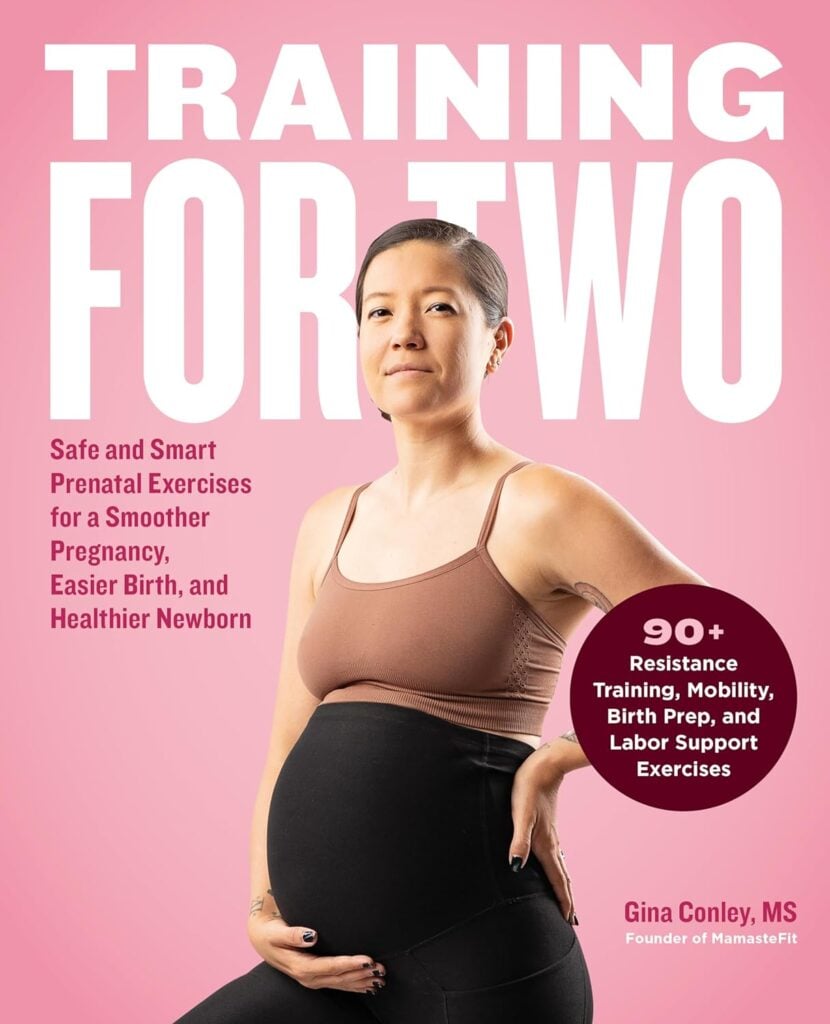
Want to learn more on how to use prenatal fitness to support a strong and pain-free pregnancy, plus exercises to release tension in the pelvic floor and open the pelvis for birth? While this book is focused on pregnancy, what we do during our prenatal workouts can impact our postpartum too!
Pre-order our book Training for Two! This book includes 90+ exercises to build your confidence as you navigate fitness throughout your pregnancy and prep for birth, plus a whole chapter on early postpartum recovery!
2) Core Stabilization: Maintain Your Position with Arm/Leg Movement
Now that we have established our foundation of position and breathing, we can begin to incorporate exercises to support core rebuilding. The beginning of core rebuilding is being able to keep our core stable as our arms and legs move aka core stabilization.
In our postpartum fitness programs, we begin with a core stabilization warm-up that includes the deadbug, side-lying hip abduction, and bird dog. These three movements challenge the core in different ways to help you rebuild your core stabilization.
In addition to maintaining your core position as you move, we are also integrating our breath-to-movement coordination. This means we are inhaling and exhaling at certain points of an exercise to help with activating our core at the correct time!
Commonly, we inhale WITH gravity or during the lengthening portion of the movement, and exhale AGAINST gravity during the harder part of the movement. Other things to consider is we want to exhale when we are extending overhead (such as with the deadbug) to help keep the rib cage down!
Here is part of our progression for the deadbug that you can do to help rebuild your core stabilization AND learn how to coordinate your breathing. In the first progression, we have limited the number of limbs moving–only one arm is moving at a time. The feet are on an elevated surface to add support. This will allow you to focus on just one arm, which is mentally much easier than arm and opposite leg.
As you reach the arm overhead, you will exhale to keep the rib cage DOWN. Then inhale to reach the arm back up to the ceiling. Repeat on the other side. Watch the video for a more in-depth break down of this exercise, plus some tips on how to activate your lower body during it, as well!
But, as will all exercise, we do want to progress the exercise to ensure that we are still challenged. If you are noticing that your diastasis healing has plateaued, it could be that you are not challenging yourself enough!
Next in our progression is arm and opposite leg are moving, BUT we have the non-moving leg supported. This addition of support helps our clients feel more “active” in the position and stable, which allows them to focus on doing the movement correctly.
In this progression, you will still exhale as the arm AND leg extend, and inhale as they return to their starting position. We still have lower body activation by driving the heel of the support leg into an elevated surface, which also aids in stability.
Now we are skipping ahead in our progression past the standard deadbug, and showing how you can continue to progress the exercise with weights and bands! As I stated before, if you are noticing your diastasis healing is not progressing, this could be why–you are not advancing your movements enough!
And an easy way to progress movements is to add weights and resistance!
If you want to return to fitness after birth, our postpartum fitness programs can be a great option for you! We have trained hundreds of postpartum athletes to reconnect with their core as they return to functional movement and sport!
Our postpartum fitness programs are offered in two main formats:
- Teambuildr App: list of exercises with short demo videos. This is a great option for those who want to workout in a gym or home gym setting and refer to workout at their own page.
- On-Demand Videos: these workouts are delivered as full length workout videos that you follow as you workout as the same time. We have a fitness and yoga variation!
You can return to fitness and feel stronger than pre-pregnancy with our programs!
3) Cross Body Exercises: Oblique and Transverse Abdominal Activation

After core stabilization, we can incorporate cross-body movements to help increase tissue density. The common focus with diastasis is to close the gap between the six-pack abs with the transverse abs, aka the corset abs. However, we also want to think about the obliques and the diagonal activation across the connective tissue!
Cross-body movements that integrate the anterior oblique sling can be really helpful to closing the gap AND increasing tissue density to decrease the depth of your diastasis to support healing.
The anterior oblique sling is a myofascial sling that runs from the chest/oblique to the opposite inner thigh–so it crosses the linea alba, the connective tissue between the six-pack abs.
One of the first cross-body exercises that you can do is a supine opposite knee press, where you are reaching across to press into the opposite knee. You can start a lot of your core rebuilding exercises in a supportive position, like the floor, to help you focus on your breathing and position!
But, we do want to eventually progress to more upright positions and exercises because we don’t live our lives on the floor! Additionally, you can begin to incorporate rotation with your exercises, as well, to activate the obliques even more.
Since adding rotation is a new element, you may want to start in a seated (supportive) position before progressing to a standing position. The reason is that you will feel more stable in a seated position as you learn the movement. Remember, we have a lot of foundational things that we are including, such as your rib cage position, how you are breathing, and then core stabilization. So, it’s a lot of little things that are building and building on top of each other!
After you feel the foundation is more second nature, you can begin to make movements more difficult by decreasing the stability of your positions!
Another rotational exercise that you can do is similar to the diagonal pull down but involves move leg movement and I find has more activation in my adductor (inner thigh).
Similar to the diagonal pull down, there are different support variations you can do with this movement such as stepping to a box so you feel more stable at the top. You can advance it by removing the box and just hovering in the outside leg at the top!
You Can Exercise with Diastasis!
There is a lot of fear surrounding diastasis during pregnancy and postpartum–but know it is NORMAL to have abdominal separation during pregnancy. We NEED our abs to separate to allow our baby to grow! And for many of us, diastasis will mostly heal spontaneously after birth.
As you return to fitness after birth, we want to focus on:
- Position of the rib cage–if the rib cage is flared upwards, it can impact diastasis healing.
- Breathing pattern–if we primarily inhale to expand only our belly, this can impact diastasis healing
- Rebuilding core stabilization and learning to coordinate our breathing to our movement
- Cross-body exercises to strengthen the obliques to support healing
- And to advance our exercises!!
Healing is realistic and possible after birth! There are so many resources out there to support you, and we are thankful to be one of them for you. If you want more support, check out our postpartum fitness programs for daily workouts that guide you through your return to fitness!
Postpartum Return to Fitness Programs

Our postnatal strength and conditioning program helps you navigate your return to fitness after the birth of your baby! Start with a rehabilitation program, then progress towards lifting weights. Feel stronger and lift heavier than ever before!
- Self-Paced
- 48 Workouts
- Teambuildr App
Instructors
GINA & CASEY
Our c-section recovery fitness program supports your healing after a cesarean birth with strength and conditioning programming. Reconnect with your core and pelvic floor! Includes access to our scar mobilization course.
- 16 Weeks
- Teambuildr App
- Lifetime Access

- 4 Workouts Week
- Teambuildr App
- Gym


Instructor
CASEY
These classes are designed to be safe to complete in the first few months postpartum but can support you throughout your motherhood journey with mobility and myofascial release.
- On-Demand
- Lifetime Access
- Support Group