



One of the most persistent myths surrounding childbirth is the belief that some women have a pelvis too small for birth. This notion can cause unnecessary fear and anxiety for expectant mothers. At MamasteFit, we aim to empower and educate women about their bodies and the birth process. Let’s dive into the facts and debunk this myth once and for all.
Why Is Your Pelvis Probably Not Too Small??
Quite a few factors contribute to how well your baby fits through your pelvis–and your pelvis being physically too small is typically not one of those reasons.
- Your pelvis is dynamic and mobile–it can move and change shape to accommodate your baby. The pelvic joints have more laxity during pregnancy. This results in increased pelvic diameters for your baby!
- Your baby can also shape shift! Pushing a baby out is NOT like pushing out a watermelon. Your baby’s skull can change shape as they move through the pelvis.
- Your baby’s head position and alignment to each pelvic level will help them fit through the pelvis.
Understanding Pelvic Anatomy
The female pelvis is designed for childbirth. It’s a robust, dynamic structure capable of adapting to facilitate the birth of a baby. Here are a few key points about pelvic anatomy:
Joint Flexibility: During pregnancy, hormones such as relaxin increase the flexibility of the pelvic joints and ligaments, allowing the pelvis to expand and adjust as needed during labor. This natural adaptation helps create more space for the baby to descend. The pelvis is not an immobile structure–it can open for your baby!
Pelvic Dimensions: The dimensions of the pelvis can change during labor due to the movement and flexibility of the pelvic joints. This adaptability is a key feature of the birthing process.
- The pelvis is more than just bone! It’s a complex system of muscles and tissues that play a crucial role in your baby’s journey through the pelvis. Understanding this can help you prepare for a smoother birth. The physical bony structure may not be ‘too small’ but there may be restrictions in the muscular path that could be addressed during pregnancy. We address common areas of tension during pregnancy with our MamasteFit Birth Prep circuit to help you create more space in your pelvis for birth.
The Role of the Baby's Position
Your baby does not maintain one position throughout all of the labor, nor is pushing your baby similar to pushing out a watermelon. Your baby rotates through the pelvis as each pelvic level shape changes and their skull molds to fit through the pelvis!
There are several movements your baby makes as they navigate through the pelvis:
Engagement: As labor begins, the baby typically engages in the pelvis, meaning their head moves into the pelvic brim. This is often referred to as “dropping” or “lightening.” Engagement is a positive sign that labor is approaching.
Descent: Throughout labor, the baby continues to descend through the birth canal. Gravity, contractions, and maternal movements help facilitate this process. The baby moves down in stages, often described by the station of the presenting part (e.g., 0 station means the baby’s head is at the level of the ischial spines).
Flexion: As the baby descends, they tuck their chin to their chest, presenting the smallest diameter of their head to the birth canal. This position, known as flexion, is the most efficient for passing through the pelvis.
Internal Rotation: During descent, the baby’s head rotates to align with the widest part of the pelvis. For most women, this means the baby’s head turns from a transverse (sideways) position to an anterior (front-facing) position. This rotation helps the baby navigate the curves of the birth canal.
Extension: As the baby’s head reaches the pelvic floor, it extends back, helping the head to emerge from the birth canal. This movement allows the baby’s face to sweep past the perineum.
External Rotation (Restitution): After the head is born, it rotates to align with the baby’s shoulders, which are still inside the mother. This movement is necessary for the shoulders to navigate through the pelvis.
Expulsion: Finally, the baby’s shoulders and body are born. Once the shoulders pass, the rest of the body follows quickly.
Skull Molding During Labor
A newborn’s skull is uniquely designed to adapt to the pressures of childbirth. Here’s how the skull molds during labor:
Fontanelles: The baby’s skull has soft spots called fontanelles, where the bones have not yet fused. These areas allow the bones to overlap and compress during labor, facilitating passage through the birth canal.
Sutures: The skull bones are connected by flexible joints called sutures. These sutures allow the bones to move and overlap during labor, a process known as molding. Molding can temporarily change the shape of the baby’s head, making it more elongated or cone-shaped immediately after birth.
Compression and Expansion: As the baby moves through the birth canal, the head experiences compression. The flexibility of the sutures and fontanelles allows the skull to change shape in response to these pressures. Once the baby is born, the head will gradually return to its normal shape over the next few days or weeks.
Your baby’s skull literally shape shifts to fit through the pelvis!

The Impact of Movement and Positioning During Labor
You can support your baby’s movements and facilitate the birthing process through various techniques:
Movement and Positioning: Staying active and changing positions during labor can help create more space in the pelvis and encourage the baby to move into an optimal position. Walking, swaying, using a birthing ball, and trying different labor positions can all be beneficial.
Gravity-Friendly Positions: Upright positions, such as standing, kneeling, or squatting, use gravity to help the baby descend. These positions can also reduce the length of labor and increase comfort.
Pelvic Mobility Exercises: Prenatal exercises that enhance pelvic mobility, such as hip circles and pelvic tilts, can prepare your body for labor and support the baby’s movements through the birth canal.
Relaxation Techniques: Stress and tension can hinder labor progress. Practicing relaxation techniques, such as deep breathing, visualization, and mindfulness, can help you stay calm and allow your body to work efficiently during labor.
The pelvis is divided into three distinct levels: the inlet, the mid-pelvis, and the outlet. Each level has unique anatomical features that can influence the baby’s descent during labor. Each pelvic level opens with different movement patterns–understanding these movement patterns can make it easier for your baby to navigate your pelvis!
We incorporate birth preparation exercises in our prenatal fitness programs and our birth prep workout program to prepare you to open each pelvic level for birth!

The Pelvic Inlet: The Top of the Pelvis
Anatomy
The pelvic inlet is the uppermost part of the pelvis, forming the entrance through which the baby descends into the birth canal. It is shaped like an oval and bordered by the sacral promontory at the back and the pubic symphysis at the front.
Creating Space with Movement
To create space in the pelvic inlet, movements that widen the upper pelvis are beneficial. Here are some techniques:
- Forward-Leaning Positions: Positions such as hands and knees, leaning over a birthing ball, or standing while leaning on a counter can help tip the pelvis forward and widen the inlet.
- Pelvic Tilts: Gentle rocking or tilting of the pelvis while on hands and knees can help encourage the baby to engage in the pelvis.
- Squats: Deep squats can open up the pelvis and allow gravity to assist in bringing the baby down into the inlet.

The Mid-Pelvis
Anatomy
The mid-pelvis is the narrowest part of the birth canal and is located at the level of the ischial spines. It is where the baby’s head typically rotates to align with the mother’s pelvis.
Creating Space with Movement
To create space in the mid-pelvis, movements that increase the diameter and flexibility of this region are helpful. Techniques include:
- Lateral Lunges: Lunging to the side with one leg can help open up the mid-pelvis, especially when alternated between legs.
- Asymmetrical Positions: Positions like a lunge with one foot up on a chair or a step can create space in the mid-pelvis by tilting and rotating the pelvis.
- Sitting on a Birthing Ball: Gentle bouncing or circular hip movements while seated on a birthing ball can help keep the pelvis mobile and flexible.

The Pelvic Outlet: The Bottom of the Pelvis
Anatomy
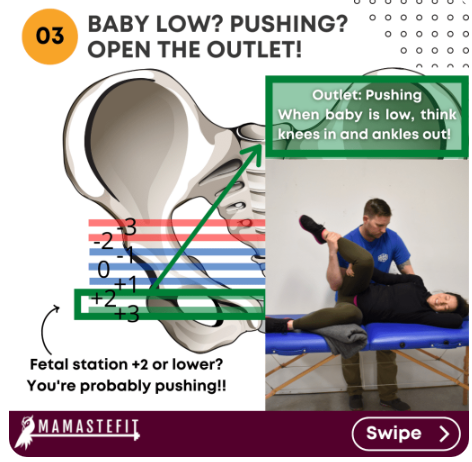
The pelvic outlet is the lower part of the pelvis and forms the exit through which the baby is born. It is wider from front to back than from side to side.
Creating Space with Movement
To create space in the pelvic outlet, movements that widen the lower pelvis and open the birth canal are key. Techniques include:
- Squatting: Hinge squats where the hips are higher than the knees, either supported by a partner or using a birthing stool, can help widen the outlet and use gravity to assist in the baby’s descent.
- Kneeling Positions: Kneeling with the knees in and ankles out, prompting internal hip rotation, can create more space in the bottom of the pelvis.
- Side-lying: You can find internal hip rotation in a side-lying position, as well, to allow the sacrum to move as you push!
Why CPD is Overdiagnosed
Cephalopelvic Disproportion (CPD) is often overdiagnosed due to a combination of factors including misinterpretation of labor progress, overly cautious medical practices, and a reliance on outdated criteria for assessing pelvic dimensions. Many cases diagnosed as CPD actually stem from non-medical issues such as poor maternal positioning during labor, ineffective contractions, or the baby’s suboptimal position rather than an actual size mismatch between the baby’s head and the mother’s pelvis. Additionally, the fear of potential complications can lead healthcare providers to opt for cesarean sections preemptively. This cautious approach, while well-intentioned, contributes to higher rates of CPD diagnosis and cesarean deliveries, despite many women being capable of vaginal birth with proper support and management. Education on labor techniques, encouraging movement, and patient-specific care can help reduce the unnecessary diagnosis of CPD and promote more natural birth experiences.
Your Pelvis Is Likely NOT Too Small!
Your body is designed for childbirth. Trust in your body’s ability to birth your baby and focus on the following:
Prenatal Fitness: Engage in exercises that strengthen your pelvic floor and core, enhancing your body’s ability to support and facilitate labor. Our MamasteFit prenatal fitness programs are tailored to help you stay strong and prepare for birth.
Birth Education: Educate yourself about the stages of labor, different birthing positions, and pain management techniques. Knowledge is empowering and can help you make informed decisions during labor.
Support System: Surround yourself with a supportive birth team, including a doula, midwife, or obstetrician, who respects your birth plan and provides guidance and encouragement.
Trust Your Body: Your Pelvis Is Built for Birth
The myth that your pelvis is too small for childbirth is just that—a myth. With the right preparation, support, and understanding of your body’s capabilities, you can confidently approach labor. At MamasteFit, we’re here to support you every step of the way. Join our community, take advantage of our prenatal fitness programs, and empower yourself with knowledge and strength for a positive birthing experience.
For more tips and insights on pregnancy, childbirth, and postpartum recovery, visit MamasteFit and subscribe to our YouTube channel.
Stay empowered, stay informed, and trust in your body’s incredible ability to bring new life into the world.