



Training hip internal rotation has quickly become the “new Kegel” in the movement and pelvic floor world. Everywhere you look, people are talking about hip mobility drills, 90/90 transitions, and exercises designed to improve hip internal rotation as the missing key to pelvic floor function, stability, and movement quality. There is a good reason for that.
Hip internal rotation plays a huge role in how we walk, run, shift weight, absorb force, and stabilize throughout movement. During gait, the non-stance leg, or the leg swinging through the air, relies on a coordinated combination of hip internal and external rotation, abduction and adduction, and flexion and extension to move forward efficiently while the pelvis remains relatively stable over the stance leg. Without adequate rotational movement at the hip, the body often compensates somewhere else, usually through excessive pelvic shifting, gripping, dropping, twisting, or stiffness through the low back and pelvic floor.
However, while hip internal rotation can absolutely be a missing piece in someone’s movement routine, there is another layer to this conversation that often gets overlooked: pelvic rotation. Hip internal rotation and pelvic internal rotation are not the same thing biomechanically, even though they are closely related and often occur together during movement. Many exercises currently being promoted online as “hip internal rotation exercises” are actually driving movement primarily through the pelvis instead of the hip joint itself.
Understanding the difference matters because the pelvis is not simply a rigid bowl sitting on top of the legs. It is a dynamic structure designed to transfer force between the trunk and lower body while adapting to breathing, gait, load transfer, pressure management, and, in pregnancy and birth, changing pelvic dimensions.
In this blog, we are going to break down the difference between hip internal rotation and pelvic internal rotation, why both matter for pelvic floor function, how they work together during walking, exercise, and birth mechanics, and how to train both in a way that improves movement quality rather than simply chasing mobility for the sake of mobility.
Hip Internal Rotation vs Pelvic Rotation
The hip moves in eight directions, although six are more commonly associated with hip mobility: hip flexion, extension, abduction, adduction, internal rotation, and external rotation. However, I also include pelvic internal and external rotation as a part of the movement options we need to access through the hip and pelvis system.
Hip rotation tends to relate more to the motion of the femur moving within the acetabulum (hip socket) of the pelvis during non-stance or open chain positions. So when you are in the swing phase of your gait cycle, the hip is moving through internal and external rotation in addition to the other hip motions as the leg moves through space.
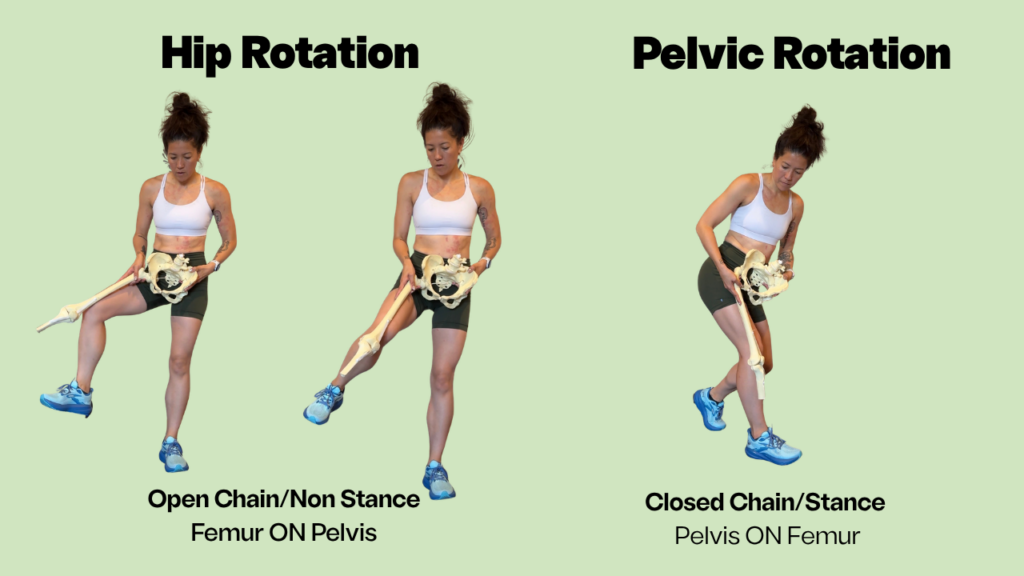
Pelvic rotation, however, relates more to how the pelvis moves on the femur during closed chain or stance positions. This corresponds more with the stance phase of gait. When the foot is planted on the floor, the femur is relatively fixed, and the pelvis rotates on top of the femur to accommodate the next step in the gait cycle.
We need both hip rotation and pelvic rotation to walk comfortably and efficiently, in addition to supporting functional movement patterns. Since the pelvic floor plays a foundational role in our stability system as a part of the deep core, hip and pelvic mobility both play a large role in how the pelvic floor functions.
Pelvic Floor Function and Pelvic Positioning
Now let’s talk about how the pelvic floor relates to the positioning of the pelvis.
The pelvic floor is a sling of muscles that sits at the bottom of the pelvis. It works as a part of the deep core system alongside the diaphragm, multifidus, transverse abdominis, and internal obliques to help support pressure management, spinal stabilization, postural control, continence, and force transfer throughout movement.
The pelvic floor attaches directly to the pelvis itself. The pelvis is made up of the innominate bones, sacrum, and coccyx, which are all connected through the pelvic joints. Previously, the pelvis was often viewed as a relatively immobile structure that simply served as a stable base for the spine and hips to move on top of. However, we now understand that the pelvic joints do have some movement capability, although the movements are relatively small.
The SI joints and pubic symphysis are capable of subtle movements and positional changes that occur in response to breathing, gait, load transfer, and force distribution. While these positional shifts are often only measured in millimeters or a few degrees, that does not make them insignificant biomechanically.
The pelvic floor itself is only a few millimeters thick in certain regions, although thickness varies throughout the pelvic floor musculature. Because the pelvic floor directly attaches to the pelvis, even small positional changes at the pelvis can influence tension relationships throughout the pelvic floor muscles and surrounding connective tissues.
When demonstrating pelvic mechanics with a pelvic model, we often exaggerate the movement because a 2–3 millimeter shift is very difficult to visually appreciate. If we demonstrated the exact amount of movement occurring during gait or weight shifting, it would likely be nearly impossible to see. So while educational demonstrations may appear exaggerated, the goal is usually to help visualize the directional changes and force relationships occurring throughout the pelvis.
Even though the actual movements are relatively small, these positional shifts still influence the pelvic floor through force and moment. In biomechanics, a moment refers to the rotational force or torque acting on a joint or tissue system, even if large visible movement is not occurring.
For example, during a plank, your body is not moving up and down, yet the exercise is still challenging because your muscles are resisting forces trying to pull the hips and spine into extension. There is an extension moment acting on the body, while the muscles generate opposing forces to maintain position.
The pelvis functions similarly. Even small positional changes at the pelvis can alter rotational torque, muscular tension, and force distribution throughout the pelvic floor and surrounding muscles. The innominates are capable of subtle positional changes involving internal and external rotation, anterior and posterior tilt, and relative abduction and adduction in a triplanar manner.
For example, during gait, the pelvis alternates between internal and external rotation as we move through stance. Early stance tends to involve more internal pelvic rotation with relative adduction and slight posterior pelvic tilt. As we progress through midstance into toe off and hip extension, the pelvis moves toward external rotation with relative abduction and anterior pelvic tilt.
Meanwhile, the opposite leg is moving through the opposite pattern as it swings through the air. As the swing leg drives into hip flexion, it moves through external rotation and abduction before transitioning back toward internal rotation as it prepares for the next stance phase.
It is important to remember that pelvic adduction and abduction relate to the movement of the pelvis itself, while hip adduction and abduction refer to the movement of the femur. Pelvic adduction typically accompanies internal pelvic rotation and relates to the innominate moving more toward midline, whereas hip adduction refers to the femur moving toward midline.
When there are limitations or asymmetries in pelvic rotation during stance, this can contribute to issues such as pelvic pain, feelings of instability, stiffness, or compensatory gripping patterns throughout the hips and pelvic floor.
We have had a lot of success helping clients improve pelvic pain and movement quality by incorporating exercises that enhance pelvic rotation and pelvic adaptability. Many of these movements are included in our Core, Pelvic Floor, and Pelvic Stability program, which includes 30 progressive workouts designed to support pelvic floor balance, pelvic stability, strength, and deep core coordination during pregnancy and postpartum recovery.
Exercises for Hip Rotation vs Pelvic Rotation
Now that we have a better understanding of the difference between hip rotation and pelvic rotation, let’s discuss how to actually train both.
Hip rotation exercises are typically more open chain and non-loaded positions. These include mobility-focused movements such as 90/90 shin box transitions, where one hip is moving into internal rotation while the other moves into external rotation. Open chain strengthening exercises such as fire hydrants and resisted hip rotation movements also focus more directly on the femur moving within the acetabulum.
It is also important to recognize that hip rotation rarely occurs in isolation. Most movement occurs in a triplanar manner, meaning multiple motions are occurring simultaneously across different planes. Internal rotation is often occurring alongside flexion, adduction, rather than as a purely isolated motion.
Pelvic Rotation Exercises
Pelvic rotation exercises, on the other hand, focus more on closed chain or stance-based positions where the pelvis is moving on top of the femur. In these positions, the foot is anchored to the ground while the pelvis rotates and shifts relative to the fixed femur.
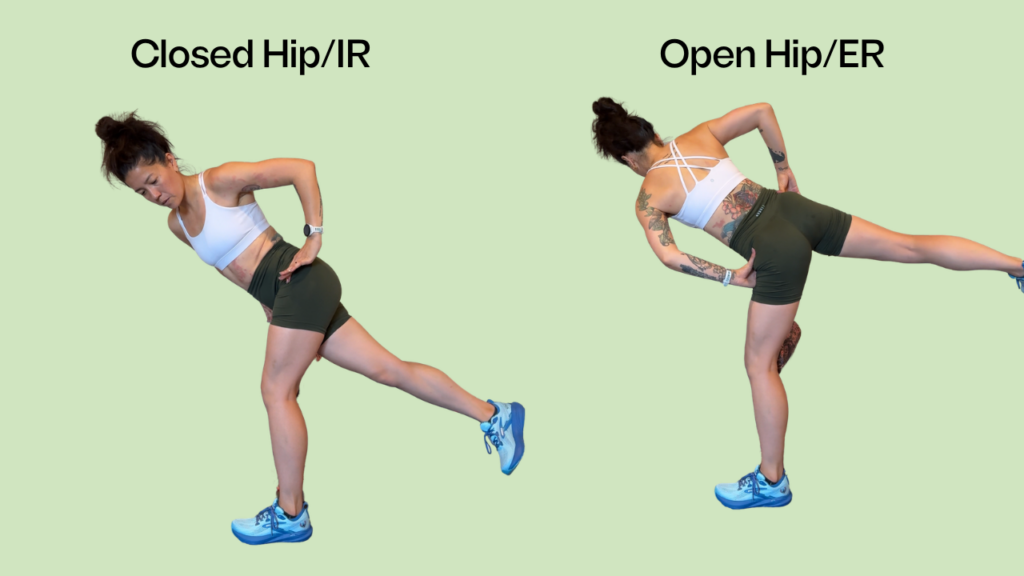
One of my favorite pelvic rotation exercises is the hip airplane. In this movement, one leg remains in stance while the pelvis rotates between a more open and closed hip position. The stance leg acts as the anchor point while the pelvis rotates on top of the femur. I often like using a foam roller positioned inside the knee to help provide feedback and support positioning.
Hip Shifts
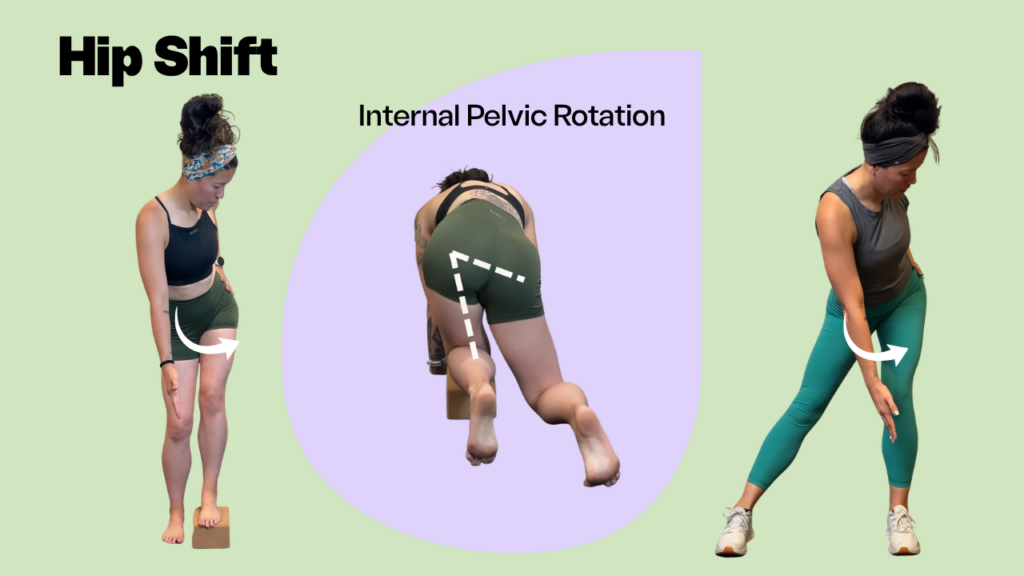
Other useful pelvic rotation exercises include hip shifts in quadruped or standing positions, as well as lateral hip shifts. These mobility exercises target different quadrants of the pelvic floor while moving the pelvis into internal and external rotation on the femur. The primary movement is the pelvis moving ON the femur, but this rotation also creates rotational torque through the pelvic joints, causing the innominate bones to shift in a triplanar pattern with internal rotation, adduction, and posterior tilt on the hip-shifted side.
Pelvic Rotation Strengthening Exercises
In addition to pelvic mobility, closed-chain strengthening exercises can be incorporated into a workout routine to train pelvic rotation. Unilateral exercises that focus on single-leg or staggered-stance positioning can incorporate pelvic rotation, such as staggered-stance RDLs, lunges, and even step-ups.
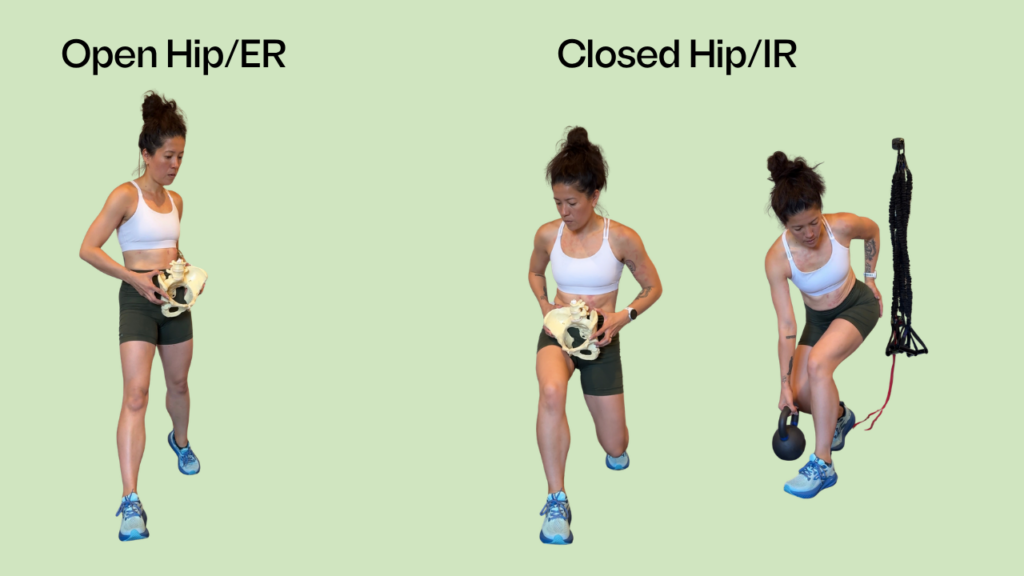
In each single-leg or staggered-stance exercise, as you lower into more hip flexion, you will internally rotate the pelvis on the femur toward the working leg. As you move into more hip extension during the ascent of the movement, you will externally rotate the pelvis away from the femur on the working leg. While moving up and down, the key is that the femur remains in a fixed position and the weight stays in the working leg. There may be a tendency to shift your weight into the support leg if there are limitations in pelvic mobility. Think about keeping weight through the big toe, allowing the knee to track with the ankle, and maintaining most of your weight in the working leg.
Conclusion
While the majority of the movement in these exercises involves the pelvis moving on the femur, there are still subtle positional changes occurring throughout the pelvic joints themselves. These changes are not nearly as dramatic as the larger movement of the pelvis relative to the femur, but they still influence force transfer, muscular tension, and pelvic floor mechanics throughout movement.
You can incorporate both hip and pelvic rotation exercises into your workout routine to support pelvic floor function during both pregnancy and postpartum. At MamasteFit, we intentionally incorporate pelvic rotation and hip rotation into every single workout within our prenatal and postpartum fitness programs because these movement patterns are essential for pelvic mobility, pelvic floor function, strength, and overall movement efficiency throughout motherhood.
Whether you prefer a self-paced strength training format or follow-along video-based workouts, we offer both options to fit your workout style and schedule. Our programs are designed specifically for pregnancy and postpartum, not just modified general fitness programs, to help you feel strong, capable, and supported through every stage of motherhood.
You can try a free sample of our prenatal fitness program here and a free sample of our postpartum fitness program here. If you are ready for more structured support, daily workouts, and guidance that intentionally trains the pelvis, pelvic floor, and entire body together, join our programs today!