
Table of Contents
The horizontal pull movement during pregnancy is typically a rowing type movement that focuses on building the musculature of the back. Strengthening the musculature of the back support maintaining optimal posture by helping to counter the shift up and out of the center of gravity as the belly grows. That’s why rows are one of our go-to back exercises while pregnant!
In addition, a strong back will help mothers in the postpartum when their babies are earth side to carry, hold, and move with their babies without compensating in the postural habits. Compensations in our postural habits tend to lead towards pain and discomfort, so alleviating those issues with strength training can help mothers stay functional in the postpartum.
All trimester recommendations are general guidelines that we have found to work well for our prenatal clients. As a disclaimer these guidelines should not be considered the set-in stone standard for every pregnant woman as every pregnancy is unique. Our recommendation is to adjust the variation of the exercise based on how you feel each day. Pregnancy is a state of growth, both in body and mind. Allow this time to be an opportunity to explore new movement without competition or performance expectations.
Back Exercises While Pregnant: 1st Trimester
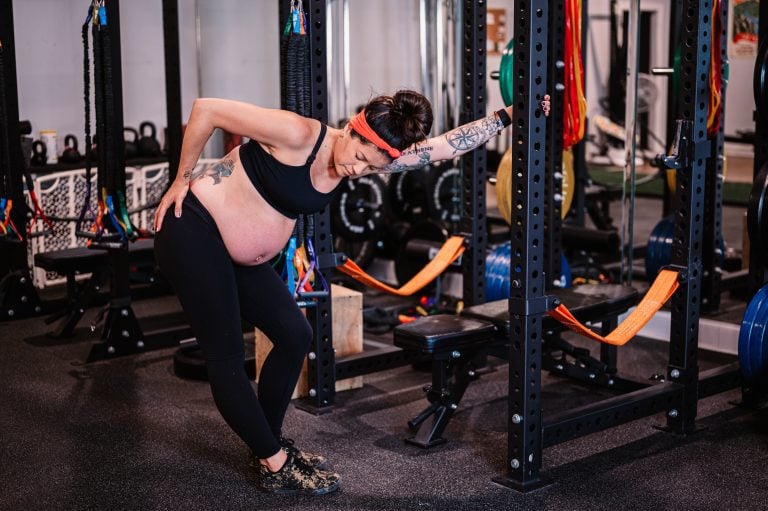
During the first trimester, most lifts look the same as pre-pregnancy. We recommend to decrease loading to 70% of your 1RM or rate of perceived effort. Our prenatal programming includes 2-4 sets of 8-12 reps with a muscular endurance focus in order to support postural adaptions due to pregnancy. We pair our horizontal pull or rowing movements with a core stability exercise such as pallof presses, opposite pulls, or bear crawls.
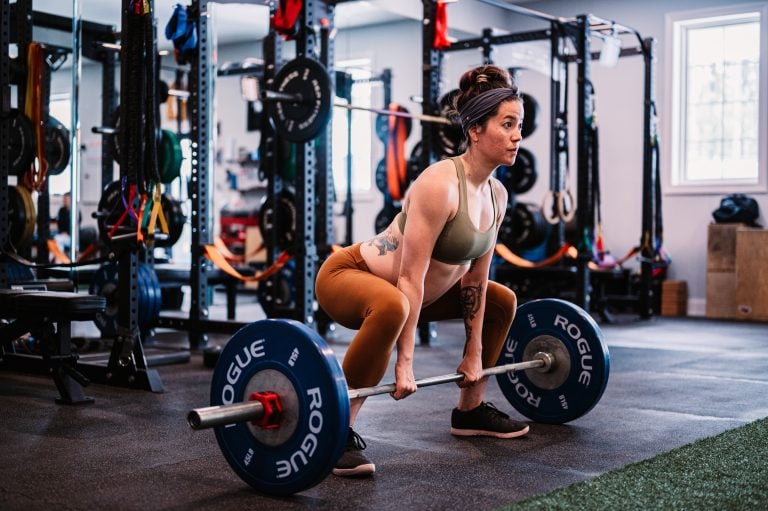
In the first trimester, we tend to program bent over rows as the belly does not impede the bar path into the torso. However, any of our horizontal pull variations would be appropriate for this trimester. With bent-over rows, we suggest incorporating a resting position at the bottom of the lift with safety straps or boxes to help relieve any tension in the low back.
Relaxin is in its highest concentration during the first trimester. While research has been controversial with respect to the effects that relaxin has on joints during pregnancy, and whether or not it contributes towards increased laxity, we still recommend transitioning to strict and controlled movements during this trimester.
 On-demand video · 128 workouts
Prenatal Workout On-Demand
Follow-along workouts from week 5 to week 41, four or five a week with guided warm-ups and cool-downs — over 128 sessions coached in real time alongside the video.
Learn more
 App program · 40 weeks
Prenatal Strength Training
A gym-based program that syncs to your current week of pregnancy — four strength sessions plus one pelvic stability workout a week, with demo videos for every exercise.
Learn more
 On-demand video · 30 workouts
Core, Pelvic Floor & Pelvic Stability
Thirty follow-along workouts across beginner, novice, and advanced levels, ten per level — core and pelvic floor strength for pain relief in pregnancy or postpartum.
Learn more
2nd Trimester
As your belly begins to impede the bar path, we suggest transitioning to dumbbells. We program the dumbbell bent-over row during the second trimester. An acceptable option is to bring the dumbbells down to boxes in between reps to help relieve any tension at the bottom of the rep during movement.
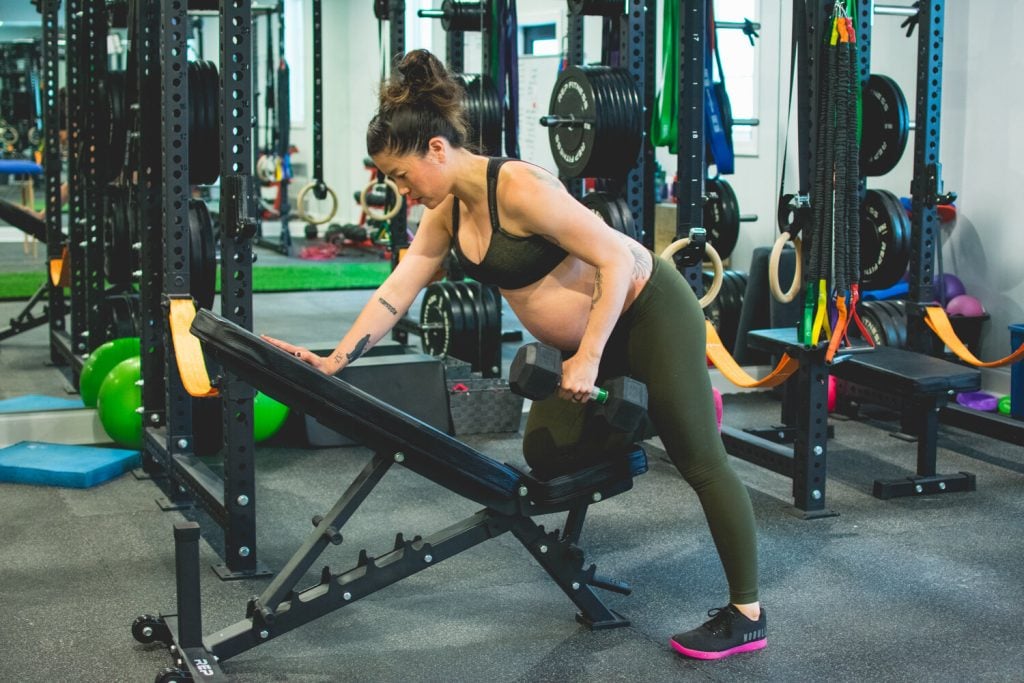
Another variation is to do a single-arm row either with a support, such as a bench or without support.
Ring rows or inverted rows are another horizontal pull option, but be mindful of any abdominal coning that may be occurring during the movement. Since the back is towards the ground, during the inverted row and ring row, the cervical spine has to resist anti-extension and usually comes into a more flexed position. This flexed position may result in a crunching or strain in the abdomen that results in abdominal coning. If you experience abdominal coning, and focusing on breath and position does not help to alleviate it, then the movement should be paused until postpartum.
3rd Trimester
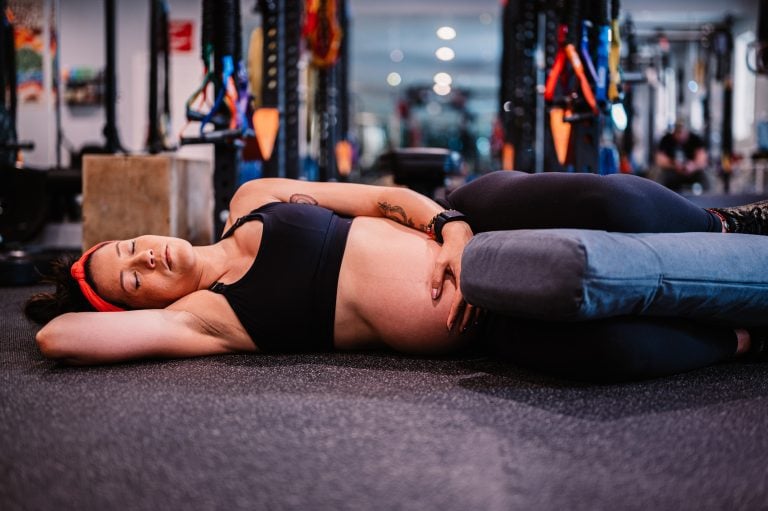
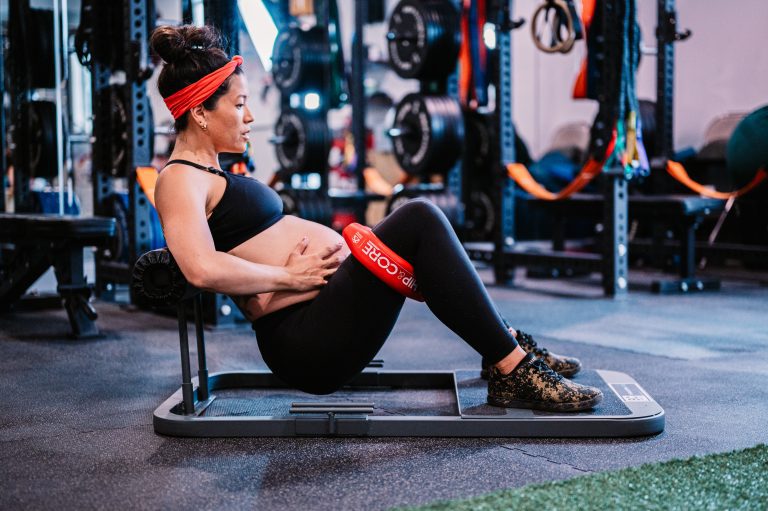
During the third trimester, we tend to transition to a more upright position with horizontal pulls. Our trimester options include the seated row (see image) with a Gertie ball or deflated kids’ ball under the pregnant mom’s butt to help keep the pelvis neutral. You could also use a rolled-up yoga mat that is placed horizontally along the back of mom’s pelvis to help keep it in a neutral position. Another horizontal pull option is the seated banded or cable row.

During this trimester, we tend to find that moms need more support in bent-over movements, so we like to use the incline bench to help provide additional support when performing a single-arm dumbbell row.
Pay attention to how the movement feels for your body rather than how hard the movement is. Do you feel pulling or strain in your abdomen or back? Is the position comfortable to be in? Do you feel confident in the lift? Use this opportunity to really sync up with your body and actually listen to what it is telling you.
 Bundle · lifetime access
MamasteFit Bundles
Combine courses and programs for lifetime access and save up to 15% — grouped for birth preparation, the third trimester, or the whole pre and postnatal journey.
Learn more
 App program
Train for a Marathon After Baby
Progressive run workouts and strength training from 5K to the marathon finish — long runs, tempo work, easy miles, and a weekly pelvic stability session.
Learn more
 Video course · 9+ hours
Childbirth Education
Over nine hours of video on contractions, comfort measures, pushing, and recovery — so you walk into labor knowing what's happening and what your options are at each stage.
Learn more