
Navigating the physical changes of pregnancy can be challenging, but with a solid prenatal fitness plan, you can build the strength you need to support your body and avoid unnecessary pain. Whether you’re a fitness enthusiast or new to exercise, understanding the essentials of prenatal fitness will help you stay strong, reduce discomfort, and prepare for a smoother labor and recovery. In this blog, we’ll guide you through the exercises and strategies that are essential for maintaining strength and comfort throughout your pregnancy.
Table of Contents
Understanding the Physical Changes During Pregnancy
Pregnancy brings about significant physiological and biomechanical changes that affect virtually every system in your body. These adaptations, from the cardiovascular to the musculoskeletal system, are essential for supporting your growing baby. Still, they can also lead to common discomforts such as back pain, pelvic pain, and fatigue. For example, as your belly grows and your center of gravity shifts, you may experience changes in your posture and balance, increasing the risk of falls and musculoskeletal pain. Additionally, hormonal changes, particularly the release of relaxin, cause your joints to become more flexible, which, while necessary for childbirth, can lead to joint instability and discomfort.
Engaging in regular prenatal fitness can be incredibly beneficial in managing these changes and mitigating discomfort. Exercise helps strengthen the muscles that support your joints, improving stability and reducing pain. For instance, strengthening your core and pelvic floor can alleviate lower back pain and enhance your body’s ability to support the growing weight of your baby. Furthermore, maintaining cardiovascular fitness can improve circulation, reduce swelling, and increase your energy levels, counteracting the fatigue that often accompanies pregnancy.
During pregnancy, both the cardiovascular and respiratory systems undergo significant changes to support the growing demands of your body and your baby. Regular exercise can further enhance these adaptations, leading to additional benefits. For instance, prenatal exercise can increase blood volume by an additional 10 to 15 percent beyond the natural increase that occurs during pregnancy, improving the efficiency of oxygen and nutrient transport throughout the body. This enhanced blood volume helps ensure that both you and your baby receive the necessary oxygen and nutrients during physical activity and throughout the day. Additionally, exercise improves the volume of blood pumped with each heartbeat, enhancing overall cardiovascular efficiency. On the respiratory side, while pregnancy naturally increases the depth and rate of breathing by up to 50 percent, exercise further optimizes the body’s ability to use the increased oxygen supply more efficiently. This improvement in oxygen usage can boost your endurance and reduce feelings of breathlessness, making it easier to stay active and comfortable throughout your pregnancy
Adopting a comprehensive fitness routine that includes strength training, flexibility exercises, and cardiovascular activities can help you stay strong, mobile, and comfortable throughout your pregnancy. This variety ensures that you are not only supporting your own health but also preparing your body for labor and a smoother postpartum recovery. As highlighted in Training for Two, these exercises can enhance your body’s ability to adapt to the physical demands of pregnancy, leading to a healthier and more comfortable experience.
Musculoskeletal System: Changes to Your Posture and Stabilization
One of the more notable changes is the shifts in your musculoskeletal system, which can be mitigated by strength training throughout your pregnancy.
In the musculoskeletal system:
- There is increased mass from pregnancy, which increases mechanical stress. This stress can be alleviated by strengthening the support musculature throughout pregnancy.
- The center of gravity shifts forward and upward as the belly grows. This shift can alter your posture and stabilization patterns. This can be countered by strengthening the posterior chain (back side of your body) to maintain an upright position better.
Because of these shifts in the musculoskeletal system, plus the increase in the hormone relaxin, there are common postural tendencies during pregnancy that can result in increased pelvic pain, pelvic floor dysfunction, and overall discomfort. These postural tendencies include more external hip rotation (toes out), anterior pelvic tilt (arched back), and weight shifting to the right leg (right stance).


Pain is NOT a requirement of pregnancy. While pain and discomfort may be common, they are not mandatory, and you can incorporate many exercises into your prenatal workout routine to prevent or alleviate prenatal discomfort or pain! In this blog, we will breakdown several pelvic stability and pelvic floor exercises to help you stay pain-free throughout your pregnancy.
The MamasteFit Birth Preparation Circuit is a carefully designed series of exercises that focuses on releasing common areas of prenatal tension, ultimately making it easier for your baby to rotate and move through the pelvis during labor. This circuit emphasizes movements that facilitate internal rotation of the hip and a posterior pelvic tilt, which are crucial for creating space in the pelvis and optimizing the baby’s position for birth. This circuit prepares the pelvis and releases tension in the posterior pelvic floor by incorporating forward-leaning inversions, back expansion breathing drills, and hip-shifted pelvic tilts. Practicing this circuit regularly, starting after 20 weeks of pregnancy, can be instrumental in achieving a smoother and more comfortable labor experience.
Grab the free PDF guide below by signing up for our newsletter!
Essential Prenatal Exercises for Strength and Pain Relief
In this section, I’ll be breaking down different types of exercises you should include in your prenatal routine to stay strong and pain-free (and prepare for birth) from my book Training for Two.
You may be nervous about lifting weights throughout pregnancy, but there is no increased risk of lifting weights for you or your baby! ACOG, the governing body of obstetricians, even recommends resistance training during pregnancy!
However, some modifications will likely need to be taken as pregnancy progresses for your comfort and to help you maintain optimal form during your lifts. Let’s quickly overview HOW to approach modification throughout pregnancy so you have a starting point on HOW to adjust your workouts to stay safe.
When should you modify your lifts:
- Your form is less than optimal
- You are failing your lift or needing to bail the bar
- You feel increased pelvic pressure or bearing down–you can’t maintain your breathing pattern without symptoms.
- You are uncomfortable during your lift
- You feel that you are not able to physically get into a position because of pregnancy
How can you modify your lifts:
- Decrease loading or intensity. Aim for 70-80% effort levels for your workouts in the first and second trimesters. This is a moderate intensity level, so it is still challenging, but you can usually maintain your form and pressure management. In the third trimester, you may need to decrease effort levels to 50-60%, which may be more of an easy to moderate intensity level.
- Widen the stance to make space for the belly. This is common in lower body exercises! If you are squatting or deadlifting, you may find a wider stance is more comfortable.
- Decrease range of motion. This means bringing the bar to you, usually by elevating the bar from the floor or lowering to a box during the squat.
- Adapt your breathing pattern to protect your pelvic floor. This means adjusting HOW you breathe to accommodate how well you can manage pressure and lift.
- Outside of pregnancy, you may be able to maintain high levels of intraabdominal pressure, which allows you to lift much heavier.
- However, during pregnancy, your ability to maintain high levels of IAP diminishes as your pregnancy progresses. This is the main reason we need to decrease loading during pregnancy–your ability to stabilize heavy loads decreases because of those musculoskeletal changes.
- Watch the YouTube video below for more of a breakdown of how to adjust your breathing pattern to support your prenatal lifts.
We break down how to modify each lift in Training for Two and walk you through modifications for each trimester in our prenatal fitness programs.
Lower Body Strengthening Exercises
1) Deadlifts: Bilateral Lower Body Exercise


The deadlift and hinge-focused exercises are incredible for pregnancy! The hinge-focused exercise strengthens the hamstrings, which tend to lengthen during pregnancy due to common postural tendencies. Strengthening the hamstrings improves our ability to find a posterior pelvic tilt and internal pelvic rotation, which is necessary to create space in our pelvic outlet for birth. It also strengthens the posterior chain to help counter the shift in the center of gravity.
In the first and second trimesters, you may be able to maintain a conventional stance for the deadlift. But at some point in the second trimester, you may need to widen to a sumo stance or elevate the bar on blocks/plates to decrease the range of motion. You can use a barbell deadlift throughout pregnancy or modify it to free weights or bands in the third trimester.
Watch this video for some examples of how to modify the deadlift for your pregnancy.
2) Staggered Stance RDL: Unilateral Lower Body Exercise
In addition to bilateral stance lower body exercises, you should incorporate unilateral (one-sided) lower body exercises. One-sided lower body exercises allow you to include hip rotation to improve glute and pelvic floor function and hip mobility. You may find that adding internal hip rotation to your single-legged exercises helps to alleviate pelvic pain.


The staggered stance RDL with a banded row is a great lower-body exercise for your prenatal routine. This exercise also targets the hamstrings as a hinge-focused movement, but adding hip rotation from a closed to open hip position improves pelvic stability.
In this exercise:
- Reach forward with the band as you hinge the hips back into the bottom of the RDL.
- As you hinge the hips back, rotate the belly towards the forward thigh to find a closed hip position (internal hip rotation).
- Exhale to extend in the hip as you rotate to face forward with the hips and row the band back.
- Inhale to return to the starting position by reaching forward with the band and finding internal hip rotation as you hinge the hips backward.
I am using the Crossover Symmetry shoulder system for the banded work in this blog. They are our personal favorites in our gym for our clients.
If you want more daily workouts to support a strong pregnancy as you prepare for birth, join our online prenatal fitness programs!
MamasteFit is unique in that we are one of the ONLY prenatal/postnatal training facilities in the United States. We develop our workout programs from our experience of working with in-person pre/postnatal fitness clients and work closely with physical therapists to refine our programming. In addition, we are birth workers, so we combine our experience as perinatal fitness trainers and birth professionals to ensure that our programs actually support your birth preparation and recovery!
Our prenatal fitness programs are offered in several formats:
- 40-Week Prenatal Strength Program in the Teambuildr App:
- This program is a self-paced workout with shorter demo videos. This is ideal if you like to workout in a gym setting and prefer a traditional workout delivery format.
- This program syncs to your current week of pregnancy, so you can start anytime, with one-time payment or month-to-month payment options.
- This program has a full and mini version, depending on how much time you have to dedicate to workouts!
- Prenatal On-Demand Fitness Program:
- If you prefer to follow a video as you workout at the same time, this workout program will be the best option!
- This program syncs to your current trimester, so you can grab the trimesters you need!
- Birth Prep Workout Program:
- If you already have a workout routine or you only want birth prep-focused workouts, check out this program!
- This program includes full-length workout videos to follow as you workout at the same time.
- Prenatal Yoga Classes:
- If you want prenatal yoga, join our prenatal yoga program! This also syncs to your current trimester.
Upper Body Strengthening Exercises
Upper body and back strengthening exercises are crucial during pregnancy because they help maintain proper posture, reduce the risk of back pain, and prepare your body for the physical demands of motherhood.
As your pregnancy progresses, the weight of your growing belly can cause your shoulders to round forward and your back to arch, leading to strain on the upper back and shoulders. Strengthening the upper body’s muscles, particularly the shoulders, chest, and upper back, helps counteract these postural changes, ensuring better alignment and reducing discomfort.
Additionally, these exercises prepare you for the tasks of new motherhood, such as carrying your baby, breastfeeding, and lifting heavy baby gear, which all require upper body strength and endurance. By focusing on upper body and back strengthening exercises, you can enhance your ability to manage these physical demands, support better posture, and minimize the risk of developing back pain during and after pregnancy.
Like the lower body exercises, you will likely need to modify upper body exercises as your pregnancy progresses.
1) Bent Over Rows: Bilateral Upper Body Exercise
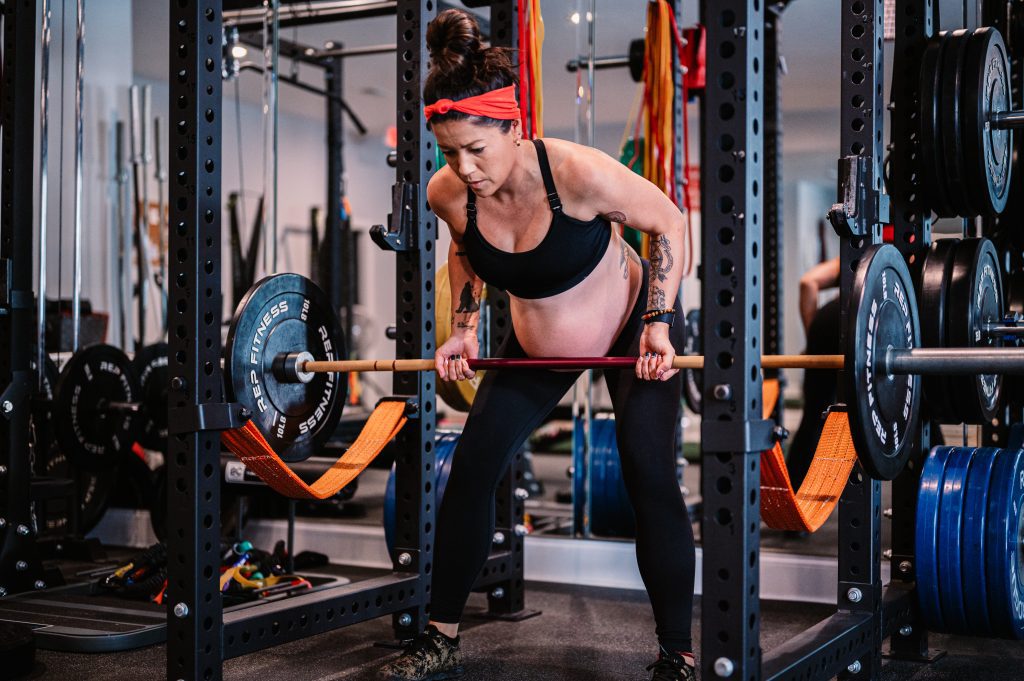

The bent-over row is a great back-strengthening exercise that you can do throughout pregnancy–but you may need to modify it as you near the final weeks of your pregnancy. Strengthening the backside (posterior chain) can be incredibly beneficial to support your posture and comfort throughout pregnancy. If you can maintain an upright position, it can also alleviate common areas of tension, such as your lats and hip flexors, that my impact your baby’s position and your ability to create space in the pelvis. So, add in all the back exercises!
In the first and second trimesters, you may find the belly down in a bent-over row position feels great. But as you enter the third trimester, you may want to opt for more upright positions, such as a seated row or single-arm row with more support. When you may want to modify, it will vary from person to person, so be willing to explore what feels best for you!
2) Diagonal Pull Down: Rotational Upper Body/Core Exercise


In addition to back-strengthening exercises, you want to continue strengthening the core throughout pregnancy. The core muscles help us stabilize our spine and support our baby’s position for birth. If the abdominal wall is weak, the belly can be pendulous or fall too forward, making it more challenging for your baby to engage into the pelvis or even end up with a breech position!
However, we don’t necessarily want to do traditional core exercises during pregnancy, as this could worsen the severity of diastasis (separation of the abdominal muscles). Instead of doing crunches or sit-up-type exercises, you can focus more on rotational exercises like the diagonal banded pull-down. This targets more obliques and transverse abs to strengthen your abdominal wall.
Pelvic Stability Exercises
Pelvic girdle pain can be a common issue throughout pregnancy, especially in the second and third trimester. However, pain is not a requirement of pregnancy, and there is a lot you can do to prevent or alleviate pelvic pain. Pelvic stability exercises are weaved within every workout in the MamasteFit Prenatal Fitness programs, as we have had a lot of success with our in-person and online prenatal clients in helping them find relief (or prevent) pelvic pain.
Pelvic stability exercises target the myofascial slings–fascial lines of muscles and tissue that work together to stabilize across the pelvis. There are four primary slings:
- Anterior Oblique Sling runs from the oblique to the opposite inner thigh. This sling stabilizes the pubic symphysis joint (front pelvic joint).
- Posterior Oblique Sling runs from the lat to the opposite glute, stabilizing the SI joint and lower back.
- Lateral Sling runs from the glute to the inner thigh, helping with single-leg stability.
- Deep longitudinal sling runs from the back of the back down one side of the body to the heel, helping to stabilize the posterior chain and SI joint.
1. Anterior Oblique Sling
- Components: Includes the external obliques, internal obliques, and the contralateral (opposite side) adductors, connected by the anterior abdominal fascia.
- Function: This sling is essential for rotational movements and transferring load across the body. It supports activities that involve twisting, like swinging a bat or throwing. It also plays a crucial role in stabilizing the pelvis and spine during dynamic movements.
2. Posterior Oblique Sling
- Components: Composed of the latissimus dorsi, gluteus maximus, and thoracolumbar fascia.
- Function: The posterior oblique sling is key for stabilizing the lower back and pelvis during movements like walking, running, and lifting. It helps generate power through the back and hips and contributes to effective force transfer between the upper and lower body during activities like sprinting or climbing.
3. Lateral Sling
- Components: Includes the gluteus medius, gluteus minimus, tensor fascia latae (TFL), and the contralateral adductors.
- Function: The lateral sling is primarily responsible for stabilizing the pelvis during single-leg activities, such as walking, running, or balancing. It helps maintain proper alignment of the hips and lower body, preventing excessive side-to-side movement. This sling is crucial for balance and lateral stability during dynamic activities.
4. Deep Longitudinal Sling
- Components: Made up of the erector spinae, deep sacral ligaments, biceps femoris, and peroneus longus, connected by the thoracolumbar fascia.
- Function: The deep longitudinal sling supports the body during forward and backward movements. It provides stability to the spine and pelvis during activities such as walking and running by helping transfer force from the ground up through the legs and into the torso. This sling helps with maintaining posture and endurance during extended periods of standing or moving.
1) Anterior Oblique Sling and Lateral Sling


The anterior oblique sling involves rotation or anti-rotation of the front side of the body. The split squat march with rotation is a great exercise to incorporate into your prenatal routine to help strengthen this sling for SPD pain relief. Since this is also a single-leg stability exercise, it also includes the lateral sling. Many exercises can incorporate multiple slings!
2) Posterior Oblique Sling and Deep Longitudinal Sling


The posterior oblique sling is strengthened with the lat and opposite glute co-activation. You can do this with rowing and hip extension exercises, such as the single-leg deadlift to hip shift with the banded row. Hinge exercises also double as a deep longitudinal sling strengthening exercise.
In addition, you can add a hip shift at the top to incorporate a pelvic floor release with the pelvic stability exercise. This exercise has been our clients’ favorite since we introduced it to our programming!
Pelvic Floor Exercises
The pelvic floor muscles are a sling of muscles that attach to the pelvis’s bottom. These muscles play a huge role in supporting our daily function and birth! The pelvic floor supports your pelvic organs, spine stabilization, lymphatic drainage, sexual function, including childbirth, and sphincter control.
However, since these muscles attach to the pelvis (which is mobile), no one movement will stretch the ENTIRE pelvic floor–we need to include a variety of hip and pelvic positions to release tension throughout the pelvic floor.
1) Deep Squats: Release the Anterior Pelvic Floor

The most common pelvic floor release exercise is a mobility exercise that emphasizes wide knees, such as deep squats or butterfly poses. These exercises can be beneficial to include in your birth prep, but they tend to target the anterior pelvic floor (front portion), which is usually already stretched/lengthened. However, hip mobility, such as finding hip flexion in a deep squat, is beneficial for birth preparation, so I still include it in our programming to support hip mobility.
2) 90/90 Variations: Release the Pelvic Floor Asymmetrically

In addition to wide knee positions, you can include asymmetrical hip positions to release tension diagonally through the pelvic floor. The 90/90 variations involve hip external and internal hip rotation to target the asymmetrical opening of the pelvic floor.
You can do several variations with the 90/90, such as side body openers, side camels, and even switches. The 90/90 variations have been a favorite of mine during my fourth pregnancy!
3) Hip Shifts: Release the Pelvic Floor Asymmetrically
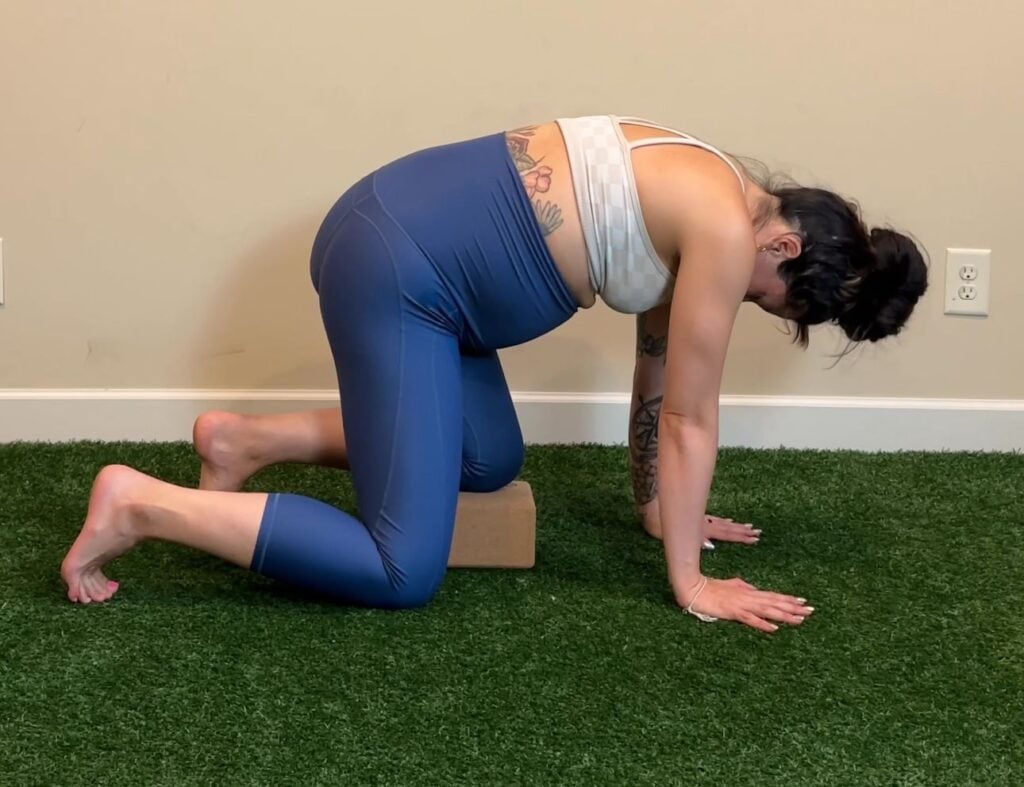
Another asymmetrical pelvic floor release exercise is the hip shift. Hip shifts differ from the 90/90, as they target pelvic rather than hip mobility. Hip shifts involve internal and external PELVIC rotation or the relationship of the pelvis to the femur.
These exercises, particularly hip shifts, are vital for releasing tension in the posterior pelvic floor and the anterior pelvic floor on the opposite side. Hip shifts are not just exercises but a tool for improving pelvic mobility. As you walk, your pelvis should shift towards one side with each step. This helps to improve pelvic mobility, leading to improved glute and pelvic floor function and hip stability. This increased hip stability can alleviate a lot of discomfort throughout pregnancy, empowering you to take control of your health.
In addition, hip shifts are essential to creating space in the lower midpelvis, where late labor stalls could occur if there is limited mobility. I’ve supported many births where the birther is “stuck” at 8cm or pushing for a long time, and once we find a hip shift, the baby will finish their rotation and suddenly be born.
There are several hip shift variations that you could incorporate into your daily routine. We include several in the MamasteFit Prenatal Fitness programs because of how beneficial they are for your pelvic floor function, comfort, and birth preparation.
4) Heros Pose: Release the Posterior Pelvic Floor
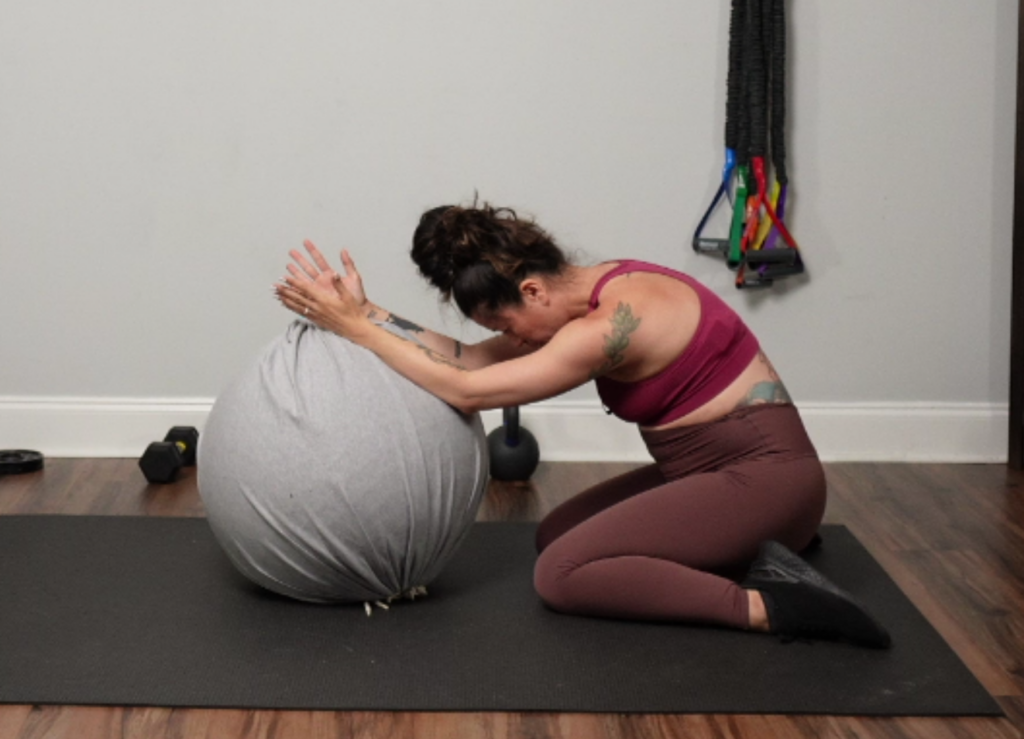
You can also include exercises that involve bilateral internal hip rotation (knees in, ankles out) to create space and stretch the posterior pelvic floor. Many of us tend to have more tension and tightness in the posterior pelvic floor due to common prenatal postural tendencies.
As a reminder, during pregnancy, we tend to favor more external hip rotation with extension, which results in a tighter posterior pelvic floor.
Remember, spending time in internal hip rotation is not just a beneficial exercise, but a crucial part of your pregnancy routine. It can help release tension, support your birth preparation, and improve sacral mobility, all of which are important for a healthy pregnancy and childbirth.
When you are preparing your pelvic floor for birth, you want to include a variety of hip and pelvic positions. This will help ensure that each part of your pelvic floor is released and ready to stretch during birth!
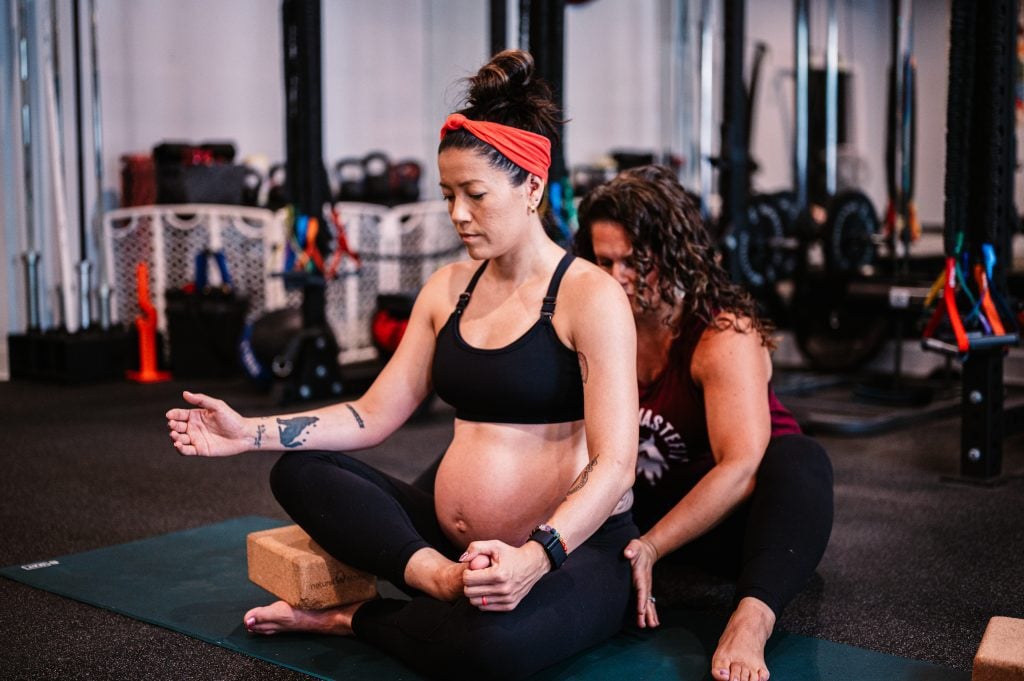

This course explore your pelvic floor anatomy, function, and how to prepare your pelvic floor for birth! This course includes educational videos, mobility exercises, relaxation drills, and how to relax your pelvic floor during labor tips.
- 2h+ of Video
- Mobility Flows
- Lifetime Access
Tips for a Safe Prenatal Fitness Routine
Staying safe during pregnancy workouts is essential to ensure that both you and your baby remain healthy and comfortable. Here are some key tips to keep in mind:
- Listen to Your Body: Pregnancy brings many changes, and your energy levels and physical abilities can vary daily. Pay attention to how you feel during your workouts and adjust the intensity accordingly. If you experience dizziness, shortness of breath, or discomfort, take a break or modify your exercise routine.
- Stay Hydrated and Cool: Your body temperature naturally increases during pregnancy, making it crucial to stay well-hydrated and avoid overheating. Ensure you drink plenty of water before, during, and after your workouts, and always exercise in a cool, well-ventilated environment. This simple precaution can help you feel secure and well-cared for, knowing that you’re taking the necessary steps to protect yourself and your baby. Avoid working out in hot and humid conditions, which can increase the risk of overheating.
- Modify Exercises as Needed: Some exercises may become uncomfortable or unsafe as your pregnancy progresses. Modify exercises to suit your growing belly and changing body, such as widening your stance.
- Focus on Proper Form and Alignment: Pregnancy can alter your posture and alignment, making it even more important to focus on proper form during exercise. Ensure that you’re using the correct techniques to avoid injury and consider working with a prenatal fitness specialist who can guide you through safe movements.
- Avoid High-Risk Activities: Steer clear of exercises that increase the risk of falling or abdominal trauma, such as contact sports, activities with a high risk of falling (like skiing or horseback riding), and exercises that involve extreme balance challenges.
- Consult with Your Healthcare Provider: Before beginning or continuing any exercise routine, check in with your healthcare provider to ensure your workouts are safe for your specific pregnancy. They can provide personalized recommendations based on your health and pregnancy progression.
By following these tips and being mindful of your body’s signals, you can safely stay active throughout your pregnancy, promoting both your own well-being and your baby’s health.
Common Myths About Prenatal Fitness
Prenatal fitness is surrounded by numerous myths that can cause unnecessary fear or confusion for expecting mothers. With modern research and expert guidance, we now know that many of these myths are outdated or simply inaccurate. Let’s debunk some of the most common prenatal fitness myths so that you can approach your pregnancy workouts with confidence and peace of mind.
Myth 1: Exercise Can Cause Miscarriage or Preterm Labor
One of the most pervasive myths is the fear that exercise during pregnancy could cause miscarriage or preterm labor. The good news is that there is no evidence to support this belief. Numerous studies, including research published in the British Journal of Sports Medicine, have shown that exercise during pregnancy is safe for most women and does not increase the risk of miscarriage or preterm labor. In fact, regular exercise can help reduce the risk of complications like gestational diabetes and hypertension. Of course, it’s important to consult with your healthcare provider to ensure your fitness routine is tailored to your specific pregnancy needs.
Myth 2: Lifting Weights Will Make Labor More Difficult
Some believe that weightlifting during pregnancy will tighten the pelvic floor, making labor harder. While it’s true that excessive tension in the pelvic floor can contribute to labor complications, lifting weights does not automatically result in a tight pelvic floor. The key is balance. When done properly and with the right form, weightlifting strengthens the muscles that support the pelvis, including the pelvic floor, without causing excessive tightness. Incorporating exercises that promote flexibility and mobility, especially in the hips, can ensure that your body remains strong and well-prepared for birth.
Myth 3: You Should Avoid Twisting and Laying on Your Back
Many people are told to avoid twisting movements and lying on their back after the first trimester due to concerns about harming the baby or compressing the vena cava (the large vein that carries blood to your heart). However, controlled twisting exercises can actually be beneficial for maintaining spinal mobility and reducing tension in the back and hips. As for lying on your back, short periods of time in this position—especially if it’s comfortable and you don’t experience symptoms like dizziness—are generally safe during the second trimester. You may want to modify or avoid these positions later in pregnancy based on how your body feels, but they are not inherently dangerous.
Myth 4: If You Weren’t Active Before Pregnancy, You Shouldn’t Start Now
Another common misconception is that if you weren’t physically active before becoming pregnant, it’s too late to start during pregnancy. In reality, beginning a low-impact, moderate exercise routine during pregnancy can offer numerous benefits, such as improved circulation, reduced swelling, and increased energy levels. The key is to start slowly and gradually build up your activity level. Walking, swimming, and prenatal yoga are excellent options for beginners. Always listen to your body and adjust your workouts as needed, but don’t let the fear of starting late stop you from reaping the benefits of staying active.
Myth 5: You Should Only Do Gentle Exercises Like Walking or Yoga
While walking and prenatal yoga are excellent forms of exercise during pregnancy, they are not the only safe options. Resistance training, swimming, and even light cardio can be beneficial for pregnant women. Strengthening your muscles, particularly in the core, back, and lower body, helps support your growing baby and prepares your body for the demands of labor and postpartum recovery. The idea that pregnant women should only stick to gentle exercise is outdated; with the right modifications, a wide range of exercises can be both safe and effective throughout your pregnancy.
Myth 6: You Need to Be Cautious About Raising Your Heart Rate
It’s common to hear that pregnant women should avoid getting their heart rate too high during exercise. However, modern guidelines focus less on heart rate and more on perceived exertion. If you can carry on a conversation while exercising, you’re likely within a safe range. It’s important to stay mindful of how you feel during your workouts—if you start feeling dizzy, short of breath, or overly fatigued, it’s time to slow down or take a break. But there’s no need to limit yourself based on outdated heart rate restrictions.
Want to learn more about prenatal fitness myths (and debunk the false ones)? Check out our YouTube series where we break down the common myths of exercising throughout pregnancy so you can feel more confident approaching exercise!
Conclusion
Staying strong and pain-free during pregnancy is possible with the right approach to prenatal fitness. By incorporating these essential exercises and strategies into your routine, you’ll not only build the strength and stability your body needs but also help alleviate common discomforts and prepare for a smoother labor. Remember, every pregnancy is unique, so listen to your body and adjust your fitness plan as needed. With a focus on proper movement, core stability, and mindful exercise, you can empower yourself to enjoy a healthier, more comfortable pregnancy while nurturing your growing baby.
Prenatal Support Courses


Learn the science of pregnancy and birth to take the mystery of labor away! Understand why you are feeling what you feel, and learn strategies to confidently move through pregnancy and birth!
- 9h+ of Video
- Support Group
- Close Captioning
- 5 Workouts/Week
- Gym Workouts
- Self-Paced

Instructor
GINA
Workout on-demand with our prenatal fitness workout videos! Each workout is 30-40 minutes to follow along as you exercise at the same time!
- Birth Prep
- All Trimesters
- Mobility Work

Instructor
GINA
Find comfort and relief from pelvic girdle pain throughout your pregnancy and postpartum period! This program incorporates myofascial sling focused exercises to stabilize across the pelvic girdle joints.
- 3 Weeks
- On Demand Workout Videos to Follow