



Should you still train your core during pregnancy?? Absolutely! But, not every core exercise is made for pregnancy!
In this blog, we will be breaking down why you should still keep your core strong throughout, what you should consider when training your core, and what type of exercises could you do to keep your core strong throughout pregnancy!
We should not completely neglect or omit core exercises from our prenatal routine! But this is tough because there is a lot of fear surrounding the safety of exercise during pregnancy, and then the safety of core exercises while pregnant.
Why do we need to still train our core during pregnancy? Because our abdominal wall supports our uterine position and our baby’s position!
An abdominal wall that is “weak” can cause a pendulous belly, which could increase the likelihood of malposition or even breech positioning (which is a variation of normal but could limit your options at birth). So, a strong abdominal wall can help to support your uterus and your baby’s position.
This can increase not only your prenatal comfort but also potentially make your labor easier as issues with your baby’s position could cause a labor stall!
Now, when it comes to core work, we need to reframe what that means. Many of us may picture crunches, bicycles, and other ab type exercises when we think of core exercises. But, core exercises are much much more than just that!
During pregnancy, we want to focus on core exercises that involve our entire core–not just our six-pack abs! So, we need to think of core work as exercises that:
- resist movement, such as with a farmer carry or plank;
- rotate the torso, such as with pallof rotations;
- involve the myofascial slings to integrate the upper and lower body, such as lunge rows and split squat marches.
But, before we dive into WHAT core exercises you should do during pregnancy, let’s discuss what you need to be aware of when doing core exercises and how to protect your core during pregnancy!
Protect the Core: Avoid Abdominal Coning
During pregnancy, you may be trying to prevent diastasis recti (DRA), or the separation of the abdominal muscles. However, DRA is a normal adaptation to pregnancy and cannot be avoided–we need the abs to spread apart to make space for baby! But, we can decrease the severity of DRA by being mindful of our movement patterns.
During exercise, we want to avoid hard abdominal coning, or coning that occurs with exertion. Coning looks like the center of the abdomen pushing out further than the rest of the abdominal wall. It can look like a tenting or cone down the center of the abs.
This is an issue if it occurs during exercise or exertion because this type of coning is the result of too much intraabdominal pressure pushing out against the thin connective tissue.
If this happens repeatedly, it can stretch and damage this tissue making it more difficult to heal postpartum.
So, we want to avoid or minimize the amount of coning that occurs during exercise!
Common exercises that may cause coning include:
- Overhead pressing exercises
- Vertical pull-down exercises, such as pull-ups or cable pull-downs
- Abdominal flexion exercises, such as sit-ups and crunches

Watch this YouTube video to learn more about abdominal coning and how you can prevent coning with those common exercises! Subscribe to our YouTube channel for weekly workout and educational videos to support your pregnancy, birth, and beyond. Your views and support help us provide all this free content!
If you want more daily workouts to support a strong pregnancy as you prepare for birth, join our online prenatal fitness programs!
MamasteFit is unique in that we are one of the ONLY prenatal/postnatal training facilities in the United States. We develop our workout programs from our experience of working with in-person pre/postnatal fitness clients and work closely with physical therapists to refine our programming. In addition, we are birth workers, so we combine our experience as perinatal fitness trainers and birth professionals to ensure that our programs actually support your birth preparation and recovery!
Our prenatal fitness programs are offered in several formats:
- 40-Week Prenatal Strength Program in the Teambuildr App:
- This program is a self-paced workout with shorter demo videos. This is ideal if you like to workout in a gym setting and prefer a traditional workout delivery format.
- This program syncs to your current week of pregnancy, so you can start anytime, with one-time payment or month-to-month payment options.
- This program has a full and mini version, depending on how much time you have to dedicate to workouts!
- Prenatal On-Demand Fitness Program:
- If you prefer to follow a video as you workout at the same time, this workout program will be the best option!
- This program syncs to your current trimester, so you can grab the trimesters you need!
- Prenatal Yoga Classes:
- If you want prenatal yoga, join our prenatal yoga program! This also syncs to your current trimester.
Prenatal Safe Core Exercises
Since abdominal flexion exercises, such as sit-ups and crunches, tend to cause abdominal coning, it may be better to omit those movements from your prenatal routine. Rather, we can focus on three types of movements to strengthen our core.
- Anti: these core exercises resist movement in various directions, such as anti-lateral flexion or side-bending, anti-rotation, and anti-extension.
- Rotational: these core exercises rotate the torso and core, and primarily strengthen the oblique or side-abs. And yes, you can twist during pregnancy!
- Myofascial Slings/Pelvic Stability: these exercises coordinate the upper and lower body across the pelvis to stabilize the pelvic joints and strengthen the core.
Let’s discuss several examples of each of these exercises so you have a better idea of what prenatal core work can look like! If you want daily workouts with prenatal safe core exercises, check out our online prenatal fitness programs too!
Anti Core Exercises: Resisting Movement
The first type of core exercise that we love to program in the MamasteFit Prenatal Programs is the anti- core exercise. These exercises primarily focus on resisting movement–so maintaining your torso position as your arms and legs do things.
Some examples include:
- One-Sided Farmer Carry: in this exercise, you are resisting lateral flexion, side-bending, as you walk or march in place. This strengthens the lower back and side ab muscles (QL and obliques).
- Pallof Press: in this exercise, you are resisting rotation, as you press a band away from your torso. This strengthens the oblique muscles.
- Bear Crawls or Planks: in this exercise, you are resisting extension, arching in the back. This strengthens the front ab muscles in a way that tends to be more accessible during pregnancy.
In general, we find that supine core exercises such as the deadbug are not very accessible during pregnancy. While it is an anti-extension exercise, in the supine position it tends to cause more coning as you extend the leg. You may be able to do movements like the deadbug in the first trimester and potentially the second trimester, but generally, we find these movements cause a lot of coning in our clients.
Watch our YouTube breakdown videos on the farmer carry and bear plank as prenatal safe core exercises! These exercises are included in our book, Training for Two!
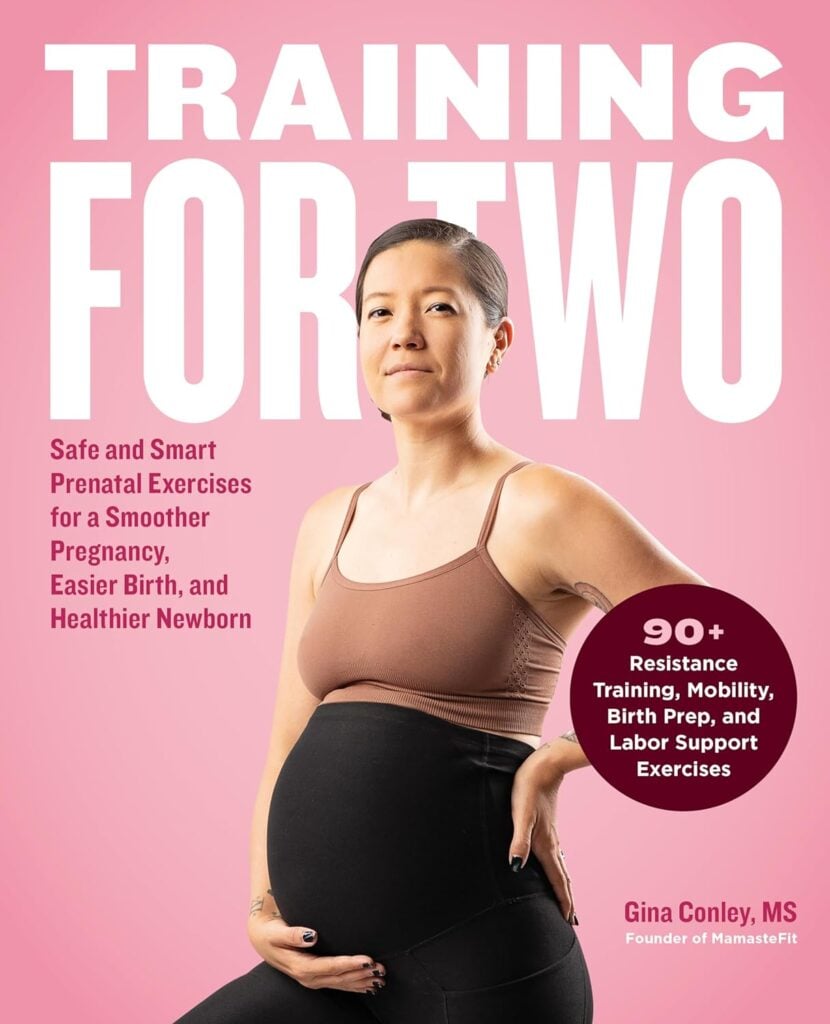
Want to learn more on how to use prenatal fitness to support a strong and pain-free pregnancy, plus exercises to release tension in the pelvic floor and open the pelvis for birth? We also break down how to use prenatal exercise and labor positions to support your baby’s position!
Pre-order our book Training for Two! This book includes 90+ exercises to build your confidence as you navigate fitness throughout your pregnancy and prep for birth, plus a whole chapter on early postpartum recovery!
Rotational Core Exercises
First, yes you can twist during pregnancy! There is this myth that twisting is bad and that you should avoid it at all costs–but this is inaccurate and you absolutely should twist in the spine during pregnancy. Read this blog for more debunking of the twisting myth.
Next, rotational core exercises primarily focus on the oblique (side abs) so they can help to increase the density of the tissue of the abdominal wall (make it less susceptible to changes in pressure and coning) which could decrease the severity of DRA! Plus, rotational core exercises tend to help with pelvic stability, as most of them will integrate with the opposite adductor (see next section on this).
You can try all sorts of rotational core exercises, such as the pallof rotations (video below), and we include tons of other rotational core exercises in our prenatal fitness programs such as diagonal pull downs and upward chops.
Myofascial Slings: Connecting the Upper and Lower Body with the Core
The final type of core exercise that we include in the MamasteFit Prenatal Fitness Programs are the myofascial sling exercises! And these also double as pelvic stabilization exercises. The myofascial slings run from the upper to lower body, crossing the pelvis. These coordinated slings help to provide force closure (bringing the physical joint closer together to stabilize) and aid in pelvic stability.
Since they are a functional core exercise, they also tend to not cause abdominal coning. So, its a great way to strengthen your core, and improve your pelvic stability, without damaging your core!
The myofascial slings include:
- Posterior Oblique Sling: this sling runs from the lat (back muscle) to the opposite glute crossing just above the SI joint area. This helps to stabilize the lower back and SI joints, and aids in extension while walking and moving.
- Anterior Oblique Sling: this sling runs from the chest/oblique to opposite adductor (inner thigh) crossing the pubic symphysis (front pelvic joint). This helps to stabilize the pubic symphysis and aid in rotation to the frontside of the body.
- Lateral Sling: this sling integrates the glute to inner thigh of the same leg for single leg stability.
- Deep Longitudinal Sling: this sling runs along the posterior chain (back side) from the back of the neck to the back of the ankle. This sling helps with SI joint stability and supporting the backside of the body.
Myofascial sling exercises are a great way to integrate core exercises that support functional movement and a pain-free pregnancy! Watch the videos below for an example of a posterior oblique sling and anterior oblique sling exercise that I love to program into all of our fitness programs!
Stay Strong & Train Your Core During Pregnancy
You can absolutely still train your core during pregnancy, but we do need to be mindful of HOW we are training our core. When doing ab work, we want to avoid abdominal coning, which could damage our core. Rather, we can focus on core exercises that focus on anti (resisting movement), rotation, and the myofascial slings to strengthen the core in a way that is much more accessible (and functional) for pregnancy!


Learn the science of pregnancy and birth to take the mystery of labor away! Understand why you are feeling what you feel, and learn strategies to confidently move through pregnancy and birth!
- 9h+ of Video
- Support Group
- Close Captioning
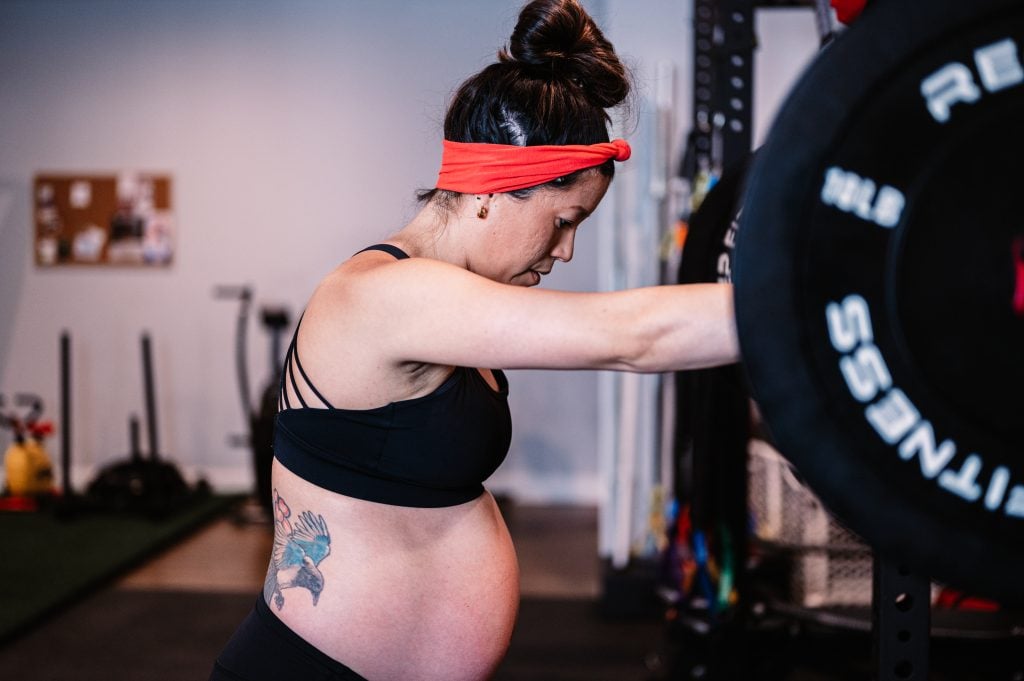

- 5 Workouts/Week
- Gym Workouts
- Self-Paced

Instructor
GINA
Workout on-demand with our prenatal fitness workout videos! Each workout is 30-40 minutes to follow along as you exercise at the same time!
- Birth Prep
- All Trimesters
- Mobility Work

Instructor
GINA
Find comfort and relief from pelvic girdle pain throughout your pregnancy and postpartum period! This program incorporates myofascial sling focused exercises to stabilize across the pelvic girdle joints.
- 3 Weeks
- On Demand Workout Videos to Follow