
If you’ve ever searched how to open your pelvis for birth, you’ve probably been told to sit in a deep squat, stretch your inner thighs, and practice a few wide-knee poses. While those movements can be helpful, they are only one small piece of a much bigger picture.
Preparing your body for birth is not about finding one magical stretch. It is about understanding how your pelvis changes shape during labor, how your hips rotate inside the socket, and how your spine and rib cage influence pelvic space. When you understand the mechanics, you stop randomly stretching and start training for birth with intention.
In this blog, I am going to break down the top seven movement patterns you need to access in order to create space in your pelvis and support birth. These include coordinated movements of the hips, pelvis, and rib cage. There is no single movement that opens the entire pelvis, and there is no single stretch that releases the entire pelvic floor. The pelvis is three-dimensional, and different levels of the pelvis respond to different movement patterns.
If you want a simple place to start while you read this, make sure you grab our free Birth Prep Circuit. It walks you through several of these foundational pelvic mobility movements in a structured, easy-to-follow format.
First: Pelvic Position Changes Hip Rotation
Before we break down each level of the pelvis, we need to clarify something that is often misunderstood. Hip rotation is not just about the hip joint itself. The position of your pelvis changes how the femur sits inside the socket.
Anterior Pelvic Tilt (APT): When you arch your back, your pelvis tips forward. In this position, external rotation (turning your thigh outward) becomes mechanically easier to access.
Posterior Pelvic Tilt (PPT): When you round your back, your pelvis tucks underneath you. In this position, internal rotation (turning your thigh inward) becomes mechanically easier to access.
Pregnancy often encourages more extension and anterior pelvic tilt as your belly grows. For many women, external rotation feels easier and internal rotation feels more limited. But birth requires access to both. Adjusting your pelvic position can make hip rotation easier or harder, which is why spinal and rib cage positioning matter just as much as your hips.
If you want a deeper breakdown of how strength training and pelvic mechanics work together during pregnancy, I go into this extensively in my book, Training for Two.
7 Movement Patterns That Help Open Your Pelvis for Birth
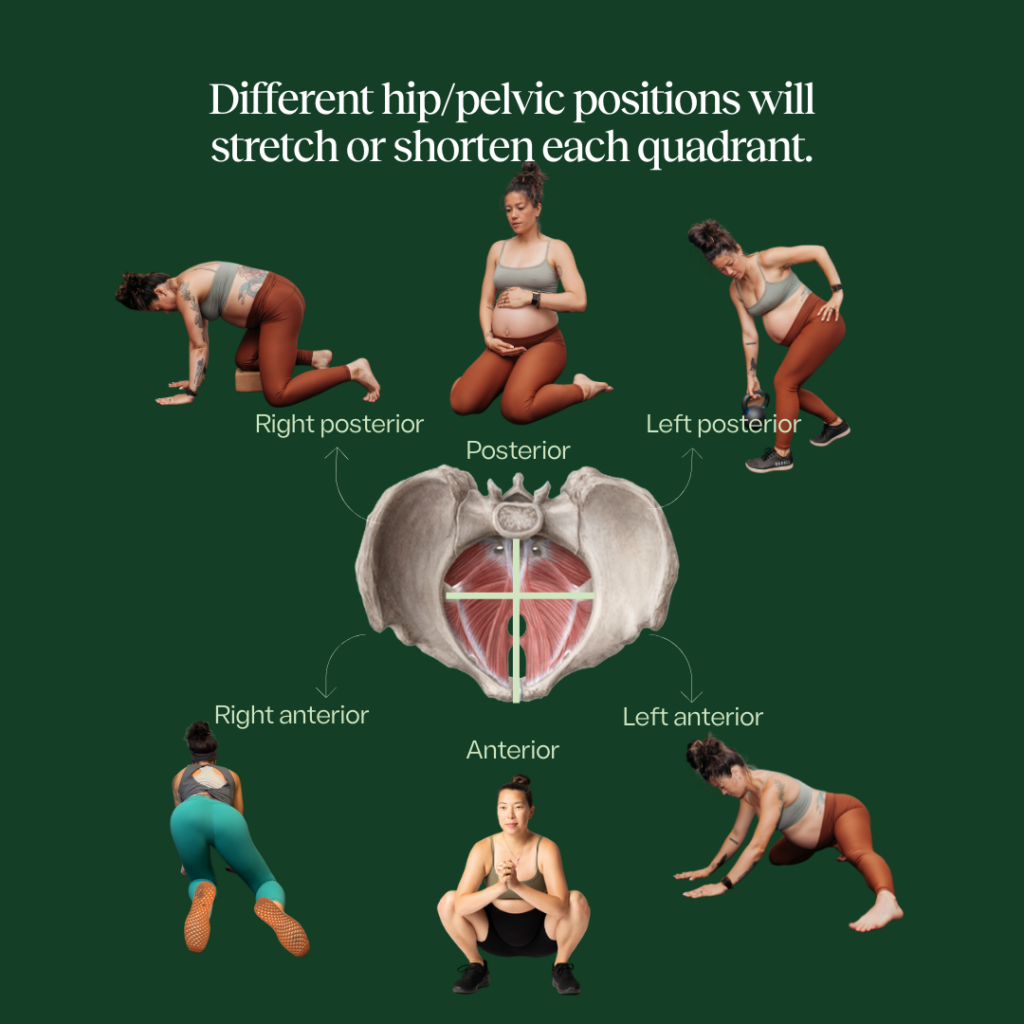
To create space in the pelvis, we need access to:
Hip and Pelvic Movements:
1. Bilateral external rotation with abduction
2. Unilateral internal and external pelvic rotation
3. Unilateral internal and external hip rotation
4. Bilateral internal rotation with adduction
Rib Cage Movements:
5. Thoracic flexion and extension
6. Thoracic rotation
7. Lateral side bending
If you want to see all seven of these movements put together into one intentional flow, you can watch the full workout on our YouTube channel where I break down each movement pattern by pelvic level and explain exactly what to focus on. Seeing the movements layered together can make the mechanics much easier to understand and apply.
And if you are looking for more intentionally designed workouts that progressively build these patterns throughout pregnancy, you can find them inside our prenatal fitness programs. Every workout is structured to integrate pelvic mobility, strength, and birth prep mechanics so you are not guessing which exercises to do or how to sequence them.
If you are a birth professional, fitness professional, doula, or medical provider reading this and wanting to understand these mechanics on a deeper level, this is exactly what we teach inside our Pelvic Mechanics course.
Our Pelvic Mechanics for Birth Professionals course breaks down thoracic positioning, pelvic rotation, internal and external hip mechanics, and how to assess and cue these movements with clients. We go beyond exercises and teach you how to see movement patterns and adjust them in real time.
If you want to confidently integrate biomechanics into your prenatal care or training practice, this course was designed for you. The Pelvic Mechanics course is also approved for 9 NC nursing credit hours and 9 ICEA credit hours.
1. Bilateral Hip External Rotation: Wider Knees
Open The Top of the Pelvis
The top of the pelvis is the pelvic inlet, and this is where your baby will first engage into the pelvis. A quick note: your baby engaging does not need to happen during pregnancy. It could happen during labor. Your baby being engaged during pregnancy does not mean you will go into labor any sooner, and your baby not being engaged does not mean you will never go into labor.
Now, how do we create space in the top of the pelvis? There are a few different movement patterns that are important for this.
The top of the pelvis opens more with bilateral external rotation combined with abduction, so we are thinking wider knees on both sides. This is going to help create more lateral space in the top of the pelvis.
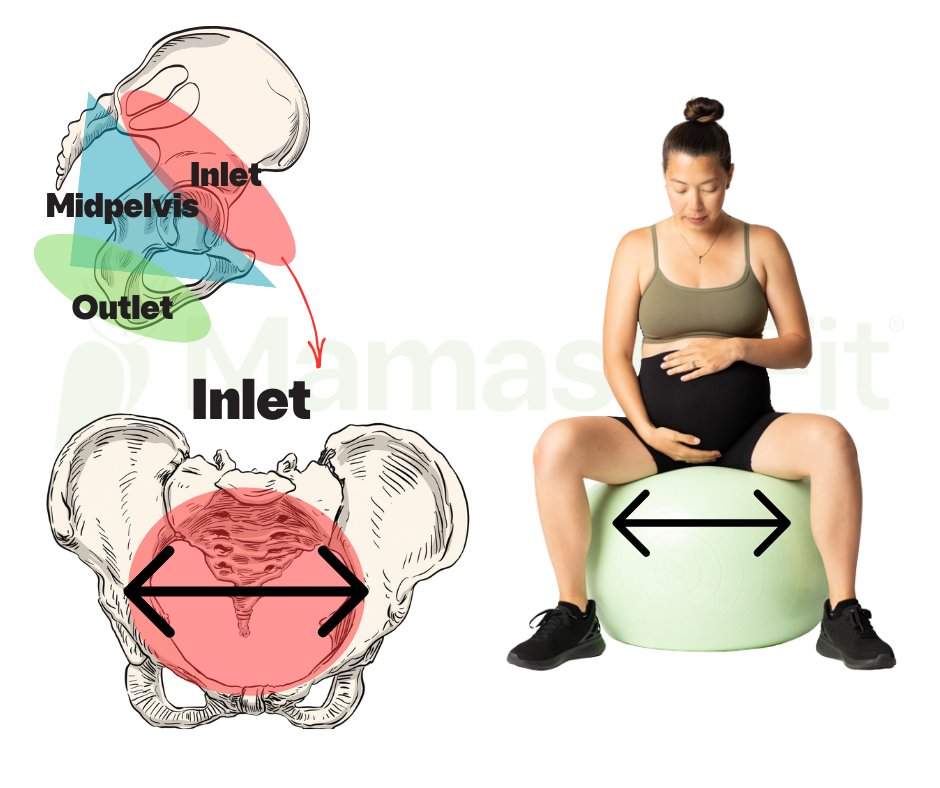
When both knees move outward, you create more lateral space at the top of the pelvis. Think wider knees, and all of the common birth prep and labor positions you have seen on social media and various blogs. These help to create more side-to-side space in the top of the pelvis.
Mobility Prep for the Inlet: Deep Squats
Mobility exercises that can help create space at the top of the pelvis are going to be those more traditional birth prep pelvic floor exercises. Think anything with wider knees, such as holding a deep squat position, butterfly pose, a straddle stretch, or wide-knee positions.
The deep squat hold can be a helpful position for getting comfortable, as it can highlight many movement and mobility restrictions you may or may not have. If you find holding the bottom of a squat uncomfortable, place something under your hips for additional support, such as a yoga block or a box. You can also place something under your heels, such as a rolled-up yoga mat, a towel, or a wedge.
In the deep squat position, you can try to press the knees further apart or even add in some thoracic rotation.

Additionally, you can hold onto something and sit back into your heels, which will allow you to find a deeper position without having to fully support your body weight, allowing you to relax and focus on the release.
Open the Inlet: Strengthening Exercises
In addition to the mobility aspect of birth preparation, we also need the strengthening aspect. It is important to understand that your muscles only have the ability to pull, not push. If we want to change pelvic position, we need to think about how to strengthen the muscles so they can actively reposition the pelvis. Movements that target the quads and glutes are going to help create more space in the top of the pelvis. You can focus on exercises such as a squat or lunge where the torso is in a more upright position. If you imagine attaching a flashlight to your tailbone, your flashlight would be shining toward the floor below you in these types of movements.
In the squat position, you can find a level of depth that feels most comfortable for you. This could be a very deep squat, or you could squat down to a box that is above parallel. You can hold weights such as dumbbells in front of you or at your shoulders, or even use a barbell. The main goal is to maintain a more upright position so that we have more quad focus in addition to glute focus.
2. Thoracic Flexion and Extension
Open the Inlet: Rib Cage Positioning
In addition to the external rotation of the hips, we also need to think about rib cage position. You might be wondering why you should even be concerned with your rib cage if your baby is in your pelvis. The rib cage is attached to the spine, which is attached to the pelvis. Movement or lack of movement in the rib cage can impact movement in the pelvis.
One of the positions that helps create space in the top of the pelvis from the rib cage perspective is rounding and extension of the spine. More extension of the spine helps create more space in the front portion of the inlet, while more rounding of the spine helps create more space in the back portion of the inlet.
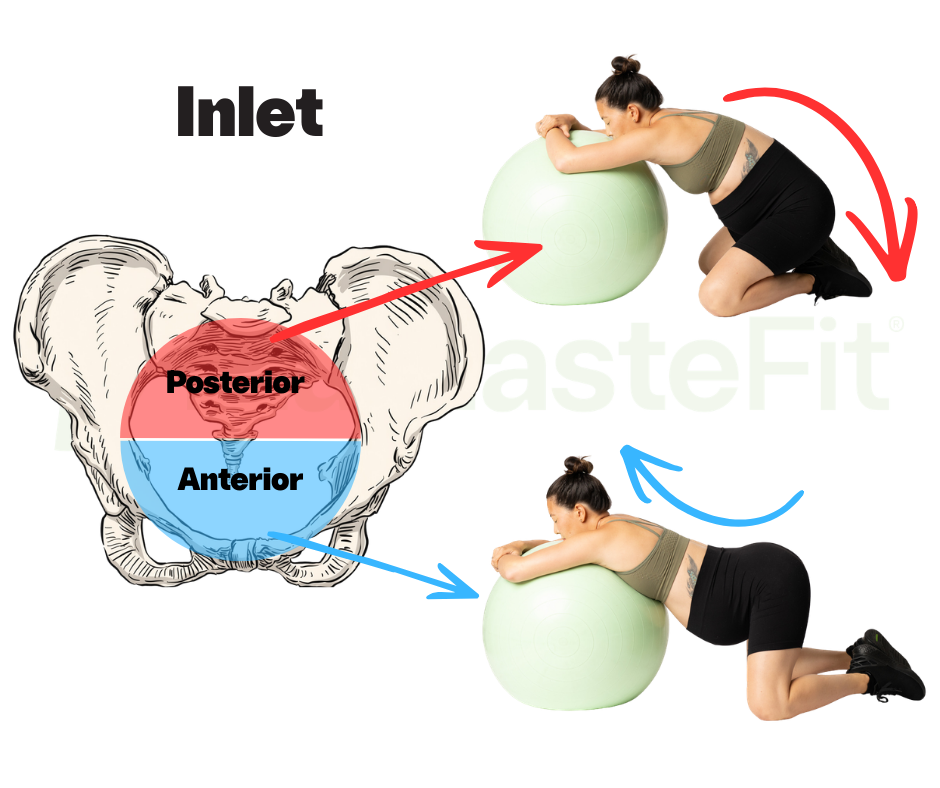
During pregnancy, we tend to favor extension, or arching in the back. Finding a more rounded position can feel harder to do, and it is important to focus on. In the free MamasteFit Birth Prep Circuit, we incorporate a strong focus on helping you find posterior pelvic tilt because of how important it is for creating space in the pelvis, while acknowledging that posturally many women default to extension.

Open the Inlet: Rib Cage Mobility & Core Strengthening
Some mobility exercises that can help you create space front-to-back in the top of the pelvis include lat-release exercises.
In this lat release exercise, you start facing a wall with both hands pressing into the wall. Then step your feet back so that you form an L shape with your body. From there, step your feet perpendicular to the wall so your feet are about one to two feet back from your hands. As you perform this curved L position, press harder into the lengthened hand and you will feel more of a stretch in that side body. You may also want to put more weight into the outside foot. A key thing is to make sure your chest stays squared to the floor, because sometimes the tendency is to rotate and twist instead of lengthen. Releasing the lats can help you find more of a rounded spinal position.
After lat releases, we can do more mobility work such as wide-knee pelvic tilts, which help target the top of the pelvis and that front-to-back pelvic movement.
Now we also want to think about the strengthening aspect to help create space in the top of the pelvis with rib cage positioning. Since we tend to favor more extension during pregnancy, it can be helpful to focus on strengthening the abdominal wall to help you find more of that tucked position. We can do this with pregnancy-safe core exercises. I like to include a lot of isometric and rotational work to help strengthen the core during pregnancy. One exercise that you can do is the front rack march. Holding weights in front of you, you simply march in place while trying to maintain an upright position. You will feel a lot of engagement in the front abdominal wall. If it feels like too much, bring the weights closer toward your body or lower the weight.
You can absolutely train your core during pregnancy, and I would actually recommend it because it can help support your baby’s positioning as well.
3 & 4: Unilateral Pelvic and Hip Rotation
Open the middle of the pelvis
The middle of the pelvis, known as the midpelvis, is where your baby rotates during labor. This also tends to be the narrowest space in the pelvis because there is a lot of bone structure and tissue that the baby is navigating through.
The midpelvis can be broken down into two sub-levels: the upper midpelvis and the lower midpelvis. These two levels open more with unilateral movement of internal and external hip and pelvic rotation.
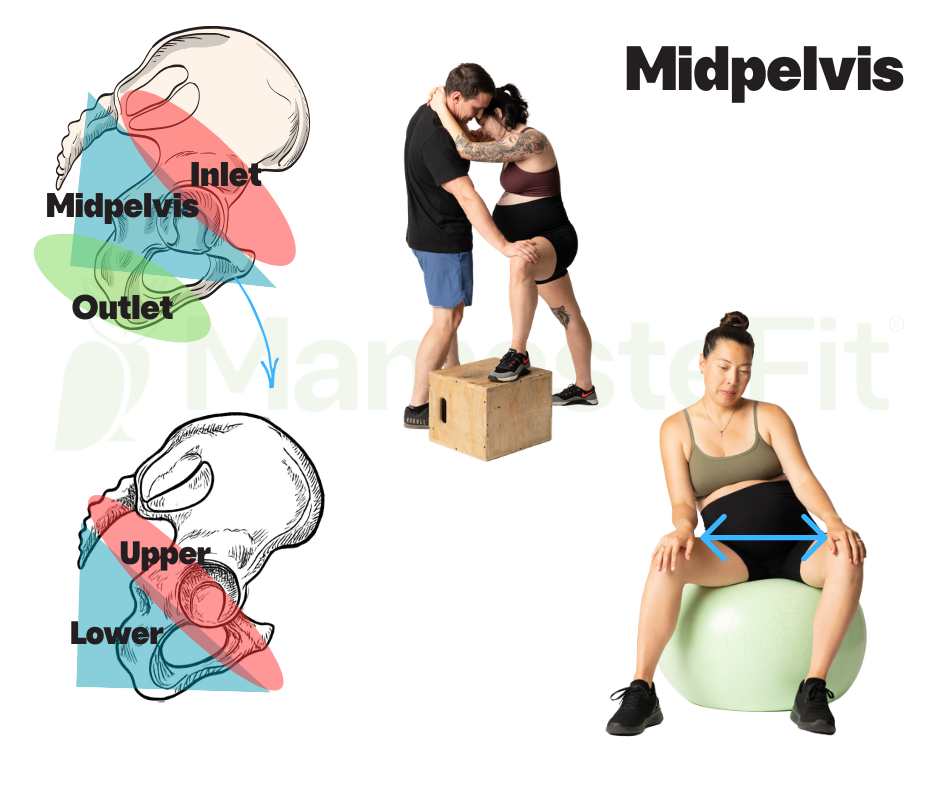
Hip Versus Pelvic Rotation
What is the difference between hip and pelvic rotation? There is a slight difference and it matters for birth prep, because we want to be able to do both! The difference lies in what is the anchor–the pelvis or the femur.
If the pelvis is the anchor point, then you are doing hip rotation. This means that the pelvis is maintaining its position as the femur (leg) moves on the pelvis. This is more common in open chain positions, such as the 90/90 shin box flow.
If the femur (leg) is the anchor point, then you are doing pelvic rotation. This means that the leg is maintaining its position as the pelvis moves on top of it. This is more common in closed chain positions, such as split squats, where you are standing on your feet and your pelvis is rotating.
If reading this makes you realize how layered pelvic mechanics actually are, that is exactly why we built our prenatal fitness programs the way we did.
Inside our programs, we do not just give you random pregnancy workouts. Every week is intentionally programmed to train inlet, midpelvis, and outlet mechanics while also building strength safely through each trimester. Birth prep movements are integrated into every single workout so you are consistently practicing these positions without having to think about it.
Both of our prenatal programs sync to your current week of pregnancy. You can join at 6 weeks or 30 weeks and immediately start with workouts designed specifically for where you are. You can choose a one-time purchase with lifetime access for this pregnancy and future pregnancies, or a monthly option if you prefer flexibility.
You do not have to figure this out alone.
Open the Upper Midpelvis: One-Sided Open Hip Positions
The upper midpelvis, where the baby begins to rotate into the pelvis, opens more with one-sided open hip positions. In these mobility exercises, you will feel more of a stretch in the groin and inner thigh. Examples include a half-lunge open hip stretch, where you come into a half-lunge position and rotate your torso away from the front thigh to feel a stretch in the inner thigh and groin.
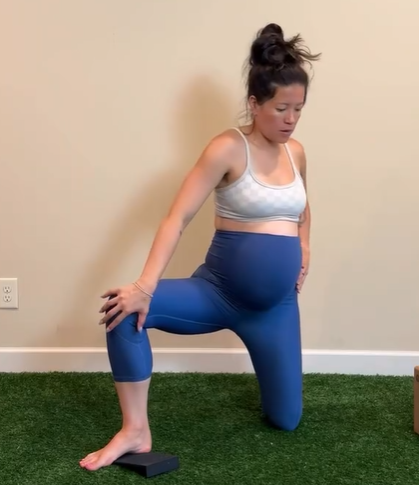
You can also do an all-fours lateral hip shift. In this movement, you take your hip and bring it toward the opposite knee to rotate the pelvis over the femur and feel a deep stretch in the groin and adductors. You can add a slight arch in the back because rib cage position impacts pelvic position and your ability to find internal and external rotation. When you find more extension in the spine, the pelvis tips forward, which changes how the femur sits in the socket and makes external rotation easier to access.
If we want to target more of the lower midpelvis, where the baby finishes rotation out of the pelvis, we want more one-sided closed hip positions with internal rotation. We can do this with hip shifts.
In a hip shift mobility exercise, we are thinking about bringing the hip toward the opposite knee, similar to the lateral hip shift, but with the legs closer together. I want to keep more weight in my target leg and feel more of a deep glute stretch. You can do this from an all-fours position with one knee elevated on a yoga block, or from a standing position.
Now for strengthening movements to help create space in the middle of the pelvis, we want exercises that incorporate rotation and weight shifting.
If I want to target the upper midpelvis, I am going to focus on upright quad and glute exercises that are more one-sided, such as a B-stance squat. I can hold the weight on the same side (ipsilateral loading), which emphasizes external rotation.
If I want to target the lower midpelvis, I will focus on one-sided hinge-type exercises that engage the hamstrings and inner thighs, helping pull the hip into internal rotation. We can do this with a staggered-stance RDL, holding the weight in the opposite hand (contralateral loading), which emphasizes internal rotation.
Similar to the flashlight cue before, if I am thinking about a hinge-type motion and that flashlight is attached to my tailbone, I want to focus on shining that light on the wall behind me. That tells me I am focusing more on the hamstrings.
Now all of those exercises are focused on pelvic rotation because the foot is stationary on the floor while the pelvis rotates on top of it.
If I want to focus more on hip rotation, I want the anchor point to be the pelvis, and these are typically open-chain positions. A mobility exercise can be a 90/90 or shin box flow where I am shifting my leg position around from a seated position. A strengthening exercise could involve fire hydrants, banded abduction or adduction, or adductor side plank pulses. The key here is that the leg is moving on the pelvis, reinforcing hip rotation capability rather than pelvic rotation.
5 & 6. Thoracic Rotation and Lateral Bending
Open the middle of the pelvis with rotation and asymmetry
Now when it comes to the rib cage with all of this asymmetrical movement, we want rotational and lateral bending happening within the rib cage. We can incorporate rotation with thoracic rotation exercises and add lateral side bending with a 90/90 side body opener, adding length through the side.
This is where most generic birth prep advice completely falls short. Simply stretching your inner thighs is not the same thing as training pelvic rotation under load, and it is not the same thing as building internal rotation strength for the lower midpelvis.
Inside our prenatal fitness programs, we structure your workouts so that these mechanics are layered in progressively. You are not just doing mobility drills. You are strengthening quad, glute, hamstring, adductor, and core patterns that directly support how the pelvis changes shape during labor.
We offer two formats so you can train in a way that fits your lifestyle. Our Self-Paced Strength Program is ideal if you prefer lifting in a gym setting and want barbell and dumbbell options. Our Prenatal On-Demand Program is fully guided and follow-along if you prefer pressing play and being coached through every rep.
Both options sync to your week of pregnancy and evolve with you as your body changes.
7. Bilateral Internal Rotation
Open the bottom of the pelvis with closed hip positions
Now for the bottom of the pelvis, known as the pelvic outlet, the mechanics that create space are bilateral internal hip rotation with adduction and a slight posterior pelvic tilt. The mobility work that helps prompt that includes hero’s pose with a rock back, where we find a more internally rotated and rounded position and get comfortable in that expanded back position.
The strengthening exercise that supports this is any hinge pattern, such as deadlifts. In this variation, you can hold two dumbbells and gently squeeze a yoga block between the thighs to activate the inner thighs. Your range of motion may be limited because of your belly, so be mindful of your accessibility to the movement.
If you have ever wondered what exercises actually prepare you for pushing, this is it. It is not about just sitting in a squat. It is about building strength in hinge patterns, adductors, and posterior pelvic control so you can access outlet expansion when you need it.
That is exactly what we program for inside our prenatal fitness training. Every trimester is intentionally structured so you build strength early, add rotational control mid-pregnancy, and emphasize birth prep mechanics in the second half of pregnancy.
You can join at any stage. The workouts automatically align with your current week of pregnancy, and you can choose either a lifetime access option or a flexible monthly plan.
The Big Picture: Opening All 3 Levels of Your Pelvis
There is no one movement that opens the entire pelvis. You need bilateral and unilateral work. You need external rotation and internal rotation. You need arching and rounding. You need strength and mobility.
If this feels complex, that is because it is. The pelvis is complex. But you do not have to figure it out alone.
Inside our prenatal fitness programs, we intentionally program inlet, midpelvis, and outlet mechanics into structured weekly workouts. After week 20, birth prep movements are integrated into every week of training.
We offer a self-paced strength program for women who want gym-based lifting, and a fully guided prenatal on-demand program where you follow along rep by rep. Both programs sync directly to your current week of pregnancy. You can join at any point and receive workouts designed specifically for where you are. You can choose a one-time purchase with lifetime access or a flexible monthly option.
If you want birth preparation rooted in biomechanics and progressive strength instead of random stretching, our prenatal programs were designed for exactly that.