

Welcome to the MamasteFit Podcast! In this episode, hosts Gina, a perinatal fitness trainer and birth doula, and Roxanne, a labor and delivery nurse and student midwife, explore the various pushing positions during labor. They emphasize that the best pushing position is the one the mother chooses and feels comfortable in. They discuss the common pushing position of being on your back, its pros and cons, and alternatives like side-lying, hands and knees, and standing positions. They also address how to handle hospital settings with certain expectations of pushing positions, and the importance of a supportive care team and prenatal conversations. The episode provides practical tips on adjusting positions to help with the baby’s rotation and the importance of relaxing muscles for effective pushing.
Read Episode Transcript
Gina: Welcome to the MamasteFit Podcast. If you’ve been wondering about what is the best pushing position, we’re going to break that down in this episode. And spoiler alert, it is any position that you choose, but we’re going to break down what positions may more optimal, which ones you can explore.
Welcome to the MamasteFit Podcast. In this episode, we’re going to be talking all about what is the best pushing position and what pushing positions may be helpful if you’re running into an issue during labor. And so while you’re pushing, your baby has to finish the rotation underneath the pubic bone, but sometimes that takes a little bit of time…. and it takes a little bit of time…. and it takes a little bit of time. And so we’re going to go over some pushing positions that can also help with that final rotation as well, so they can finally come out.
So let’s start with what is the most common pushing position and is it bad? Is it bad to push on your back, Roxanne? Are you just destroying your entire birth experience? ‘Cause I’ll see a lot of content on that, where you should never push on your back.
Roxanne: No, it’s not the worst pushing position, if you personally choose it. If you personally choose to push on your back, it is not the worst pushing position. But when you are like forced into pushing on your back, that’s when it’s least optimal. With, when you’re on your back, flat, your sacrum doesn’t have as much space to be able to move out of the way to create more space. It’s not creating like inches for your baby, but like millimeters for their heads, like we want all the millimeters that we can get for the baby to be able to be born out of the pelvis. So if we can allow the sacrum to move out of the way, this gives baby more space to get underneath that pubic bone and be born, which is what we’re wanting. So if you are more comfortable on your back, you can definitely push on your back, but still lay in a way that’s still creating space for that sacrum.
For me personally, I chose to be like on my back for two of my deliveries- one at, both at the hospital. I was like slightly tilted, so I was creating space in my sacrum, but it was just more comfortable for me to lay on my back and like fully surrender. Like I tried pushing standing up, I tried pushing on my side, and I tried pushing hands and knees. I think I probably could have been fine in hands and knees, but I just, the thought of my like butt hole in people’s faces, like, freaked me out a bit. So I was most comfortable just on my back, slightly tilted. And that’s fine, ’cause I personally chose that position.
Gina: That’s how it was for me in my second and third birth. I ended up like kind of on my back, kind of on my side for both of them because I felt like I was able to relax into pushing, like, easiest, in a recline supported position. So that could be something that could be beneficial to pushing on your back or in a reclined type position is if you feel like you can relax the most here, especially if you have a really strong urge to push, like you have this fetal ejection reflex, you’re just along for the ride- being in a position that you can just surrender in can be super helpful.
I have clients where they enjoy being in more upright active positions like that helps them push a little bit better. And I have other clients that find like being in a more restorative position feels best for them ’cause they can focus a little bit better, there’s a little bit less going on. And so the best pushing position is the one that you choose, not the one that you are forced into.
And so there is a lot of controversy with pushing on your back. ‘Cause one, it could decrease space, it can make it a little bit harder for your sacrum to move if you’re laying on a flat surface. And so there are things that we can do to help increase space to ensure that the sacrum still has movement capability by one, just being slightly tilted. Ways that we can find a slight tilt is you can either take a pillow and just cram it up underneath like one of your sides, and that’ll slightly tilt you. You can take like a towel and roll it up and place it underneath one hip, and that’ll slightly tilt you. There’s also like a little cutout portion in the bed if you’re giving birth in a hospital bed that you can push your hips into- and usually they’ll have you scoot down anyways while baby is crowning- that could be like a really good place to position your hips that we have a little movement capability as well. So it doesn’t have to be, again, like inches, like we don’t need six feet of space, but just a little bit of a tilt can give us that little bit of movement that we need for the sacrum.
The other reason why I typically find that pushing on your back is “bad,” or where that comes from, is typically this is a position that somebody’s being forced into. It’s convenient. It’s where your provider may feel most comfortable catching your baby. And so because of that, you may be encouraged, or essentially forced, into this position because of other people’s convenience. It makes them more comfortable, not necessarily you. And so something that I would encourage, if you are pushing and you’ve found a position that feels good for you, whatever that position is, if somebody is telling you that you need to change to X, Y, and Z position, and it’s, and there’s not like any emergency or anything going on, like it’s just like they want you to be on your back ’cause the provider’s in the room and they like catching babies when you’re on your back- typically what I’d recommend is, let’s say somebody’s in a side lying position or they’re in a tabletop position and the nurse is like, “You have to get on your back. The doctor likes catching babies on your back,” I usually will just ask my client, “Do you feel comfortable in this position? Do you feel good right now?” And if they’re like, “Yeah,” usually that’s where the conversation ends. She’s comfortable where she’s at, she’s not going to move. Are you going to put hands on her? Or you may be like, you know what, “Actually I’m really tired. That sounds great. I really want to be on my back.”
Roxanne: Yeah.
Gina: “That’s whatever for me.” So I find just saying that out loud, lets everyone else in the room know that you are happy in that position that you’re in, and that you don’t want to move. And then it’s, how do we force you into another position?
One of the things that I’ve run into in some of the hospitals in our area is there’s this perception that the provider wants every patient in this one position, when they really don’t care. And so the nurse will be like, “They have to get on their back. They have to get on their back!” And then we will be like, “They’re really comfortable where they’re at. They don’t want to flip.” And then the provider will come in, and they’ll be like, “She won’t get on her back!” And they’ll be like, “I don’t care. I’ll catch the baby in a handstand. Like, it’s not that complicated.” And so there could be a little bit of that tension going on where there’s an assumption that the provider has a certain preference. That maybe they don’t actually care about, and so like maybe people are getting forced into positions that like they didn’t actually need to be in. And so that’s where I think a lot of the, like pushing on your back is bad comes from is folks may be feeling that they’re being forced into that position when maybe it’s not the most comfortable position- it’s not the position they’re choosing.
And so again, if you are comfortable in a position and somebody is telling you that you need to get on your back and you don’t want to get on your back, I find it really helpful for somebody else in the room, like your partner or your doula to say out loud, “Are you comfortable in this position?” And if you’re like, “Yes, then they can either say out loud, “She’s comfortable where she’s at, she’s not going to move. What would you like to do now?” And then usually it’s, “I’ll just catch the baby here.” ‘Cause surely it’s not that…. I don’t know, is it that much different catching a baby that’s like in a side lying, or tabletop, or all fours?
Roxanne: So, it is different. So when you do attend to birth in a different position other than their back, it is different. So the pelvis has like a curve, and it’s called the Curve of Carus that a baby is going through to be born. It’s not just straight through, just shoot like straight out of the pelvis, they have to go under this curve. And then when they get to the pubic bone at the bottom of the pelvis, then they do another type of curve to get their shoulder out and then their other shoulder. So this is like what the baby is doing, and when we are there supporting them, we have to think about these maneuvers so that we can, like if the baby needs some help to get under the pubic bone or through the pelvis, we know where the baby is in relation to the body, and then potentially the bed, to be able to assist them. If you’ve only supported births where people are on their back, a lot of people think, “Oh, I just help guide baby downwards, and then up.” And that’s a lot of what people are taught, is down and then up- instead of like, down towards the butt, and then up towards the vagina. That, it’s a slight instruction difference, because if someone is hands and knees, their butt is not down, their butt is up. So you’re pulling baby up and then down, which is a total mind fuck for some people. ‘Cause like literally the first time that someone was in hands and knees and the provider took a little while to get into the room and I’m the nurse and I’m like, “I don’t know what to do, and I need someone to help deliver this baby,” in my head. I immediately was like, the only birth that I’ve ever helped, they were on their back ’cause the baby literally shot out of them, and I just had to give gentle, like, downward pressure and then the baby came out. So in my head I was like, “Oh yeah, I go down,” and I was like, “no, that’s not right,” and then the midwife came and saved me, ’cause I was like, “I don’t know what the fuck I’m doing. I’ve been a nurse for a year!” And then they’re like, “No, we go up and then down.” And I was like, “Yeah.” But if someone has never done that and they’ve never been around people that deliver in any other position, it does take a second to be like, “How?”
Gina: To reorient yourself.
Roxanne: Yeah. Yeah, to be like, “Hey, where’s this baby in the pelvis? And what are the positions that this baby needs to do in order to be born when they’re on their side? When they’re on their hands and knees? If they’re standing, also. A lot of people also get very concerned about standing ’cause a baby, they come out and they’re pretty slippery and they’re wet and slimy, and they don’t just, they don’t stay in your gloves very easily sometimes. So people when they’re standing, they’re like, “This baby’s just going to drop to the ground!” But, you would be very surprised that if a baby is coming out, you have time to use your hands and just guide them upwards. But again, if someone is not comfortable in those situations, they don’t want to cause harm accidentally by dropping a baby or like doing something inappropriately while trying to like help coax this baby out. So it is like a bit of comfort for them by having them just on their back ’cause it’s the one that they’ve been taught all through most residencies and a lot of clinicals.
Gina: It sounds like the movement, like muscle memory for the provider is like in a certain direction. But I do like how you said instead of thinking they go towards the bed, which would mean they would have to be on their back, is like, how would you move the baby in relation to their body? ‘Cause that is going to be similar regardless of what position they’re in.
Roxanne: Yeah.
Gina: And so I think understanding what your provider’s comfort is in different positions is a really good prenatal question to ask as well.
And so, I think that it’s important to not be completely married to giving birth in one specific position, because you may find, like, in the moment, that it’s not as comfortable as you thought it was going to be.
Roxanne: Yeah.
Gina: Like being in a squatting position, or a standing position, or all fours may not be comfortable for you…
Roxanne: No.
Gina: …in the moment. And so I think it’s really important, not necessarily to have one specific position that you want to give birth in, but rather have a provider and a team that is going to support you in a number of positions, and support you wherever you end up, like, wherever you end up deciding is most comfortable for you. As opposed to, “No, you have to be in this position,” or, “No, I’m going to fight you and I’m only going to be in this position to give birth in,” when you maybe not love that position. Like I’ve given birth in numerous different positions, and each one has been a little bit different for me, depending on my own birth experience. And so if I had this mindset of I could only give birth in this one specific position, I would be doing a disservice to myself, ’cause I would not have been comfortable in any of those positions. And I’ve had so many clients give birth in so many different positions that all work for them individually that, again, it’s important to know what the positions are, but keep an open mind about where you end up. And then ensure that your team is there to support you wherever you want to go.
Let’s take a break from this week’s episode to hear about our podcast sponsor, Needed. Needed is a nutrition company that specializes in optimizing nourishment for the perinatal timeframe, and you can use our code MAMASTEPOD to get 20% off your entire order at Needed.
And one of our favorite products from them is their prenatal vitamins. One, they have multiple options, so that you can choose your adventure. Just there’s no one best pushing position, there’s no one best prenatal vitamin option. And with Needed, they have a powdered version, they have their full capsule version, and then they have this mini option if you don’t want to take eight capsules. And so during my first trimester, I was doing their powdered version in like a smoothie, and that made it really easy for me because I was very nauseous and not very happy with pills. And so that still allowed me to get the nourishment that I really needed to support me and in pregnancy in a way that was accessible to me.
Roxanne: And they released their capsules when I was postpartum with Colin, which I was really excited about, because I was loving putting the powder in my smoothies during pregnancy, but postpartum, I really just wanted warm things and the powder just didn’t mix with my warm things. So the capsules came out, super excited ’cause I was still able to get like all of the nourishments my body needed in the postpartum, but just in a capsule form. But if scents are hard, I love that they have this little scent thing that you can add into any of their capsules so that your senses aren’t overloaded with the scent of supplement. You can get like an orange, or like a lime scent, which I love for the prenatals.
So if you want to try out Needed’s prenatal vitamins, either they’re powder or their capsules, go to thisisneeded.com and use our code MAMASTEPOD to get 20% off your first order.
Gina: So what are some different positions that people could end up pushing in?
We can talk about ones specific to like a hospital setting where someone’s probably going to be in the bed. I’ve only had a very small handful of folks not give birth like in the bed if they’re planning a hospital birth. Once you’re in a community birth setting, there’s a little bit more flexibility with like, where it’s like in a choose your adventure, that I’ve had people give birth standing people, like in a pool, people on their bed, people on the couch, or wherever. Let’s talk specifically with a hospital setting. What are some different pushing positions that maybe somebody could explore?
Roxanne: So in a hospital setting, obviously most people are going to be in the bed- unless your hospital supports like a water birth, then you could potentially be in the tub. But most of the time, in the bed, they’re either on their back with the bed and like some crazy configuration where like your butt’s in the cutout, hopefully; on your side- either fully on the side, or like just slightly tilted, whatever’s more comfortable- some people don’t like to be fully on their side ’cause it’s like a lot of pressure on like their one hip bone while they’re pushing, they would rather be like slightly tilted. Then, they can also be in hands and knees. So hands and knees I think is a little bit more versatile because you can be in just like traditional like tabletop position, or you can raise the head of the bed and then it’s like hands and knees, but it’s really more like a kneeling, using the top of the bed to help grip onto something while you’re pushing. And I’ve seen that one be a little bit more comfortable for people because it is a little bit more upright and it feels like more accessible for some people, especially if their bellies are bigger or like they just can’t be in hands and knees comfortably ’cause it is not always comfortable for people.
Gina: I also find that sometimes when people are on hands and knees, they end up in like puppy pose where their hips are higher than their chest and we’re like, anti-gravity.
Roxanne: Yeah.
Gina: Like, when we’re pushing. And so I find the kneeling where we incline the top of the bed and they hold on, helps with kind of the flow of gravity, and I also find that they tend to be more relaxed in their legs.
Roxanne: Mm-hmm.
Gina: With pushing positions, it’s important to note that you don’t just pick one position and then stay in it the whole time.
Roxanne: What?!
Gina: Especially if you push for more than five minutes, you’ll probably flip flop to different positions. And so, what I would usually recommend for any of my doula clients that are like, “I have no idea what’s happening… like, my body is pushing.” Or, if they have an epidural and they’re like, “I can’t feel anything,” I usually will recommend starting on your back to get it, to figure it out, to connect mind to body. Usually, I typically find, like, the nurse- who is usually the one that’s in the room when you start pushing, the provider doesn’t show up until baby’s about to be born- is most familiar with people that are pushing on their back, so they can give the best feedback, typically, in that position. Now, if your nurse is really skilled with and really experienced with a lot of different positions, they may be able to give you feedback in different positions, but I commonly find being on your back is going to be the easiest way for your nurse to give you feedback on, “That is a good push. What you, whatever you just did, do that again.”
And so this is, especially if my clients have an epidural, they will start pushing on her back, the nurse will give them feedback on, “Yes, that was a good push. That’s what moves your baby,” and then they can connect the pieces where they’re like, “Okay. That sensation is my baby pushing down. Like, I need to repeat that.” And they don’t need to have like internal feedback the entire time. Like usually it’s just like a little bit where they’re like, “Okay, that moves baby.” And then once they get it, we can flip flop around. So maybe it’s 20 minutes on your back trying to figure it out. “Okay. I think I got it.” And then let’s flip on the other side. “Okay. How’s this side feel for you?” And then baby also gets a say. Sometimes baby doesn’t like certain sides, where they’re like, “I don’t like your left side. Don’t you dare push on your left side.” And then maybe we get into tabletop position.
You can still get into upright positions, even with an epidural, if you can get into it yourself. So if you can get into a tabletop position, or all fours, or kneeling position, with fairly little assistance, like have spotters just in case. Your partner should not need to pick you up and put you in an upright position. If you can get there yourself, usually your epidural is at a level or a dose that is easy for you to move, it’s typically safe for you to be in an upright position. Now, should you get out of bed and push standing? Probably not. But getting into kneeling or tabletop is probably fine. If your epidural is so strong that you cannot move, do not get into an upright position, it is probably not a safe place for you to be at that time. But otherwise, you can push on your side, push on your back, push on your side, get into tabletop, get back on your side, and so you’re just going to flip flop around like every 20 to 30 minutes. One, this is going to slightly alter your pelvic position, which as baby is rocking to get underneath the pubic bone sometimes this little bit of shift in space can help them finish that rotation, too.
So any position that you start to explore, know that you don’t have to maintain that position for four hours. You could do 20 minutes here, 20 minutes there, 20 minutes there. Maybe it’s five pushes here, five pushes, five pushes, and then you just flip flop, and you just play with different tools.
And so, other tools that we could add into pushing to help increase the strength or the power of our pushes is, there’s bed handles that you can grab onto. Commonly, those are easiest to use in a supine position, so on your back. They just flip flop onto the table, you can grab ’em- I typically recommend underhand grip. You can also play tug of war, which I find that you can do in a number of positions- you can be on your back, you can be on your side, you can pull from overhead, you can pull from between your legs, and sometimes that little bit of lat engagement can help increase the strength of your pushes as well. So there’s different tools that we can add in. You can also add in like a peanut ball in between pushes while you’re resting, to still keep that space opened up without… like you can remove the peanut ball while you’re pushing, but like in between, just place it usually between the ankles, maybe between the knees or underneath one leg, depending on what feels comfortable for you. ‘Cause sometimes as the baby gets lower, it’s like really uncomfortable to keep your legs closed or like to bring ’em together as you rest. So putting the peanut ball there can help with your comfort as well.
Roxanne: And with pushing like on your back and on your side, you’re not just like laying flat in the bed, ideally. If that’s what’s most comfortable for you is just like having the bed, like flat, like the planes of the middle, the Midwest of America, yes, then that’s fine, if that’s what’s comfortable. But, we want gravity to try to help us if we can, so lifting the head of the bed ideally would be what we want to help increase the gravitational pull on your baby to help them come out as well.
So a lot of the times I’ll come into a birth and they’re like laying flat on their back and I’m like, “You could raise the head of the bed just a little bit,” and they’re like, “Are you sure?” I was like, “If we have an emergency then you can drop the bed.” But we can lift them so they’re not just on their back ’cause it’s very uncomfortable and like no matter how many pillows you shove under them in the hospital, it’s still not enough ’cause they just pancake and then they’re still just flat on their back. So lift the head of the bed up, it’s more comfortable that way. And it’s also helping baby come out, especially if you do have an epidural and you can’t do as many position changes as you can, ’cause maybe your epidural’s really strong.
Gina: And so now, if you are not in the bed, there’s like a number, tons of positions that you can do- it’s really just your imagination at this point. You can try standing. If you’re in the water, you can explore different positions in the water. Giving birth in the water is different than the same positions in the bed. ‘Cause we’ll have some folks that are like, “If I want to push in a pool, should I not be on my back then?” You’re buoyant at that point, your sacrum is not pressing flat against a surface, it’s floating there as well and we don’t have quite the same gravitational pull that we do in a supine position. ‘Cause some folks will say, “If you’re pushing on your back and baby is arching underneath the pubic bone, they have to do this upward rotation. But if you are in the water, they still have to do the upper rotation,” not quite, ’cause the buoyancy kind of changes that.
Roxanne: The gravitational pull is different.
Gina: The gravitational pull is different in the water. And so if you’re in the water, you can be more reclined, more towards your back. You can be in a tabletop position, you can be in a kneeling position, half lunged position. Really, again, your imagination is really whatever works for you. I will say though, if you’re in the water, your hips have to be in the water. Like you can’t be like halfway out of the water, ’cause we don’t want your baby to touch air and then get dunked into the water. And so there’s a little bit of safety with that where if you’re giving birth, the baby has to be completely submerged and then come out, it’s not born, dunk ’em and then bring ’em out- so just being mindful of like where your hips are. But, if you are giving birth with a team, they should help you stay safe if you are wanting to give birth in the water.
Roxanne: The reason for that water though is because with water birth babies don’t take their first breath until you lift them out of that warm water and the cold air hits them and that’s when they’re triggered to breathe. Whereas when you’re a land birth, for land birth, as soon as they’re born, they hit that cold air and then they’re triggered to breathe. So if you are, if they’re like airborne and then they go into the water, they’ve already breathed, then you just dunk them into the water to like almost drown them. So ideally we, if you lift your butt above the water, you have to deliver above the water and then you can sit back down with your babies, also their head above the water, ideally. But that’s why you can’t give birth in the air and then sit back down with your baby’s head half out of your body.
Gina: Yeah, we don’t want to do that.
Roxanne: No, not ideal. Not ideal.
Gina: So the best pushing position is the one that you choose, and I would definitely recommend exploring what different positions might feel comfortable for you, be familiar with different options that are available to you, and then be okay with changing position while you’re pushing and be okay with the actual birth not being the exact picture that you were imagining. Because you may find that the position that you were like really hoping for, it just didn’t feel comfortable for you. Like you just didn’t feel like you can relax with it, and that’s okay. The best pushing position is the one that you choose, not the one that someone forces you into for their own comfort. And so if you are not sure where you’re provider may align with how they may support your pushing, great question to ask prenatally, “Hey, when I’m pushing, what positions do you support me in? What positions would you support me in? And if they’re like, “You can push in whatever position you want, but when the baby’s being born and you have to be on your back,” that’s a red flag to me. We maybe want to have a different conversation or maybe choose a different provider. You should have somebody that’s willing to support you to push in whatever position works best for you, all the way through your baby being born, not just, “Oh yeah, for the first three hours, do whatever you want, but once I’m in the room, like you have to be on your back,” like that’s not going to fly for me personally. I don’t know, what’s your opinion on that?
Roxanne: No.
Gina: Yeah. Okay, good. We’re aligned. We’re aligned, you can still be my sister.
Now let’s talk about what positions could we explore if baby is having a little bit harder of a time moving through that pelvis- where they’re just rocking and rocking, and they’re not quite getting underneath that pubic bone. If we’re having a harder time with baby finishing their rotation to get into the pelvic outlet, we want to think about the mid pelvis, and specifically the lower mid pelvis, which is going to open more with closed hip positions. And what closed hip positions are, is the belly essentially coming more towards the thigh; or, a hip shift. And so if you are not familiar with what a hip shift is, head to YouTube, type in “MamasteFit hip shift”, and we’ll link some stuff down in the show notes as well, so you can see what this movement looks like. But essentially, when we find a hip shift, this helps to create more space underneath that pubic bone, so the baby has more room to finish that rotation. And there’s a number of ways that we can find a hip shift.
If you have a ton of movement capability, getting into a half a lunge position is usually like one of the easiest things to do. I’ve had a lot of success with my clients whose baby’s just rocking and rocking, and I’m like, “Hey, let’s get into a half lunge,” and then that like change in space, the baby just finishes that rotation and they’re born usually within a few pushes. Other things that we can do, if you don’t have a ton of movement capability, let’s say if an epidural, or maybe you’re super fatigued, is your partner can do a single knee hip shift where they essentially drive your knee straight back into the femur or the hip socket, and this kind of forces your pelvis into a hip shifted position, and that can also help baby finish that rotation. I’ve also had a lot of success with that. It is a little bit more of a technical movement, and so we’ll link our YouTube video down below where we show you how to do these movements as well, and we break down a ton of different movements that you can do to help support your baby’s position and rotation through your pelvis in our online childbirth education course. So, if there’s any issues that you encounter along the way, we’ve got movements that can help to support you with that.
Roxanne: Something that I’ve noticed is that- and the hip shift can still be beneficial for this as well- is that some people can be just very tight in their like pelvic floor and in their hips, and that final rotation can take a really long time because when they’re pushing, they’re holding so much tension within their legs and in their butt. And when they’re pushing, they’re not pushing like just downward, they’re pushing using their legs in their butt, and once they release that tension in their legs and then their butt then usually the baby finishes that rotation because it was just almost being like held in by all of the muscles. So two different like cues that have been really helpful for some people is one, my preceptor actually told them, keep your tailbone like towards the bed- because she was pulling her legs back, ’cause this was what was comfortable for her, but her butt was going with her like to lift because she was using her muscles to lift up off of the bed. And once she relaxed, pretty much, to keep her tailbone like downward, then her baby shot out. So she’s like, “That cue was so helpful to me,” ’cause she said, like, “As soon as you said that, I was like, ‘Ooh, I’m really tense there,’ and as soon as I relaxed, then the baby came out.”
The other one was not everybody can, if you tell them like, “Hey, just think about relaxing your butt down towards the bed and relax those legs,” they’re like, “I don’t understand how to relax. I’ve never been relaxed a day in my entire life.” So I recently did their, I don’t know the name of it, but it was basically I pressed the sitz bones with my hands…
Gina: Cook’s Counter Pressure.
Roxanne: Cook’s Counter pressure, but with pushing. This was really helpful for her because just having that tactile press of her knowing that, “Oh, I’m pressing against those,” so then relaxing in that area was helpful for her baby to then finish that rotation and be born. Because once the baby finishes the rotation, all they have to do is extend their head and then they’re like out of your body. So that’s why that rotation, it’s like it comes down, sneaks back up, and comes down, and sneaks back up. So once the baby finishes it, then they are really just born. But there’s so many things that could keep the baby in there. It could be just like positional wise, like creating the space for the baby, but sometimes you can create the space, but then the muscles are just like, “Nope, I don’t want to.”
And so relaxing those muscles can also be important, ’cause I think a lot of people, and even me in my birth, ’cause I think you even said it at one point, was like, “Stop pushing in your legs,” and I was like, “Oh, that makes sense.”
Gina: I’ll have that sometimes when I’m like holding somebody’s leg and they’re like pushing into my hand, where they’re like almost extending their leg as they push, to be like, “Hey, we’re not pushing through our legs. We’re not trying to just push through our feet. Think like push like into your butt.”
Roxanne: Yeah.
Gina: Just don’t push through your, don’t push into your feet, push into your butt.
Roxanne: You’re just holding your legs there mostly to give you something to pull against if you’re using those legs, you’re not just like using all of your strength in your legs. ‘Cause then that’s using all of those muscles, which we want them to be relaxed and open so the baby can shimmy through that.
Gina: Have you found that internal releases during pushing have been helpful? So like internal pelvic floor releases or is that not as common?
Roxanne: I, so I’ve done them previously, as a labor nurse, before like in clinicals and stuff- because you’re there more for the pushing portion- where I can, like we’re doing more hands off. I prefer to do hands off personally. But if I notice that, hey, we’ve been pushing for a little bit and this baby is like not moving at all, then I’ll do some more like guided. And when I’m doing more internal guided pushing, I can feel the muscles within the pelvis, and when they’re pushing I can tell like which ones are like maybe not relaxing or which ones are tight. And usually I’ll ask permission ’cause again this is still their body to be like, “Hey, I feel a little tension here, in between pushes are you okay if I just place some gentle pressure on them to see if we can get that to release?” ‘Cause sometimes if they don’t relax and release, it will just tear, which is unideal as well. Because it will make space, and it will give at some point potentially, but ideally we don’t want it to tear. So if I just give a little bit of just like gentle pressure- just like if you were getting a massage and you have a knot and they just press down on the knot- and usually that gives way if someone is unmedicated, probably not going to do that for them most of the time because no one really tolerates an internal exam like that in the middle of pushing with an unmedicated birth. But with epidurals it’s a little bit more accessible as an option because they don’t feel it as much, and it’s not like something that like is causing tension within their body.
So I do find that it can be helpful, especially if someone is pushing and like their baby is not coming down. Into the pelvis. So this is like mid pelvis to lower mid pelvis. Like you can’t see the baby from the outside. If you can see the baby without me touching you, likely it’s not tension. It could be just like that baby’s finishing the rotation, it’s more like tension from the other muscles within the body.
Gina: Okay.
So essentially in summary, is the best pushing position is the one that you choose to be in. And know that you’ll probably change through a few different positions. Even for me, like my last few labors, the pushing periods have been less than 10 minutes- I was still changing positions. Like I do a few, like one or two pushes here, and then I would move over here and then do my last two pushes. But you’ll probably shift and move around with your pushings because the little movements that you make and the big movements that you make will really just adjust the pelvic position. So sometimes I’ll find if somebody’s pushing is not progressing and they’re like in the labor pool, for example, once they get out and they lift their leg over the edge of the pool…
Roxanne: Oh, yeah.
Gina: …all of a sudden the baby’s falling out. And so sometimes going into a really big change can also help. So if you’re on your back, maybe you come up into a lunge position, if that’s accessible to you, even if you have an epidural. Like that one big sweeping motion is sometimes like just gives that big opening that your baby needs as well.
Roxanne: Yeah.
Gina: So be willing to change positions. Try not to fixate on, “I must push in this one specific position ’cause that’s quote unquote the best position.” Be willing to explore and to change positions based on what makes the most sense for you in that moment. But ensure that you are choosing a team that is willing to support you as you change to whatever position works best for you. It’s not push in whatever you want until I get in the room, and then once I’m in the room, you have to be on your back. That’s not going to work like that’s not being a supportive team member.
And so the best position is the one that you choose. If you’re having issues with pushing where baby is just having a hard time rotating, think really big movement change. Think a half lunge position. We can try some hip shifting. Maybe we can incorporate some cues to help you relax a little bit more into it. Maybe we’re holding a little bit of glute or pelvic floor tension. You can also try exhaling with your push, it’s said sometimes that can help relax the pelvic floor a little bit more.
But we dive a lot deeper into pushing in our online course where we break down specific pushing techniques, breathing techniques, how to decrease your risk of tearing. So there’s a lot more information within our online course. We share a lot more information in other podcast episodes about pushing. I know that this is one of the times of labor that is most stressful and most anxiety producing for a lot of folks. Even for myself thinking about labor, I think about pushing and that is what makes me the most nervous ’cause it’s the most intense part for me. But I, in all the labors, even though I was nervous for it, I still felt very confident because I knew that my team was going to support me however I decided to move my body and wherever I decided to go, and they were going to help guide me to keep me and my baby safe. ‘Cause, during my third labor, I was pushing in the water and then we decided, or my midwife recommended that I get out of the pool because they were having a hard time tracking my baby’s heart rate. And so we got out of the pool and so she gave me a recommendation based on safety, which I was really thankful for. And I was willing to let go of my water birth dream and give birth on the bed, on my back, ’cause that’s what worked best for us, not only for safety, but also for my own comfort while I was pushing.
So thanks so much for listening to this episode. If you want more support throughout your pregnancy, check out our online prenatal fitness programs, ’cause one of the things that can be really helpful to creating space, not only at the bottom of your pelvis, but also the other parts of your pelvis is exercising throughout your pregnancy and being familiar with movement patterns that help to create that space, especially in the bottom part of the pelvis. Our prenatal fitness programs incorporate tons of birth preparation exercises, tons of pelvic floor release exercises so that you can feel strong and comfortable throughout your pregnancy as you prepare for birth. We also have a very in-depth childbirth education course that breaks out not only pushing, but so much else- how to address issues, your birth options, laboring positions, all within our very in depth childbirth education course. We probably put too much information in there. We should probably raise our prices, but we won’t ’cause we want to make sure that this information is accessible to as many people as possible.
So you can check out our online prenatal fitness program and our online childbirth education course on our website at mamastefit.com. And as I thank you for listening to this podcast, you can use code STORY10 to get 10% off any of our online offerings. And the good news is, you can bundle things together to save an additional 15% off for a total savings of 25% off. So pretty much…
Roxanne: Basically free.
Gina: Pretty much free.
Roxanne: And this podcast is sponsored by Needed. Needed is a nutrition company that’s focused on the perinatal timeframe that both Gina and I have utilized and still utilized to this day, as well as like literally everyone we know. So if you want to try out Needed, head to thisisneeded.com and use code MAMASTEPOD to get 20% off your first order.
Prenatal Support Courses


Learn the science of pregnancy and birth to take the mystery of labor away! Understand why you are feeling what you feel, and learn strategies to confidently move through pregnancy and birth!
- 9h+ of Video
- Support Group
- Close Captioning
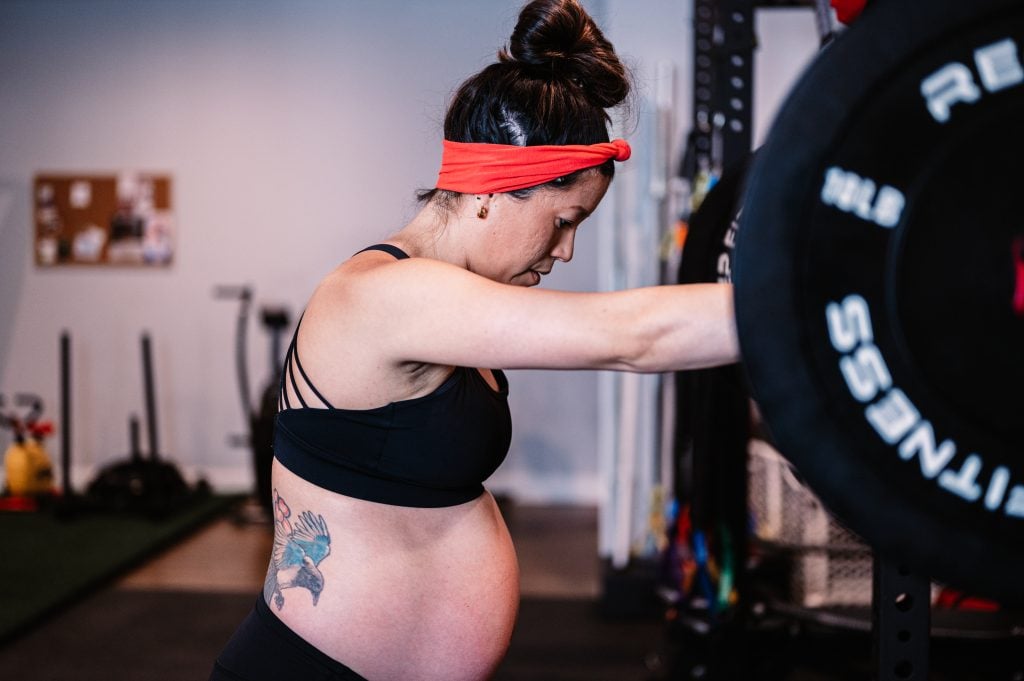

- 5 Workouts/Week
- Gym Workouts
- Self-Paced

Instructor
GINA
Workout on-demand with our prenatal fitness workout videos! Each workout is 30-40 minutes to follow along as you exercise at the same time!
- Birth Prep
- All Trimesters
- Mobility Work

Instructor
GINA
Find comfort and relief from pelvic girdle pain throughout your pregnancy and postpartum period! This program incorporates myofascial sling focused exercises to stabilize across the pelvic girdle joints.
- 3 Weeks
- On Demand Workout Videos to Follow