
You can have a strong pregnancy as you prepare for birth–in fact, we recommend it! While incorporating mobility and birth preparation stretches into your prenatal workout routine is crucial, it’s equally important to include strengthening exercises that help PULL the pelvis into more open positions. In this blog, we will share both strength and mobility exercises to help you get ready for birth!
Prepare for Birth: Strength and Mobility
When preparing for birth, we need more than just stretches and mobility–we also need strengthening exercises to pull our pelvis into more open positions.
However, it is important to note that THREE pelvic levels open with different movement patterns. This means that there is no one movement that opens the ENTIRE pelvis–so doing only deep squats and butterfly poses is not going to be enough for your birth preparation.
As a part of your birth preparation, we need to include exercises that will support your baby’s position, prepare to open each pelvic level, and release tension in your pelvic floor.
You can see that this is already a lot–but the good news is we already have this figured out for you with the MamasteFit Prenatal Fitness Programs. You can join our online fitness programs for daily workouts that keep you strong, pain-free, and prepare you for birth!
Birth Prep: Support Your Baby's Position
Birth is more than just how big or open your pelvis is–your baby’s position plays a large role in how well they will navigate through your pelvis! Since there are three different pelvic levels, your baby also needs to move through different positions to navigate the pelvic space. This means there is no one best position for your baby to be in for birth–so trying to force your baby into one specific position is not necessary.
Rather, we want to focus on ensuring your baby’s path to rotate is clear when labor does begin! This means there is balance in the uterine ligaments and surrounding musculature, and the pelvis can easily open to allow your baby to move without obstacles.
One of the reasons that may cause your baby to find a less optimal position is that some physical restriction prevents them from being able to rotate to their best positions–this could be due to some tension in the uterine ligaments or surrounding musculature or limited pelvic mobility.
We can support our baby’s position by releasing common areas of tension and improving uterine balance–and we do this with the MamasteFit Birth Prep Circuit!
1. Forward Leaning Inversion: Support Your Baby's Position

The MamasteFit Birth Prep Circuit starts with the forward-leaning inversion to release tension in the vertical running uterine ligaments–the round ligament and uterosacral ligaments.
The forward-leaning inversion is a technique that positions your head below your hips to utilize gravity in stretching and untwisting the lower uterine ligaments and vertically oriented round ligaments. Here are the steps for performing this exercise:
- Start in an upright position with your hip extended on an elevated surface, such as your couch.
- Carefully move to place your forearms on the floor in an inverted position. The inversion should be fairly upright, and your legs should be relaxed. Your partner can spot you by placing their hands under your shoulders.
- Tuck your chin to your chest.
- Hold this position for 3 full cycles of breath.
During this exercise, you may feel stretching in the lower back, sacral area, and lower abdomen. If you feel lightheaded or dizzy, bring your knees to the floor and rest before standing up. It is advisable to avoid inversions if you have elevated blood pressure or hypertension. If the movement is too intense, you can try a less intense variation, such as the puppy pose or open-knee chest.
Birth Prep: Open the Pelvis and Release the Pelvic Floor
The next step to supporting your baby’s position and path through the pelvis is creating space in your pelvis for birth. You don’t need to wait until birth to figure out how to open your pelvis! You can begin to incorporate these exercises into your daily prenatal workout routine.
The pelvis has three main levels: the inlet, the midpelvis, and the outlet. Each of these pelvic levels opens with different movement patterns–and you’ll notice that there are more than just wide knees to open your pelvis!
Pelvic Inlet: The Top of the Pelvis
- Opening Movements:
- External Rotation and Abduction at the Hip: This involves the knees rotating outward as the ankles move inward and the legs moving away from the body’s center, respectively. A common position that achieves this is a wide knee squat.
- Anterior Pelvic tilt: This is achieved by arching in the back, which changes the pubic bone angle to increase space in the anterior inlet. An anterior pelvic tilt can also make finding more external hip rotation easier, contributing to more space side-to-side in the inlet.
- Posterior Pelvic Tilt: This is achieved by tucking the butt under and rounding the back, which increases the front-to-back diameter of the pelvic inlet.
- Baby’s Position:
- The baby first engages in the pelvis at this level, starting their descent.
- Opening Movements:
Midpelvis: The middle of the pelvis. This pelvic level can be divided into two levels: the upper and lower midpelvis.
- Opening Movements: Upper Midpelvis:
- External Hip Rotation: This involves rotating the belly away from the thigh to find an open hip position. This is usually one-sided wide knee positions.
- Abduction at the Hip and Anterior Pelvic Tilt: This makes it easier to find external hip rotation and creates more space in the upper midpelvis.
- Opening Movements: Lower Midpelvis:
- Internal Rotation at the Hip: This involves rotating the belly to the thigh and maintaining weight in the big toe with the knee aligned over the ankle. Step-ups are a good exercise for this.
- Adduction at the Hip and Posterior Pelvic Tilt: Internal rotation combined with adduction and a posterior pelvic tilt helps open the midpelvis.
- Baby’s Position:
- The baby twists through this pelvis section, rotating to fit through the narrower space. Baby starts their rotation in the upper midpelvis, then finishes their rotation under the pubic bone in the lower midpelvis. The midpelvis is a common area where labor stalls occur, particularly the lower midpelvis.
- Opening Movements: Upper Midpelvis:
Pelvic Outlet: The Bottom of the Pelvis
- Opening Movements:
- Internal Rotation and Adduction at the Hip: This involves bringing the knees together and rotating the hips inward. Movements that encourage this pattern are beneficial, such as certain yoga poses.
- Posterior Pelvic Tilt: This helps make it easier to find internal hip rotation, creating more space side to side in the pelvic outlet.
- Baby’s Position:
- The baby extends their head beneath the pubic arch to crown and be born.
- Opening Movements:
Watch this YouTube video for a visual example of how each pelvic level opens, plus the movements that create that space. Then continue scrolling to see prenatal exercises you can do to prepare for birth.
Open the Top of the Pelvis: Help Baby Engage!
The top of the pelvis is where your baby enters or engages into the pelvis! This is a common area that many of us are focused on as a part of our birth preparation. But the pelvic inlet is only ONE part of the pelvis that we should focus on!
The exercises you can include in your prenatal workout routine to help make it easier to open the top of the pelvis could include:
- Squats
- Deep Squat Back Expansion
- Pelvic Tilts with Wide Knees
2) Squats: Open the Top of the Pelvis

The most common exercise to do to prepare to open the top of the pelvis is the deep squat movement–and you can do this with weight! The squat involves wider knees as you drop to the bottom of the position.
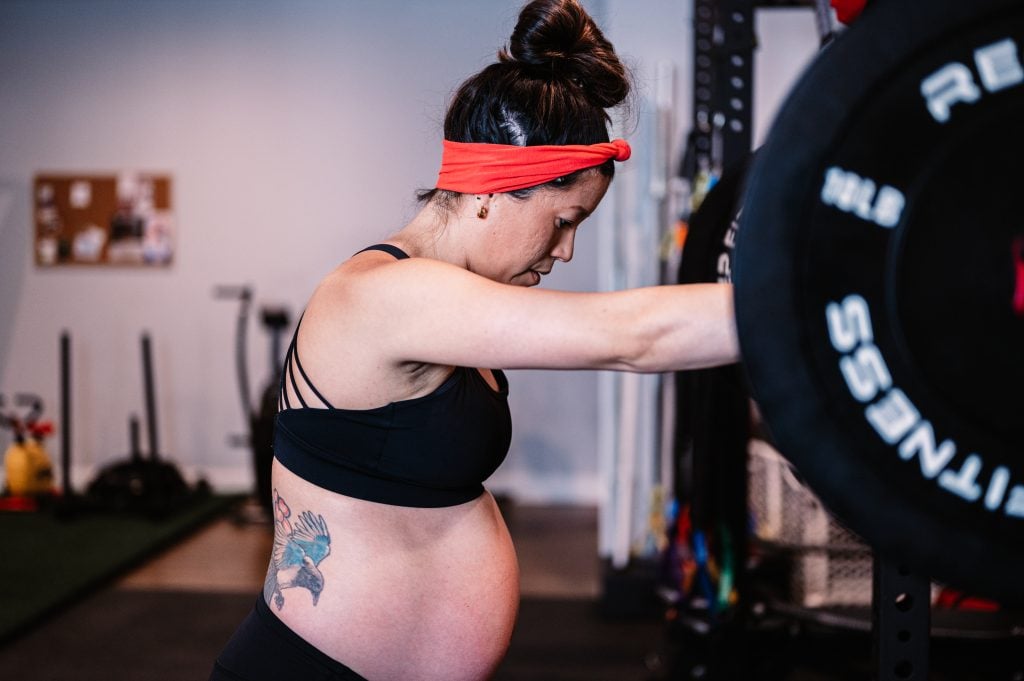
As pregnancy progresses, you may want to widen your stance and/or squat to a box for additional support. You can continue to barbell squat until your due date–however, many may opt to use free weights such as dumbbells or transition to body weight near the end of the third trimester.
3) Deep Squat with Back Expansion: Open the Top of the Pelvis
The good news is the pelvic inlet opens more with external hip rotation, abduction, and an anterior pelvic tilt–all movements that are typically easy to find during pregnancy because we favor those positions. However, the inlet also needs to open with posterior pelvic tilt (tucking butt under/rounding in the back), which may be more difficult to find during pregnancy (this is where the MamasteFit Birth Prep Circuit comes in handy).
Adding in pelvic tilts and movements that involve a rounded back position can be beneficial for our birth prep to help our baby engage!
Back expansion breathing drills can help you find that more rounded position, thus making it easier to find a posterior pelvic tilt to create space in the pelvic inlet.
Let’s break down the deep squat-back expansion breathing drill. Start by dropping to the bottom of a squat while holding onto a supportive structure. This position allows you to sink into the squat, aiding in the discovery of the desired rounding.
Inhale to feel your back expand. Then exhale to pull your belly to your spine to round more in your back. Hold here for ten full breaths.
Watch the demo video for more of a walkthrough of this exercise.
4) Pelvic Tilts with Wide Knees: Open the Top of the Pelvis
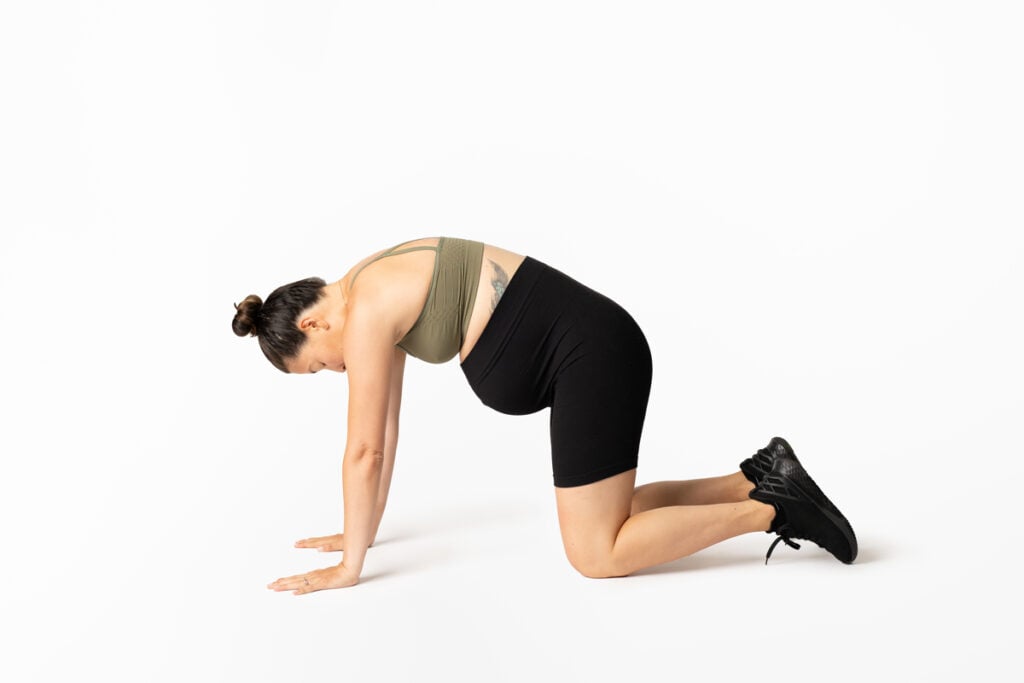
Another exercise that opens the top of the pelvis with more of that posterior pelvic tilt is pelvic tilts! We can emphasize opening the top of the pelvis with wider knees.
In a tabletop position, spread the knees wide as you bring your ankles closer together. Then, arch and round in your back for 10-20 repetitions.
Open the Middle of the Pelvis: Help Baby Rotate
The midpelvis is the middle of the pelvis. This is where your baby rotates from the top to the bottom, but it can also be the narrowest space in your pelvis! This is the pelvis area where I see the most labor stalls, particularly the lower midpelvis.
The upper midpelvis is where your baby begins their rotation into the pelvis. This space opens more with one-sided open hip positions–think knee away from the belly.
The lower midpelvis, where your baby completes their rotation under the pubic bone, is a critical area. It opens more with one-sided closed hip positions, like bringing your belly into the thigh. These positions can be challenging to find during pregnancy, so our prenatal fitness programs emphasize them, ensuring you’re well-prepared for childbirth. In addition, we can use closed hip positions and hip shifts to release tension in the posterior pelvic floor (where we tend to have more tension) as we prep for birth.
Exercises that you can include in your prenatal workout routine to prepare to open the midpelvis could include:
- 90/90 Side Camel and Switches
- Lateral Step with Lateral Hip Shift
- Standing Hip Shifts
5) 90/90 Side Camel and Switches: Opens Midpelvis

The midpelvis opens more with external AND internal hip rotation. As your baby rotates through the midpelvis, altering between open and closed hip positions can help your baby rock and wiggle through.
The 90/90 positions incorporate external and internal hip rotation to create space in the midpelvis. There are so many variations of this exercise that you can do!
In the 90/90, you’ll start with one leg in front in external rotation and the other leg to the side in internal hip rotation. You can add a side body opener for the internally rotated leg.
Then, either place your hands behind you or keep the hands off the floor as you rotate to the opposite side.
Modifications
- For Beginners: Keep your hands on the floor for support throughout the movement.
- Advanced Variation: As you get more comfortable, try performing the shinbox flow without using your hands for support, relying more on your core and hip strength.
6) Lateral Step Up with Hip Shift: Opens Lower Midpelvis and Pelvic Floor Release
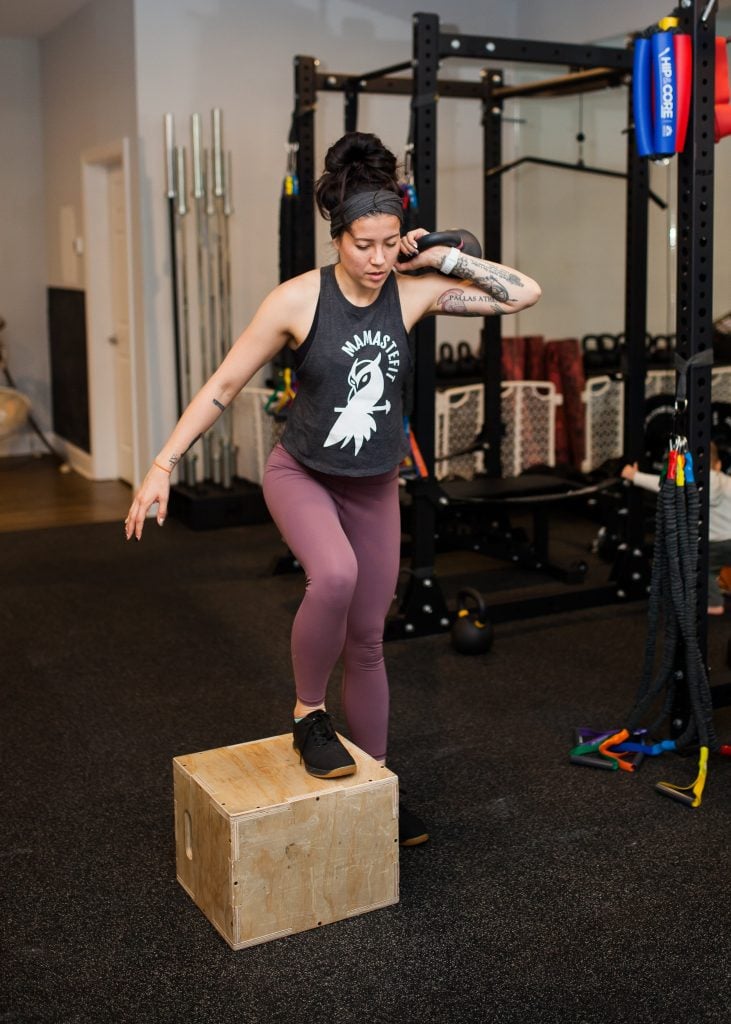
Step-ups and single-leg exercises are great midpelvis opening exercises. You can find both internal and external hip rotation, or close to open hip positions, with single leg exercises, such as the step up.
The step-up variation, with its emphasis on the hip shift, is highly effective in targeting the lower midpelvis and pelvic floor release.
Stand beside the elevated surface with your inside foot on the box. Then, reach with the opposite hand to bring the belly towards the elevated thigh. This will help you find a closed hip position.
Exhale to stand up, as you rotate to face forward (neutral or open hip positions). Inhale to lower back to the closed hip position.
After you complete your step up, you’ll place both feet on the floor and shift into the outside hip for a pelvic floor raise.
7) Standing Hip Shift: Opens Lower Midpelvis and Pelvic Floor Release
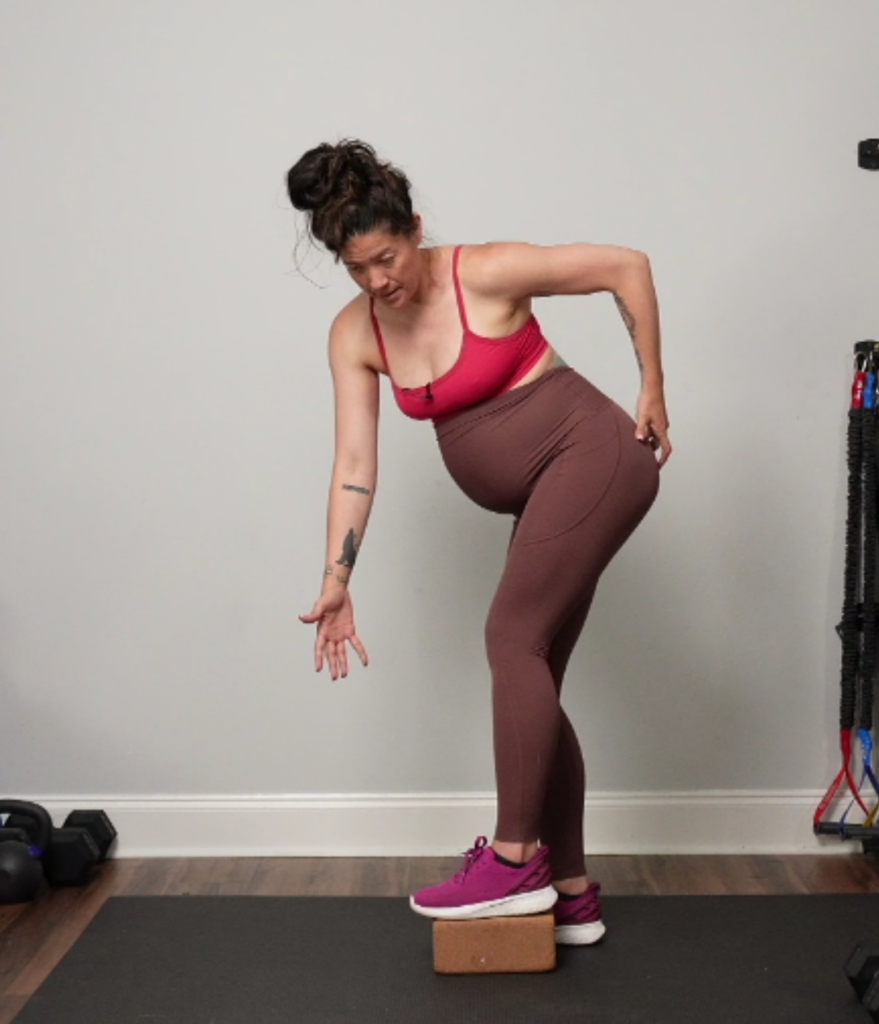
Hip shifts are a great exercise to prepare for birth–and we incorporate a number of variations in the MamasteFit Prenatal Fitness Programs.
Hip shifts involve shifting your weight towards one leg. This shift brings your hip into a closed hip position and internal pelvic rotation. The shift moves the tailbone towards the opposite side, which can also stretch the posterior pelvic floor.
In this standing hip shift variation:
- Start with one foot on a yoga block.
- Shift your weight to the elevated foot, placing more weight into the big toe.
- Reach with the opposite hand towards the foot to rotate the upper body and belly towards the elevated thigh.
- Hold here for 10 breaths
Then, we can add movement by moving in and out of the hip shift. This is important for daily function- when we walk, we find a milder version of this hip shift!
Open the Bottom of the Pelvis: Prep for Pushing
The pelvic outlet, known as the bottom of the pelvis, opens more with internal hip rotation (knees in, ankles out). Our hamstrings and adductors PULL the pelvic outlet more open, so focusing on deadlifts, adductor strengthening exercises, and posterior pelvic floor release can be helpful when preparing for pushing,
8) Deadlifts and Hinges: Open the Bottom of the Pelvis

Hinge exercises, such as the deadlift, strengthen the hamstring muscles. The hamstrings help to pull the pelvis into internal rotation with the help of the adductor muscles!
Deadlifts are a great prenatal exercise to include in your daily routine–as they strengthen not only the hamstrings for birth preparation but also the backside of the body to help counter the shift forward of the center of gravity as the belly grows.
As pregnancy progresses, you may want to widen the stance and/or elevate the barbell to make the movement more comfortable. Similar to the squats, you can use a barbell until your due date, or you can opt to use dumbbells or resistance bands.
We include a variety of hinge variations in our prenatal fitness programs.
9) Standing Adduction: Open the Bottom of the Pelvis
The adductor, inner thigh muscles, also helps to pull the pelvis into internal rotation. Exercises that you are bringing the legs closer together help to strengthen the adductor muscles. This banded variation can be done with a resistance band or cable machine!
10) Hero Ball Crunch: Open the Bottom of the Pelvis and Release the Posterior Pelvic Floor
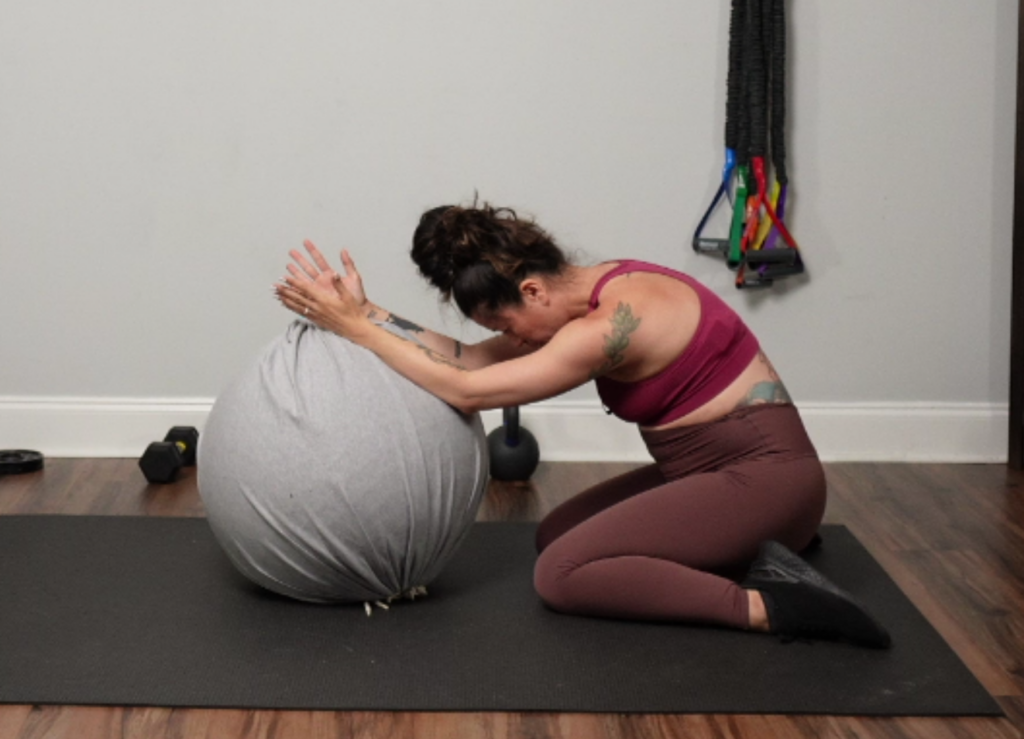
As we delve into our strengthening exercises, let’s not forget the importance of mobility and core work in preparing for pushing. In the hero’s pose, your hips are in internal rotation with the knees in ankles out. To ensure you feel fully supported, consider placing a yoga block under your hips. This simple addition can provide a sense of security and stability, allowing you to focus on your form and technique.
In addition to hip mobility, we can add a ball crunch to activate the abdominal wall to help us find a posterior pelvic tilt.
Place your forearms on the ball, and press down as you pull the ball back towards you to activate the core. This crunching motion will help you round in your back.
Stay Strong and Prepare for Birth!
Birth preparation is more than just wide knees with deep squats and stretching. We can also incorporate strengthening exercises to pull the pelvis more open! No one movement opens the entire pelvis, so adding a variety of hip movements will help prepare for birth.
There are so many exercises that you can do to stay strong throughout pregnancy as you prep for birth, and we already have daily workouts in our prenatal fitness and birth prep workout programs!
Prenatal Support Courses

Learn the science of pregnancy and birth to take the mystery of labor away! Understand why you are feeling what you feel, and learn strategies to confidently move through pregnancy and birth!
- 9h+ of Video
- Support Group
- Close Captioning

- 5 Workouts/Week
- Gym Workouts
- Self-Paced

Instructor
GINA
Workout on-demand with our prenatal fitness workout videos! Each workout is 30-40 minutes to follow along as you exercise at the same time!
- Birth Prep
- All Trimesters
- Mobility Work

Instructor
GINA
Find comfort and relief from pelvic girdle pain throughout your pregnancy and postpartum period! This program incorporates myofascial sling focused exercises to stabilize across the pelvic girdle joints.
- 3 Weeks
- On Demand Workout Videos to Follow