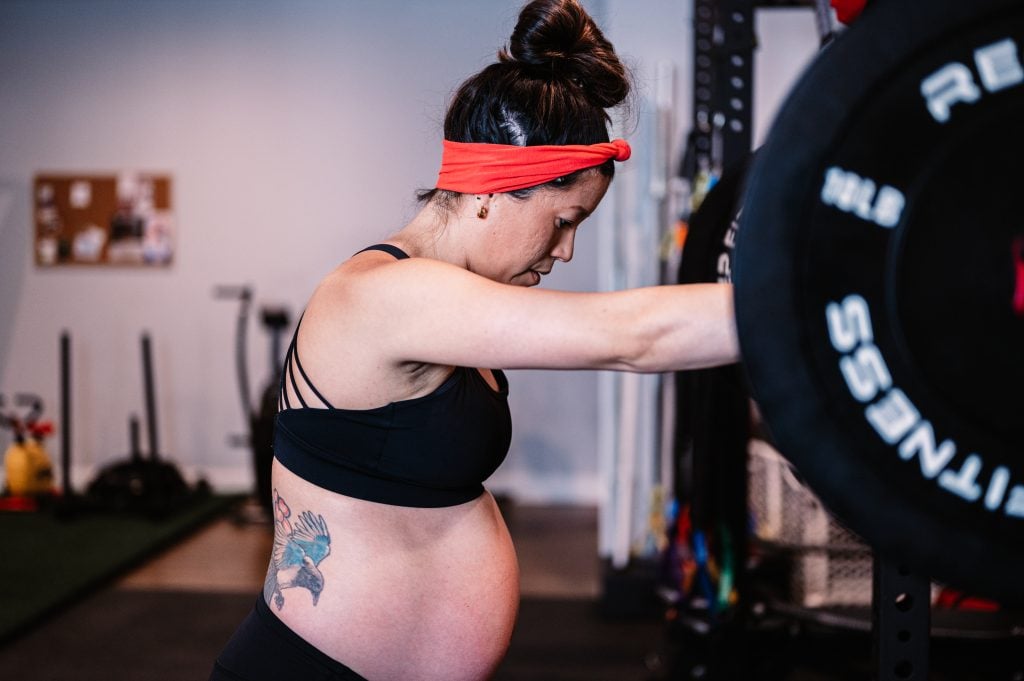
In this blog, we’re going to break down the four types of movements that you need to be doing in your prenatal routine to help create space within your pelvis to make it easier for baby to navigate and rotate through during birth. It’s important to note that there’s not just one movement that opens the entire pelvis – there are actually three different pelvic levels that all open with different types of movement patterns.
Understanding the Pelvis
There are actually three different pelvic levels that all open with different types of movement patterns:
- Pelvic Inlet – The top of the pelvis where your baby’s going to first enter or engage into the pelvis.
- Midpelvis – The bony structure that your baby is going to be rotating through during labor and where they will probably spend the most amount of time.
- Pelvic Outlet – The bottom of the pelvis where your baby’s going to exit.
Interested in learning more about what to expect during labor? Sign up for our newsletter for our FREE 30-minute intro to childbirth class! This 30-minute class will walk you through what is a contraction, what is dilation/effacement, and the labor timeline!
1. External Hip Rotation for the Pelvic Inlet
The pelvic inlet is the top entryway of your pelvis, where your baby first engages during labor. To create space here, focus on movements that promote external hip rotation. Think of deep squats, butterfly poses, or any exercise that encourages both legs to move outward. These movements help open the pelvic inlet from side to side.
Additionally, adjusting your pelvic tilt can further assist in opening the top of the pelvis. An anterior pelvic tilt, where you arch your back slightly, changes the angle of your pubic bone and facilitates more external hip rotation. Conversely, a posterior pelvic tilt, where you tuck your butt under and round your back, creates space from front to back in the pelvic inlet.
Movements to help you prepare to open the inlet include:
- External Rotation
- Squats
- Adductor Release
- Posterior Pelvic Tilt
- Deadlifts/Hinge for hamstring strengthening
- Pelvic Tilts
- Lat and Hip Flexor Releases
2. Asymmetrical Movements for the Mid Pelvis
The mid pelvis is where your baby will likely spend the most time rotating during labor. To create the necessary space here, incorporate asymmetrical movement patterns.
For the upper mid pelvis, focus on unilateral external hip rotation. Exercises like elevated lunges, where one leg is positioned away from your body, help create space in the upper mid pelvis. On the other hand, for the lower mid pelvis, internal hip rotation is key. Incorporate movements that shift weight onto one leg and bring the belly towards the thigh, such as hip shifts or single-leg movements.
Movements to help you prepare to open the midpelvis include:
- External Rotation
- Side Lunges
- Adductor Rock Backs
- Internal Rotation
- Step Ups with IR
- RDLs with IR
- Lunges with IR
- Hip Shifted Movements
3. Internal Hip Rotation for the Pelvic Outlet
The pelvic outlet is the bottom part of the pelvis where your baby will exit. To create space here, engage in movements that promote internal hip rotation. Think of exercises that involve bringing your knees inward while keeping your ankles outward. This can be achieved through exercises like deadlifts, which strengthen the hamstrings and promote internal hip rotation, and adductor strengthening exercises, which target the inner thigh muscles.
Movements to help you prepare to open the pelvic outlet include:
- Internal Rotation
- Staggered Stance RDL with IR
- Posterior Pelvic Tilt
- Deadlifts/Hinge for hamstring strengthening
- Pelvic Tilts
- Lat and Hip Flexor Releases
- Adductor
- Copenhagen planks
- side lying hip abduction
4. Combining Movements for Optimal Pelvic Space
To comprehensively prepare for birth, it’s essential to incorporate all four movement patterns into your routine. Here’s a quick breakdown:
- Bilateral External Hip Rotation: Squats and hip thrusts that engage both legs in outward movement.
- Unilateral External Hip Rotation: Elevated lunges or rotational step-ups that open the hip on one side.
- Unilateral Internal Hip Rotation: Hip shifts or single-leg movements that promote closed hip positions.
- Bilateral Internal Hip Rotation: Exercises like deadlifts and adductor strengthening to facilitate internal rotation on both sides.
Get Started with Our Prenatal Fitness Programs
If you want more daily workouts to support a strong pregnancy as you prepare for birth, join our online prenatal fitness programs!
MamasteFit is unique in that we are one of the ONLY prenatal/postnatal training facilities in the United States. We develop our workout programs from our experience of working with in-person pre/postnatal fitness clients and work closely with physical therapists to refine our programming. In addition, we are birth workers, so we combine our experience as perinatal fitness trainers and birth professionals to ensure that our programs actually support your birth preparation and recovery!
Our prenatal fitness programs are offered in several formats:
- 40-Week Prenatal Strength Program in the Teambuildr App:
- This program is a self-paced workout with shorter demo videos. This is ideal if you like to workout in a gym setting and prefer a traditional workout delivery format.
- This program syncs to your current week of pregnancy, so you can start anytime, with one-time payment or month-to-month payment options.
- This program has a full and mini version, depending on how much time you have to dedicate to workouts!
- Prenatal On-Demand Fitness Program:
- If you prefer to follow a video as you workout at the same time, this workout program will be the best option!
- This program syncs to your current trimester, so you can grab the trimesters you need!
- Birth Prep Workout Program:
- If you already have a workout routine or you only want birth prep-focused workouts, check out this program!
- This program includes full-length workout videos to follow as you workout at the same time.
- Prenatal Yoga Classes:
- If you want prenatal yoga, join our prenatal yoga program! This also syncs to your current trimester.
Conclusion
By focusing on these specific movement patterns before you go into labor, you can help create the necessary space within your pelvis, making your labor and delivery experience smoother. Incorporate these exercises into your prenatal routine, and you’ll be well on your way to a more comfortable and prepared birth!
Prenatal Support Courses
Learn the science of pregnancy and birth to take the mystery of labor away! Understand why you are feeling what you feel, and learn strategies to confidently move through pregnancy and birth!
- 9h+ of Video
- Support Group
- Close Captioning
- 5 Workouts/Week
- Gym Workouts
- Self-Paced
Instructor
GINA
Workout on-demand with our prenatal fitness workout videos! Each workout is 30-40 minutes to follow along as you exercise at the same time!
- Birth Prep
- All Trimesters
- Mobility Work
Instructor
GINA
Find comfort and relief from pelvic girdle pain throughout your pregnancy and postpartum period! This program incorporates myofascial sling focused exercises to stabilize across the pelvic girdle joints.
- 3 Weeks
- On Demand Workout Videos to Follow