



After your baby has entered the pelvis, they need to rotate through the midpelvis to reach the outlet for pushing.
Labor positions that focus more on asymmetrical or unilaterally loaded positions tend to create more space in the midpelvis to make your baby’s rotation easier.
What can we do to prepare for birth? We can ensure that we can find these movement patterns during pregnancy so they are more accessible during our labor!
Let’s explore two labor positions that open the midpelvis and six prenatal exercises you can do to prepare for birth!
This course includes our 90-minute labor biomechanics webinar recording plus our 24-page labor biomechanics quick reference guide.
- 90-min webinar
- 24-Page E-Book
- Upcoming Live Webinar & Q&A
- Watch on Mobile Device
Open the Midpelvis:
Creating Space for Baby's Rotation
The midpelvis is the bony structure that baby has to rotate through during labor.
For some of us, we will start labor with our baby’s already engaged and may find that we are favoring swaying and asymmetrical labor positions.
For others, after laboring for some time, baby will engage and then begin to rotate!
But for all of us, baby eventually needs to rotate through the midpelvis, so we need to be able to create space asymmetrically in the pelvis.
The midpelvis opens more with:
- Swaying
- Side to side movements
- Open hip and closed hip positions
Let’s explore some labor positions that help to open the midpelvis!
Midpelvis Laboring Positions
During labor, we tend to intuitively move in a way to create space for our baby.
If our baby is still high and not yet engaged, we tend to favor movements that open the inlet of the pelvis.
But, once our baby has engaged, or entered the pelvis, we tend to favor movements that are side to side or swaying, to open the midpelvis.
Want to learn more about the science of birth and the different pelvic levels? Check out our childbirth education course!
We teach you what is actually happening in your body during labor, the anatomy of birth, and labor positions + comfort measures to help you navigate your labor with your partner!
Learn the science of pregnancy and birth to take the mystery of labor away! Understand why you are feeling what you feel, and learn strategies to confidently move through pregnancy and birth!
- 9 hours of on-demand video
- Lifetime Access of E-Course
- Watch on Mobile Device
1) Elevated Side Lunge

The midpelvis opens more with asymmetrical movements, or one leg is doing something differently than the other, or we are shifting weight into one leg.
The elevated side lunge tends to open the upper midpelvis more as baby begins its rotation into the pelvis.
The elevated side lunge incorporates an open hip position, or external rotation, with one leg, as the other is more neutral.
Holding onto your partner, rock your weight back and forth between your two legs, to help open the midpelvis.
You can adjust the height of the stool or elevated surface based on what is comfortable for you!
2) Ball Supported Half Lunge

If you are finding that you need to move closer to the floor as labor progresses, try using the birth ball in an all fours position!
There are so many options with the birth ball, but one that you can try is the half lunge position.
Depending on how you rock, this can open both the upper and lower midpelvis!
Sacral counterpressure tends to be an easy comfort measure to incorporate in the half lunge position, as well!
Want to learn more labor positions and comfort techniques? Check out our childbirth education courses!
We also incorporate labor prep workouts in our prenatal fitness programs where you and your partner can practice labor positions and comfort techniques by following an on-demand workout.
These workouts are incorporated in the third-trimester portion of both our 40-week prenatal strength program and 3rd-trimester prenatal on-demand program
Prepare to Open the Midpelvis
Upper Midpelvis: Help Baby Begin Their Rotation
Prenatal fitness can help us prepare for birth! One aspect of the preparation is to ensure that the necessary movements to open each pelvic level are accessible to us.
The upper midpelvis opens more with:
- External rotation of the femur, or an open hip position, on one side
- Anterior pelvic tilt
This means that we need to incorporate exercises into our programming that favor unilateral external rotation and an anterior pelvic tilt.
Let’s explore three exercises you can try to prepare for birth!
1) Cossack Lunge
The cossack lunge is a strengthening exercise that focuses on external rotation or an open hip position on one side. This is great for the upper midpelvis that favors unilateral external rotation!
You may find that the cossack lunge is not accessible if you have pelvic girdle pain in the pubic symphysis. If you are experiencing pelvic girdle pain, we can address it during pregnancy to try to minimize or alleviate it, or check out our blog on laboring with pelvic girdle pain for some tips.
2) Adductor Rock Back with Rotation
In addition to strengthening, we need to release the muscles on the opposite side which may make it more difficult to find external rotation.
The adductor rock back focuses on releasing the inner thigh, the adductor, that we need to stretch to find external rotation.
3) 90/90 Side Body Opener
In addition to focusing on the legs, we need to consider how the rest of the body influences the pelvic position! Releasing in the side body can help us find more external rotation on that side, as well!
In the 90/90 side body opener, we are leaning away from the externally rotated leg to find the stretch. You may also feel a release in the hips (which helps open the midpelvis).
We incorporate mobility drills like these in the third-trimester portion of our prenatal fitness programs to prepare you for birth!
Lower Midpelvis: Help Baby Finish Their Rotation
The lower midpelvis needs to open more as baby finishes their rotation!
The lower midpelvis opens more with:
- Internal rotation of the femur, or a closed hip position
- Posterior pelvic tilt
Internal rotation work is huge for labor preparation! And is usually neglected in fitness programs, in general, since power is generated from externally rotated positions.
But, part of our hip’s range of motion is an internal rotation!
If we incorporate exercises that favor internal rotation, we will not only strengthen our glutes overall but prepare for birth!
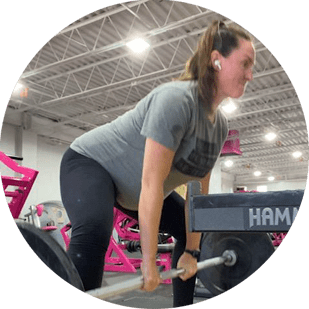
1) Staggered Stance RDL with Banded Row
The staggered stance RDL is a hinge-focused exercise that strengthens the hamstring, glutes, and lats.
The banded variation allows us to stay more upright, which may be more comfortable in the third trimester.
Holding the band with the opposite hand of the forward leg, hinge at the waist.
The knee should stay directly above the ankle, and not push outwards.
Think belly to the thigh or rotating the pelvis on top of the femur. You should feel the forward leg glute and hamstring stretch more at the bottom when you do this!
Watch the video below for a breakdown of this exercise!
2) Step Up with Banded Row
Another internally rotated focused exercise is the step up! Some folks find the step up is easier to do since the leg starts in a bent position.
At the bottom of the movement, think rotate belly to thigh (as best you can). Remember, it’s the pelvis that is rotating in the femur, not the knee pushing outwards. The knee should stay stacked over the ankle.
Exhale as you step up and row the band back, and face forward. Then inhale to lower as you rotate back towards the working leg.
Watch the video below for a breakdown!
3) Hip Flexor Release with Pelvic Tilt
In addition to the strengthening movements, we need to find release so that finding internal rotation and a posterior pelvic tilt is easier. Releasing the quad and hip flexor can make it easier to find that posterior pelvic tilt or tucking the butt underneath.
After you do the quad and hip flexor release, we can shift into an uneven pelvic tilt to focus on finding that tucked position on each side!
Prepare for Birth with Exercises Focused on Opening the Midpelvis
We can use prenatal fitness to prepare for birth by ensuring that movement patterns that are necessary to open the pelvis are accessible to us. If we find that internal rotation is challenging to find, it could cause issues during labor!
During our prenatal workouts, we can focus on strengthening and mobility to find openings in the pelvis!