
Preparing for your upcoming birth?? Ditch the kegels! The pelvic floor does NOT push your baby out–it needs to release and move out of the way! As you prepare for birth, particularly for pushing, we want to think about creating space in the BOTTOM of the pelvis and releasing tension in the pelvic floor.
In this blog, I will break down what exercises help to open the bottom of the pelvis and one of my favorite pelvic floor release exercises for birth preparation.
Prepare the Pelvis for Birth
No one movement opens the entire pelvis! There are several different types of movements in the hip, pelvis, and even spine that open each part of the pelvis.
The pelvis has three main levels:
- Inlet–the top of the pelvis. This is where your baby first enters the pelvis. Wider knees and external hip rotation tend to create more space in this part of the pelvis.
- Midpelvis–the middle of the pelvis. This is where your baby rotates, and will likely spend a lot of time during labor. Asymmetrical, side-to-side, and weight-shifting movements tend to create more space in the middle of the pelvis.
- Outlet–the bottom of the pelvis. this is where your baby is born and where we are primarily focusing on when you are pushing! Knee ins, with ankles out, in internal hip rotation tend to open the bottom of the pelvis.
In this blog, we are focusing on the pelvic outlet–the bottom of the pelvis. When you are preparing for birth, you may be encouraged to do a lot of kegels to strengthen the pelvic floor. This may even be a recommendation from your medical provider! However, the pelvic floor does NOT push your baby out–the pelvic floor needs to relax to allow the bony structure to shift positions and to allow your baby to more easily pass through it.
As a part of birth preparation, doing a lot of kegels may actually make your labor harder–so likely opt out unless you have direct guidance with a pelvic floor physical therapist to help with some sort of pelvic floor issue (although kegels are usually NOT the solution to your pelvic floor issues either).
When preparing for pushing, the focus is to be able to easily create space in the bottom of the pelvis and relax the pelvic floor!
The bottom of the pelvis opens more with:
- Internal hip rotation, knees in with ankles out. This helps to spread the ischial tuberosities (sitz bones) further apart and opens the bottom fo the pelvis more side-to-side.
- Sacral nutation, tailbone moves backward. This helps to create more space front-to-back
- Releasing the posterior pelvic floor to make it easier to find internal pelvic rotation and move the sacrum.
Not every birth preparation exercise is wide knees, such as deep squats and butterfly pose!! We also need to incorporate other types of hip movements to open the pelvis for birth.
Birth Prep Exercises to Prepare for Pushing
You can use your prenatal workouts to prepare for birth by incorporating exercises that target internal hip rotation, lat strengthening, and pelvic floor release.
Pelvic opening birth prep exercises can include both strength and mobility exercises–birth prep is not all just stretching!
The strength exercises make it easier for you to PULL your pelvis into different positions–for the bottom of the pelvis, strengthening the hamstrings and adductors (inner thighs) helps to PULL the pelvis into internal rotation. Mobility exercises make it easier for those muscles to pull the pelvis into those positions by releasing tension–for the bottom of the pelvis, focusing on the posterior pelvic floor is most helpful.
Exercises that open the bottom of the pelvis include:
- Hamstring and adductor strengthening exercises. The hamstring and adductors pull the pelvis into the internal rotation to create more space side-to-side in the pelvic outlet.
- Exercises could include deadlifts, hinge-focused exercises, Copenhagen planks, and seated or standing adduction.
- Lat strengthening exercises. The lats do not directly attach to the sacrum, but there is a connection with connective tissue and fascia. If we generate lat tension, it can apply traction against the sacrum to pull the bottom of the sacrum out to create space from front to back. This is a common reason why when pushing you may find pulling on your legs or a sheet to feel very intuitive.
- Exercises could include lat pull-downs, cable or banded rows, and bent over rows.
- Posterior pelvic floor release. The pelvic floor attaches to the pelvis and sacrum, so tension or limited mobility of the pelvic floor can impact how well you can create space in each pelvic level. The posterior pelvic floor attaches to the sacrum and tailbone, so releasing tension here can make it easier to create space in your pelvic outlet.
In this 21-minute birth prep workout, I guide you through exercises that focus on the pelvic outlet! This workout includes:
- Banded Good Mornings to strengthen the hamstrings which pull the pelvis into internal rotation aka opens the pelvic outlet side to side.
- Standing Archer Row to strengthen the lats which apply traction to pull the bottom of the sacrum backward to create space front to back. In addition, this exercise includes a hip shift which releases tension in the posterior pelvic floor.
- Standing Hip Shift to Move to release tension in the posterior pelvic floor and improve pelvic mobilty.
We include birth prep workouts in our prenatal fitness programs. Our app-based program includes a weekly birth prep workout that targets each pelvic level, while our on-demand program includes full-length birth prep workout videos like the one listed above.
1) Banded Good Morning: Hamstring Strengthening


The hamstrings are the muscles on the back of your thighs. These muscles help to bend your knee, extend your hip, and most importantly for birth prep, create internal hip and pelvic rotation.
Exercises that target the hamstrings, such as banded good mornings and hinge-focused exercises like the deadlift, are great to include in your prenatal workouts. Deadlifts and other hinge exercises strengthen the posterior chain (back side of your body) to counter the increased weight on the front side of your body during pregnancy (hello baby) which can help you stay more comfortable! Then add on the benefit of deadlifts creating more space in the lower pelvis, and it’s a win-win.
If you want more daily workouts to support a strong pregnancy as you prepare for birth, join our online prenatal fitness programs!
MamasteFit is unique in that we are one of the ONLY prenatal/postnatal training facilities in the United States. We develop our workout programs from our experience of working with in-person pre/postnatal fitness clients and work closely with physical therapists to refine our programming. In addition, we are birth workers, so we combine our experience as perinatal fitness trainers and birth professionals to ensure that our programs actually support your birth preparation and recovery!
Our prenatal fitness programs are offered in several formats:
- 40-Week Prenatal Strength Program in the Teambuildr App:
- This program is a self-paced workout with shorter demo videos. This is ideal if you like to workout in a gym setting and prefer a traditional workout delivery format.
- This program syncs to your current week of pregnancy, so you can start anytime, with one-time payment or month-to-month payment options.
- This program has a full and mini version, depending on how much time you have to dedicate to workouts!
- Prenatal On-Demand Fitness Program:
- If you prefer to follow a video as you workout at the same time, this workout program will be the best option!
- This program syncs to your current trimester, so you can grab the trimesters you need!
- Prenatal Yoga Classes:
- If you want prenatal yoga, join our prenatal yoga program! This also syncs to your current trimester.
2) Archer Row: Lat and Hip Shift Birth Prep Exercise
The archer row is one of my new favorites this pregnancy! The archer row includes a banded row (either from an anchor point or you can hold the band in your hands) to strengthen the lats and a hip shift to release tension in the pelvic floor and improve pelvic mobility.


In the banded row, you will start with both hips extended with one foot about 6 inches behind the front foot. Then you will row the band back with the same side hand as the back foot. For example, if your right foot is back, this is the leg we plan to hip shift into. You will row back with the right hand as you shift into the right hip.
See the video for a more in-depth breakdown of this exercise!
3) Standing Hip Shift to Move: Pelvic Floor Release and Pelvic Mobility
Hip shifts are one of the best exercises for pelvic floor release! Hip shifts target the posterior pelvic floor on the shifted leg (more toward one side) and the anterior pelvic floor on the non-shifted side (so, it’s a diagonally release).
Being able to hip shift is so important for hip stability (internal rotation is how we stabilize when we stand), pelvic floor function, and birth preparation. It’s a big deal!!
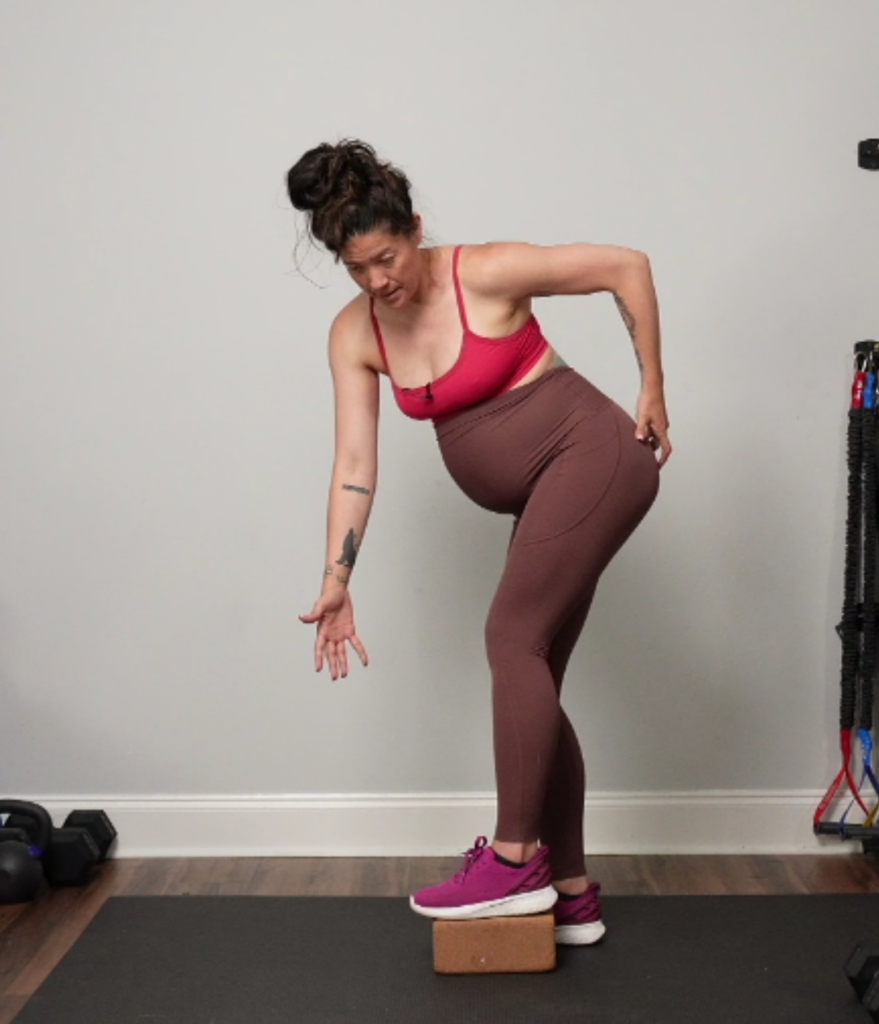
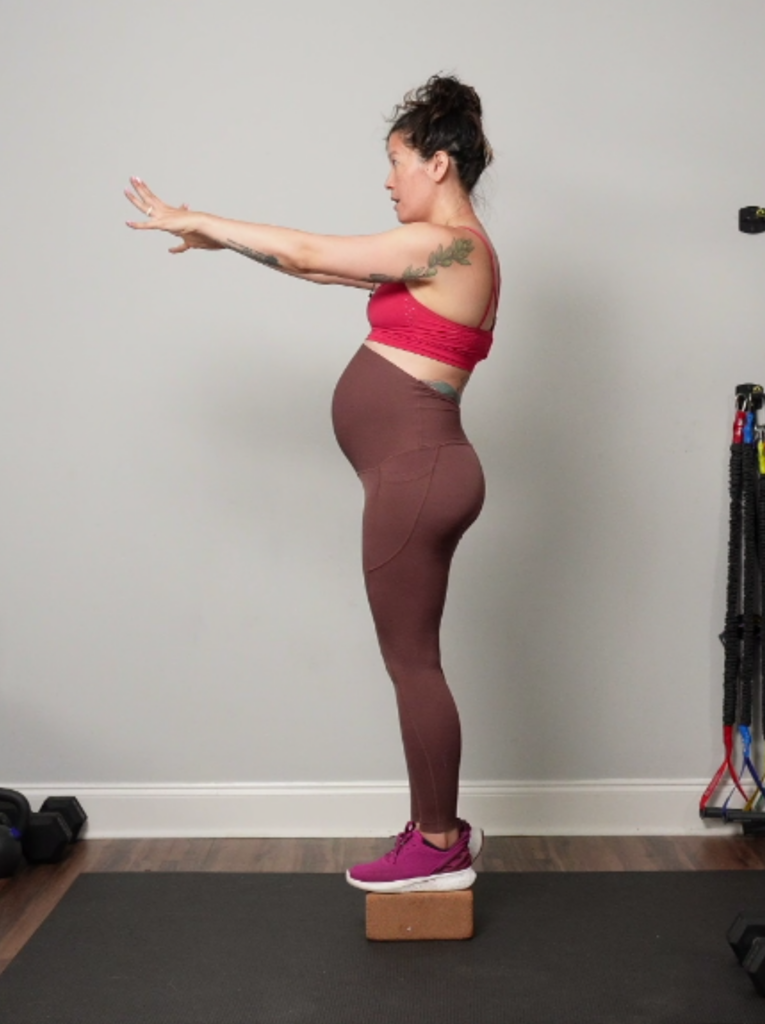
The standing hip shift is a full-body mobility exercise, and I find because of the increased muscular activation, I can “feel” the release much more than in more restorative positions.
In the standing hip shift, start with one leg on an elevated surface such as a yoga block, then hinge your hips back as you rotate your belly towards the elevated leg. A helpful cue is to think about keeping weight on the big toe of the elevated leg.
Then reach across your body towards the elevated foot to rotate the upper body, which will counter the rotation in the lower body to bring you deeper into the posterior pelvic floor on the elevated leg.
See the video for a more in-depth walkthrough of this exercise.
There are common areas of tension during pregnancy due to our common postural tendencies (how we like to stand and move).
The MamasteFit Birth Prep Circuit targets these common areas of tension to make it easier for you to create space in your pelvis and release tension in your pelvic floor! In the circuit, we include two hip-shifting exercises!
Sign up for our newsletter for the free birth prep guide!
Conclusion
There is a lot we can do throughout pregnancy to prepare for birth–and it usually does NOT include kegels. When preparing for pushing, we want to focus on strengthening the hamstrings, adductors, and lats and releasing tension in the pelvic floor to opne th ebottom fo the pelvis!
Learn more in our daily prenatal workouts and childbirth education course!
Prenatal Support Courses


Learn the science of pregnancy and birth to take the mystery of labor away! Understand why you are feeling what you feel, and learn strategies to confidently move through pregnancy and birth!
- 9h+ of Video
- Support Group
- Close Captioning

- 5 Workouts/Week
- Gym Workouts
- Self-Paced

Instructor
GINA
Workout on-demand with our prenatal fitness workout videos! Each workout is 30-40 minutes to follow along as you exercise at the same time!
- Birth Prep
- All Trimesters
- Mobility Work

Instructor
GINA
Find comfort and relief from pelvic girdle pain throughout your pregnancy and postpartum period! This program incorporates myofascial sling focused exercises to stabilize across the pelvic girdle joints.
- 3 Weeks
- On Demand Workout Videos to Follow