



I remember in my first pregnancy, my mother-in-law aggressively told me that I couldn’t eat salmon (yes, you can), and random onlookers repeatedly told me that I should “be careful” when working out during my pregnancy. But the unsolicited advice can be relentless during pregnancy–and make you begin to question if exercising (or what you are doing) is even safe!
In a recent Instagram reel, our followers shared the unsolicited fitness advice they received during their pregnancy.
Some were fortunate to have a really supportive environment, in which they were cheered on and modifications were offered as needed throughout their pregnancy.
But most of us received backlash for exercising during our pregnancy. Some were concerned that exercise was not safe for the baby. Others were blamed for their miscarriages (exercise does NOT cause miscarriage). Some were called selfish for wanting to exercise (even though there are so many benefits for both mom and baby).
Advice was also conflicting–some were told to ONLY walk, and others were told to NOT walk at all. So, you can see how this starts to get confusing and could impact your confidence in continuing to exercise throughout your pregnancy.
In this blog, we are going to break down the benefits of exercising throughout your pregnancy for you and your baby, debunk the myths around prenatal fitness, and share how you can use your prenatal fitness to support your pregnancy, birth, and beyond! Our goal is to help you feel confident as you move throughout your pregnancy because it is so beneficial!
What are the benefits of prenatal exercise?? Is the "risk" worth it??
First, there is fairly little risk to exercising throughout your pregnancy, as we will discuss in the next section–so unless your provider has told you that exercise is not safe (there are some complications that exercising may be unsafe such as risk of premature labor, preexisting medical conditions, severe prenatal complications) then exercising is likely a safe option for you and your pregnancy!
But, let’s discuss the benefits of prenatal exercise! There is a lot of talk (not necessarily true talk) about the risks of exercise–and most of these risks revolve around whether is it safe for the baby. However, I don’t hear as much about the benefits of exercising, so let’s explore what research supports!
The benefits of prenatal exercise can include:
- More comfortable pregnancy
- Decreased risk of developing a prenatal complication, such as gestational diabetes, hypertension, or preeclampsia by up to 40%
- This decreased risk can reduce the need for a medical induction at the end of your pregnancy, which can positively impact your birth and postpartum!
- Decreased risk of a cesarean birth
- Decreased occurrence of instrument-assisted delivery (forceps or vacuum)
- Shorter labor
- Improved placenta functional capacity and volume (which is likely a big reason for the decreased risk of prenatal complications and increased benefits for your baby)
And since a lot of the unsolicited advice revolves around exercising and your baby, here are the benefits of prenatal exercise for your baby (and some may surprise you)!
- Increased placental functional capacity–placentas tend to be larger and more voluminous if you exercise throughout your pregnancy. This increase in size correlated to improved function, which can optimize nutrient and oxygen flow to your baby.
- Increased blood volume of the baby–this increased blood volume means increased oxygenation and resiliency to planned and unplanned stressors.
- Improved brain and nervous system development–this translates to increased cognitive function and language skills in the first years of life. Additionally, this contributes to improved motor skills.
- Positive impact on baby’s growth and body composition
We break down the benefits of prenatal exercise in our book Training for Two. We want you to feel confident that exercise is in fact SAFE for you and your baby–and incredibly beneficial!
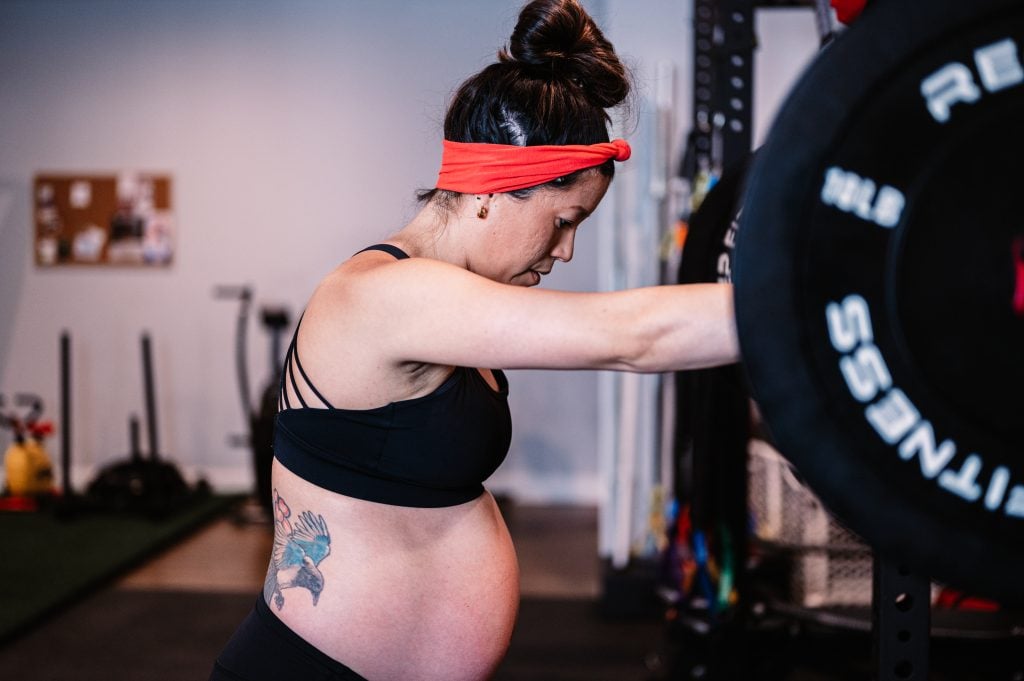
Here is what one of my first trimester workouts looked like because nausea and fatigue took over–but you can see that I am still lifting weights and exercising because of how beneficial it is for both my baby and me!
What about the myths of prenatal fitness?? Are they true?!
There are SO many myths and misinformation out there about prenatal fitness to navigate. It is not surprising that you may feel nervous about exercising with all the supposed movement restrictions and danger of moving your body during pregnancy. Plus, these myths tend to conflict with one another–so you have no idea what to do!
Here is an excerpt from our book, Training for Two, that debunks common prenatal myths:
“MYTH 1: EXERCISING DURING PREGNANCY INCREASES YOUR RISK OF MISCARRIAGE AND PRETERM LABOR.
This myth is false. Exercising during your pregnancy, including lifting heavy weights, does not increase your risk of miscarriage, nor does it increase your risk of preterm labor (labor before 37 weeks). The fear of miscarriage can be a huge deterrence to exercising throughout your pregnancy, especially if you have numerous people giving you unsolicited advice about your fitness routine and suggesting it is putting your baby in harm’s way.
In multiple randomized controlled trials published in the British Journal of Sports Medicine and the Journal of Clinical Medicine, researchers found no significant associations between exercising during pregnancy and the occurrence of miscarriage. In these studies, exercises included low- to moderate-intensity aerobic exercise and resistance training, with workout durations of 20 to 65 minutes per session. A Norwegian study published in the BMJ Open Sport & Exercise Medicine also found
that exercising more than 150 minutes per week, the minimum recommendation for pregnancy, did not increase the risk of miscarriage.
The majority of miscarriages are due to chromosomal abnormalities, or a fetus that is, sadly, not compatible with life. In other words, there is nothing that you could have done to cause it, and unfortunately, nothing anyone could have done to prevent the pregnancy loss. Miscarriage does happen in one out of every four pregnancies, so it is tragically more common than many of us realize.
Furthermore, exercising during pregnancy does not correlate with a higher likelihood of preterm labor. This myth that exercise can cause preterm labor may originate from the recommendation of bed rest, which is often prescribed to prolong
pregnancies at risk of delivery before 37 weeks. Bed rest may be prescribed if you are carrying twins or multiples, are experiencing preterm labor, have a short cervix, or are at risk of early water breaking.
Nevertheless, recent studies in the Canadian Medical Association Open Access Journal and Australian and Current Opinion in Obstetrics and Gynecology have indicated that bed rest does not effectively prolong pregnancies when complications risking early delivery arise. Research reviews in the Canadian Medical Association Open Access Journal have found that one week of bed rest can actually worsen newborn outcomes. Additionally, bed rest could result in muscular atrophy from lack of physical
activity, contributing to discomfort and pain. Current research in the Australian and New Zealand Journal of Obstetrics and Gynecology agrees that bed rest is an outdated practice.
The misconception that exercise might lead to miscarriage or preterm labor, along with negative commentary questioning the safety of staying active, can intensify the burden of responsibility you bear if unfortunate events occur. Instead of offering empathy in moments of grief and loss, these notions place undue blame on the woman.”
Other myths surrounding prenatal fitness include:
- Can you exercise on your back?
- Can you twist during pregnancy?
- Do you have to monitor your heart rate and keep it below a certain level?
- Can you only lift 20 pounds?
- Should you stop running immediately?
- And just continue what you were doing before, but do it a little lighter and easier.
As a quick synopsis:
- Yes, you can exercise on your back for short periods as long as you don’t have symptoms such as lightheadedness or dizziness.
- Yes, you should absolutely continue to twist–it’s really important for opening your pelvis for birth.
- You don’t need to monitor your heart rate–rather pay attention to your effort levels.
- You can lift more than 20 pounds–this weight limitation fluctuates depending on the person you talk to, and most of the everyday items we carry weigh more than 20 pounds.
- You can continue to run if it’s comfortable for you–but may want to opt for a low-impact cardio option as you move into the second and third trimesters.
- And sure, you can continue to exercise like you did pre-pregnancy, but you will likely need to modify–however, you can also start a new program in pregnancy!
Listen to our podcast episode all about debunking common prenatal fitness myths!
Does exercising during your pregnancy cause issues for your birth??
Another common “myth” about exercising throughout your pregnancy, particularly lifting weights, is that it will make your pelvic floor too tight and you will have a hard labor or need a c-section. This is not necessarily true!
Now, there are some reasons that your pelvic floor may have more tension.
- It could be due to your common postural tendencies–you always stand or sit in the same way (see the next section for the solution to this).
- It could be that your workouts always favor the same direction of movement, usually front to back, and neglect side-to-side and rotational exercises. This could contribute to limited hip mobility and increased tension in the pelvic floor.
So, during your workouts, it’s important that you incorporate exercises both in the sagittal plane (squats, deadlifts, forward-backward movements) and in the frontal (side-to-side) and transverse plane (rotational).
For example, your workout could include:
- 3 rounds:
- 10 squats (sagittal plane)
- 10 per side lateral step up with hip rotation (lateral and transverse)
- 10 per side hip shifted pelvic tilts (transverse)
- 10 split squat march with rotation (lateral and transverse)
Exercising does not = c-section, but there are some reasons that you may have limited pelvic mobility and increased pelvic floor tension! So, we must include a variety of exercises to ensure muscular balance. Luckily, the MamasteFit Prenatal Fitness Programs are already designed to do this for you!
If you want more daily workouts to support a strong pregnancy as you prepare for birth, join our online prenatal fitness programs!
MamasteFit is unique in that we are one of the ONLY prenatal/postnatal training facilities in the United States. We develop our workout programs from our experience of working with in-person pre/postnatal fitness clients and work closely with physical therapists to refine our programming. In addition, we are birth workers, so we combine our experience as perinatal fitness trainers and birth professionals to ensure that our programs actually support your birth preparation and recovery!
Our prenatal fitness programs are offered in several formats:
- 40-Week Prenatal Strength Program in the Teambuildr App:
- This program is a self-paced workout with shorter demo videos. This is ideal if you like to workout in a gym setting and prefer a traditional workout delivery format.
- This program syncs to your current week of pregnancy, so you can start anytime, with one-time payment or month-to-month payment options.
- This program has a full and mini version, depending on how much time you have to dedicate to workouts!
- Prenatal On-Demand Fitness Program:
- If you prefer to follow a video as you workout at the same time, this workout program will be the best option!
- This program syncs to your current trimester, so you can grab the trimesters you need!
- Prenatal Yoga Classes:
- If you want prenatal yoga, join our prenatal yoga program! This also syncs to your current trimester.
Use your prenatal fitness to prep for birth!
Another reason that your pelvic floor may have more tension is due to our common postural tendency, or the way we like to stand and sit. You can use your prenatal workouts to support muscular balance to relieve tension in your pelvic floor and prepare to open your pelvis for birth.
Commonly, we favor:
- External hip rotation (toes out)
- Anterior pelvic tilt (arched back)
- Right stance (weight more in the right leg)
Because of this, we have common areas of tension, including our pelvic floor. In your prenatal workouts, you can include exercises that:
- Release the lats and hip flexors to make it easier to round your back
- Release the posterior pelvic floor to make it easier to find an internal hip rotation
- Find hip shifts to the left to release tension from the right stance position
There are several exercises you can include in your prenatal workouts (and we include more in our prenatal fitness programs)! We include six exercises to prepare you for birth in our MamasteFit Birth Prep Circuit. This circuit targets those common areas of tension!
In addition to relieving common areas of tension, we also need to prepare to open our pelvis for birth! There are levels to your pelvis that all open in different ways, so there are a variety of hip movements required to create space in your pelvis for birth.
- The top of the pelvis opens more with external hip rotation (toes out), abduction (wide knees), and both an anterior (arched) and posterior (rounded) pelvic tilt.
- The middle of the pelvis opens more with asymmetrical movements, so one-sided external hip rotation and internal hip rotation.
- The bottom of the pelvis opens more with internal hip rotation (toes in), adduction (knees in), and a posterior pelvic tilt (rounded back).
When you understand the different types of hip movements required to open the pelvis, you can then incorporate those types of movements into your prenatal workouts to prepare for birth! In case you haven’t noticed a trend, we already do this for you in our prenatal fitness programs and birth prep workout program!
Stay Confident Against Unsolicited Advice!
Pregnancy makes us a target of everyone’s unsolicited advice. Everyone has an opinion on what you should and should not do during your pregnancy–and for some reason, they feel they need to share that opinion with you regardless of whether you asked for it. Because of this onslaught of conflicting and misinformed opinions, it can be hard to feel confident that exercising is safe, how you should exercise, and to find the motivation to even go workout.
Exercise is beneficial for you AND your baby–and the risk is relatively low! Unless you have a complication that your provider has said exercise is not recommended, it is safe for you to do! Most of the myths surrounding prenatal fitness are incorrect, and we debunked a lot of those in this blog. And you can exercise in a way that supports your prenatal comfort and birth prep!
Prenatal Support Courses


Learn the science of pregnancy and birth to take the mystery of labor away! Understand why you are feeling what you feel, and learn strategies to confidently move through pregnancy and birth!
- 9h+ of Video
- Support Group
- Close Captioning

- 5 Workouts/Week
- Gym Workouts
- Self-Paced

Instructor
GINA
Workout on-demand with our prenatal fitness workout videos! Each workout is 30-40 minutes to follow along as you exercise at the same time!
- Birth Prep
- All Trimesters
- Mobility Work

Instructor
GINA
Find comfort and relief from pelvic girdle pain throughout your pregnancy and postpartum period! This program incorporates myofascial sling focused exercises to stabilize across the pelvic girdle joints.
- 3 Weeks
- On Demand Workout Videos to Follow