



The pelvic floor is a big focus when it comes to birth preparation! If you’re like me, you didn’t even know what a pelvic floor really was until you were pregnant… and suddenly you needed to figure out what you were supposed to do with it for birth.
You may be curious if you are supposed to make your pelvic floor super strong for birth or make it as loose as possible! There can be conflicting information on whether you should do all the Kegels or if you should do all the deep squat stretches to prep for birth.
Should you do Kegels to strengthen the pelvic floor, so it can push your baby out?? No… the pelvic floor does NOT push your baby out–the uterus does–so strengthening the pelvic floor so it can push is not necessarily the focus we need to have right now.
So, then you should do tons of stretches to relax the pelvic floor so it’s easier for your baby to move through during birth, right? This is more on the right track.
In this blog, we are going to break down several ways you can release tension in your pelvic floor as you prepare for birth, such as strategies to release tension in your jaw (which releases tension in your pelvic floor, surprisingly) and pelvic floor exercises that will actually stretch the portions of your pelvic floor that are “too tight.”
How to Prepare Your Pelvic Floor for Birth
No one movement stretches the ENTIRE pelvic floor… and most of us have more tension in certain parts of our pelvic floor. If you scroll long enough, you’ll find many pelvic floor exercises, usually butterfly poses, deep squats, and other very wide knee positions.
Most of us tend to have a tighter back half of our pelvic floor (posterior) and a lengthened front half of our pelvic floor (anterior). These wide knee positions (external hip rotation with abduction) tend to stretch more of the front half of our pelvic floor–where more of us tend to already be too stretched.
If the posterior half of your pelvic floor is tighter (which during pregnancy, is most likely tighter), then you have more issues with SI joint pain, constipation, or even tailbone pain. It can also make it harder for your sacrum to move during birth!
So, instead of focusing ONLY on wide knee stretches, we also need to incorporate way more mobility exercises that find internal hip rotation with a rounded back to stretch the back half of our pelvic floor.
You can absolutely still include the wider knee stretches, but adding in more hip shifts and internal hip rotation with a rounded back can help you actually release the tension you have in your pelvic floor! We incorporate a lot of these pelvic floor exercises into our prenatal workout program and educate on the why pelvic floor prep for birth course.
How to Relax the Pelvic Floor... Without Pelvic Floor Exercises
First, let’s break down a few ways you can relax your pelvic floor without actually doing any pelvic floor exercises or stretches! Sometimes, as we learn about our pelvic floor, it gets overwhelming to figure out what exercises to do. So, one strategy is to focus on something more familiar–your jaw!
The jaw is connected to your pelvic floor via a connection that develops when you are an embryo! It’s one of our first connections in our body! Tension in our jaw tends to correlate to tension in our pelvic floor, and vice versa.
Some of our favorite ways to release tension in the jaw to help release tension in the pelvic floor include:
- Face Massage or Myofascial Release
- Deep, Low Noises
- Puffer Fish or Cheek Movement
1) Face Massage
One of my prenatal self-care routines is to get monthly face massages from a massage therapist/esthetician. You can also get a face massage specific for jaw tension from a physical therapist, most massage therapists, and even craniosacral therapists.
When you manually massage the face and jaw muscles, you can help to release tension! You can either do this with your hands, or there are various tools you can use to help massage your face, as well.
During labor, it can be helpful for someone else to massage your cheeks and jaw, as well, to help you relax your pelvic floor!
2) Deep, Low Noises
Next, the type of noises you make can either increase or decrease tension in your jaw and pelvic floor.
High-pitched, screaming-type noises can increase tension. If you make the noise “EEK,” you likely find that your entire body lifts up and tenses from the noise.
In comparison, if you make a deep, low noise, such as a “ooooo” or “ohmmm,” you likely notice that you entire body sort of sinks down and relaxes. During contractions, you can focus on making deep, low moaning or mooing type noises to help release tension throughout your body!
3) Puffer Fish
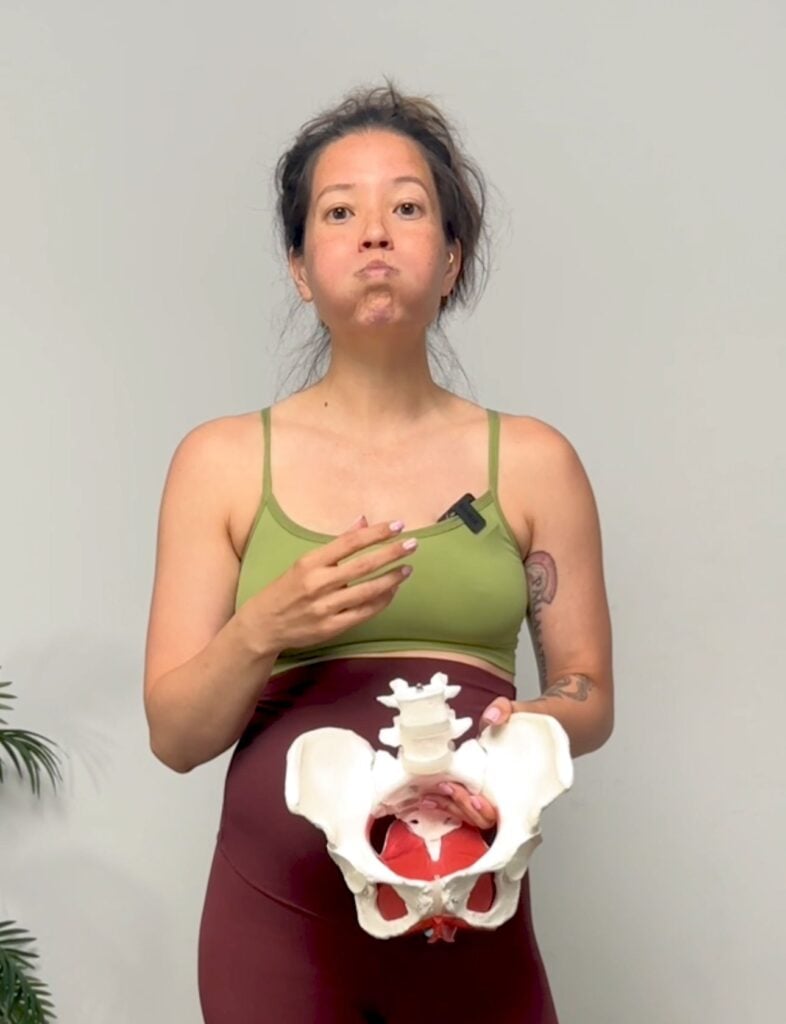
Another technique to relax the jaw is to move or stretch the cheeks. Some of us can make horse lips where you blow air out and your lips flutter–but I find this to be really difficult to do! An easier technique is to do puffer fish.
In puffer fish, you will blow up your cheeks to stretch them, then slowly release air out of your mouth as you exhale. Then repeat this for a few breaths. This will help to stretch your cheeks and release some tension in your jaw, and can be a great distraction tool during labor!
Now that we’ve discussed a few ways to release tension in your pelvic floor without thinking about your pelvic floor.., let’s explore some exercises that do target the pelvic floor!
Pelvic Floor Release Exercises: Stretch the Tight Areas!
As we discussed earlier in this blog, the entire pelvic floor is likely not tight–but certain areas may have more tightness than others. For most of us, we tend to have more tension in the posterior portion of our pelvic floor because of our common postural tendencies. Many of us, especially during pregnancy, tend to favor more external hip rotation (toes out) with an arched back. This position stretches the front half of our pelvic floor, while shortening the back half.
Wider knee stretches involve external hip rotation and tend to stretch more of the front half of the pelvic floor–where most of us already have too much stretch. So, it may feel like you’re getting a big stretch in, but it’s mostly because that area is already too stretched, and you added on more stretch.
We can target the back half of our pelvic floor with internal hip rotation, hip shifts, and a rounded back position.
You can try exercises like:
- All Four Back Expansion Breathing Drill
- All Fours Hip Shift with Pelvic Tilts
- Heros Pose Ball Crunches
These exercises are explained in our 10-minute pelvic floor release “workout” video. You can follow this workout, as I explain how to find each movement and the benefits of each exercise.
For this workout you will need:
- Long Strap or Band
- Yoga Block
- Birth Ball
If you want more daily workouts to support a strong pregnancy as you prepare for birth, join our online prenatal fitness programs!
MamasteFit is unique in that we are one of the ONLY prenatal/postnatal training facilities in the United States. We develop our workout programs from our experience of working with in-person pre/postnatal fitness clients and work closely with physical therapists to refine our programming. In addition, we are birth workers, so we combine our experience as perinatal fitness trainers and birth professionals to ensure that our programs actually support your birth preparation and recovery!
Our prenatal fitness programs are offered in several formats:
- 40-Week Prenatal Strength Program in the Teambuildr App:
- This program is a self-paced workout with shorter demo videos. This is ideal if you like to workout in a gym setting and prefer a traditional workout delivery format.
- This program syncs to your current week of pregnancy, so you can start anytime, with one-time payment or month-to-month payment options.
- This program has a full and mini version, depending on how much time you have to dedicate to workouts!
- Prenatal On-Demand Fitness Program:
- If you prefer to follow a video as you workout at the same time, this workout program will be the best option!
- This program syncs to your current trimester, so you can grab the trimesters you need!
- Prenatal Yoga Classes:
- If you want prenatal yoga, join our prenatal yoga program! This also syncs to your current trimester.
1) All Four Back Expansion Breathing Drill
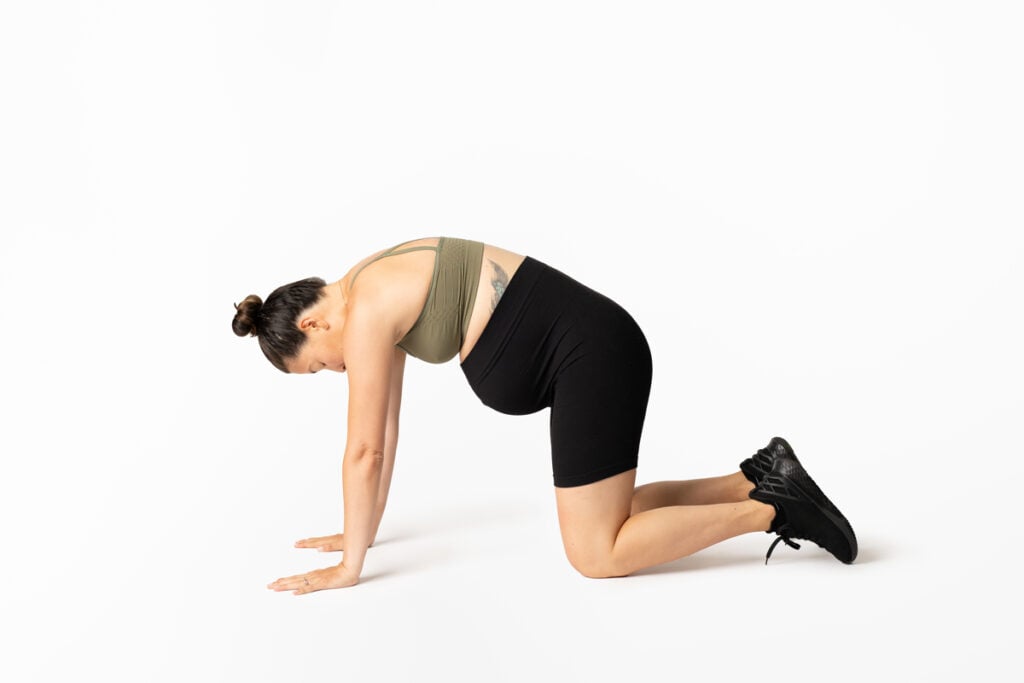
In this breathing drill, you will find both internal hip rotation and a rounded back position to release tension in the posterior pelvic floor. Start by bringing the ankles out as you squeeze a yoga block between the thighs to find internal hip rotation. Then you will use the resistance band for external feedback to find a rounded back position.
In this position, you will take 10 full breaths, feeling your back expansion with each inhalation. Then exhale to pull belly to spine as you round more in your back, pressing into the band.
2) All Fours Hip Shift with Pelvic Tilts
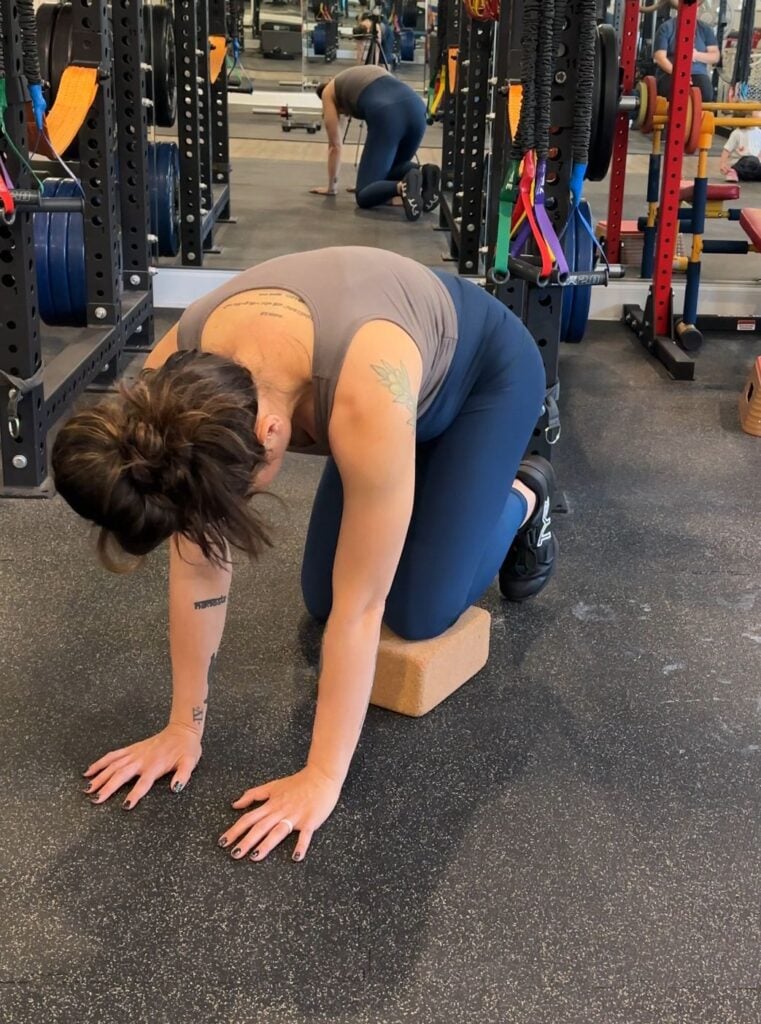
The all-fours hip shift is included in the MamasteFit Birth Prep circuit, but if you aren’t doing the entire circuit is still worth incorporating for full body mobility and pelvic floor release.
In this exercise, you are shifting your weight towards the elevated hip to bring that hip into internal pelvic rotation. This will stretch the posterior pelvic floor on that side while stretching the anterior pelvic floor of the lower hip–so there is a diagonal stretch happening in the pelvic floor in this position!
Then you can move through pelvic tilts for spinal mobility!
3) Heroes Pose with Ball Crunch
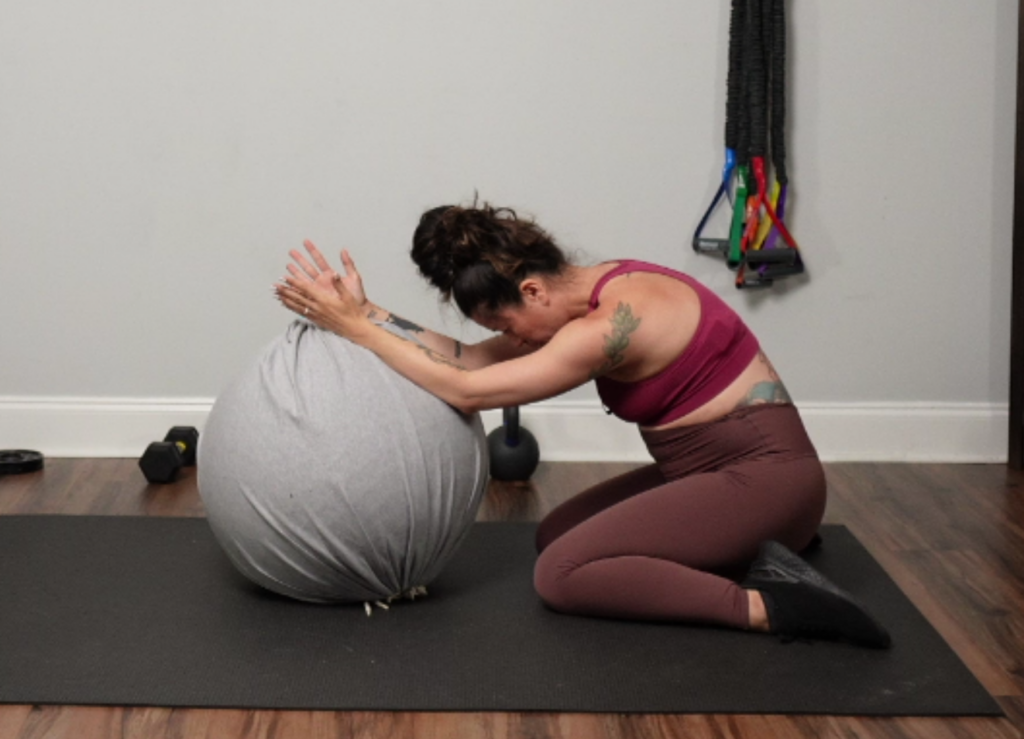
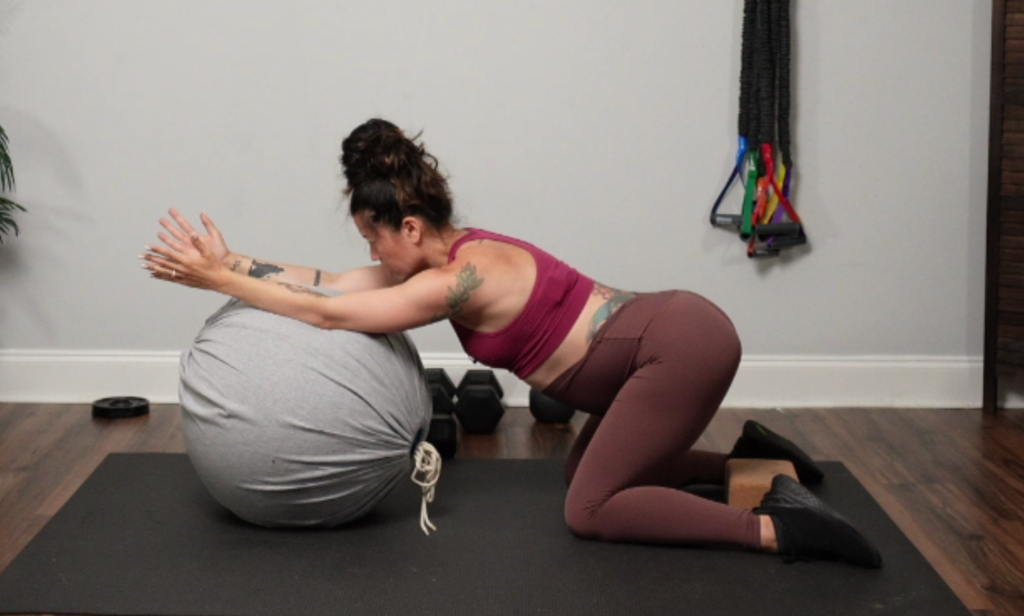
In this exercise, the hips are in internal rotation as you use the abdominal activation to help you round more in your back. In the heroes pose with ball crunch, you are sitting on a yoga block or on the floor in heroes pose. Heroes pose is when your knees are in, and your ankles are a bit further apart. The yoga block can decrease the intensity of the stretch, especially in the knees, but you can sit on the floor for more intensity.
In this position, you will then pull the birth ball closer to you as you “crunch” in your abs. This backward drag of your forearms will help to activate your abdominal wall which helps to pull you into a rounded position. After holding this position for several breaths, you can begin to move forward and backward from the seated position with ball crunch to an arched position with more internal hip rotation.
Prepare Your Pelvic Floor for Birth!
There is a lot we can do to help prepare our pelvic floor for birth! But it can get overwhelming to figure out what even is your pelvic floor, how you know it’s relaxed, and what are the best exercises to do.
As you prepare for birth, we are focusing on ensuring that our pelvic floor can release and let go to allow our baby to pass through during birth. We can do this by focusing on our jaw tension (as this correlates to pelvic floor tension or relaxation). Plus, we can add on exercises that stretch the portions of our pelvic floor that are actually tight–the back half.
Birth Preparation Courses


Learn the science of pregnancy and birth to take the mystery of labor away! Understand why you are feeling what you feel, and learn strategies to confidently move through pregnancy and birth!
- 9h+ of Video
- Support Group
- Close Captioning

- 5 Workouts/Week
- Gym Workouts
- Self-Paced

Instructor
GINA
Workout on-demand with our prenatal fitness workout videos! Each workout is 30-40 minutes to follow along as you exercise at the same time!
- Birth Prep
- All Trimesters
- Mobility Work

Instructor
GINA
Find comfort and relief from pelvic girdle pain throughout your pregnancy and postpartum period! This program incorporates myofascial sling focused exercises to stabilize across the pelvic girdle joints.
- 3 Weeks
- On Demand Workout Videos to Follow