



Your baby will usually enter the pelvis with the back of their head towards either hip (usually left side), with their chin tucked.
Then they will rotate towards the front as they enter and move through the pelvis.
And then they finish their rotation under the pubic bone while you’re pushing to begin to crown and to be born! So, just with that rotation your baby moves through THREE different positions.
In addition, if your baby is in X position before birth–it’s okay! There is a lot of pressure to FORCE our baby into what someone tells us is the BEST position (usually LOA or OA).
But, it’s important to note that babies still wiggle and move around during pregnancy, all the way up until labor begins, so not only is trying to force your baby into the “perfect” position just wasted energy because they will move out of it, but you don’t always know what exactly is the best position because it also depends on WHERE baby is in the pelvis and if they can tuck their chin.

So, if you shouldn’t force your baby into one specific position–what can you do to support their positioning in preparation for birth??
You can focus on ensuring that their path to rotate is clear! Let’s discuss what that means and HOW to help you baby find their best position when labor begins in this blog!

Want to learn more on how to use prenatal fitness to support a strong and pain-free pregnancy, plus exercises to release tension in the pelvic floor and open the pelvis for birth? We also break down how to use prenatal exercise and labor positions to support your baby’s position!
Pre-order our book Training for Two! This book includes 90+ exercises to build your confidence as you navigate fitness throughout your pregnancy and prep for birth, plus a whole chapter on early postpartum recovery!
Clearing the Path to Rotate: Finding the Best Position for Your Baby!
Your baby’s positions are not random! Their position is based on the space that is available for them. And we can increase the space available for them by releasing tension and restrictions in their path to rotate, particularly in the uterine ligaments.
There are several structures that your baby has to rotate through or by in order to find their best position, such as the uterine ligaments, tissues and muscles surrounding the uterus (think, pelvic floor), and the actual bony pelvis. If we can release tension in those areas and also be able to create more space in the pelvis, it can be easier for your baby to find a better position when labor begins!
The uterus has several ligaments that help attach it to the surrounding structures (such as your pelvis) to support its position.
The front of the uterus has two round ligaments that run vertically from the front of the uterus to the labia–hence the nickname lightning crotch if you have tension in the round ligaments. If the round ligaments have tension or are imbalanced, then you may have sudden sharp pain toward one side of the lower abdomen, particularly with hip extension (such as standing up or walking). If there is uneven tension in these ligaments, it can pull the uterus more toward one direction.
The broad ligament runs horizontally across the front of the uterus. If this ligament is restricted, your baby’s movements may be painful. If this ligament has some restriction, it can cause an inward “speedbump” that may make it harder for your baby to move down into the pelvis.
Then the uterosacral ligaments are located on the bottom of the uterus and attach to the sacrum. If these ligaments are tight, they can twist and decrease space in the lower part of the pelvis. You may experience lower back or SI joint-type pain if these are tight, or your baby may be in a breech position due to decreased lower uterine space.
When supporting our baby’s position, we can focus on releasing tension in the uterine ligaments to create more space for your baby! This will also decrease the obstacles in your baby’s path to rotate. Watch this YouTube video for three exercises to release tension in the uterine ligaments to support your baby’s position!
Subscribe to our YouTube channel for weekly workout videos and educational videos to support your pregnancy, birth, and beyond–your subscription and views help support us as we provide all of this free content!
Continue reading for a breakdown of each of these exercises!
1) Release the Round and Uterosacral Ligaments: Forward Leaning Inversion

The forward-leaning inversion brings the chest lower than the hips to stretch the vertical running uterine ligaments. In the inversion, you will feel a stretching sensation in the belly and the lower back area, particularly the sacral area.
With your knees on an elevated surface, such as your couch or a bench, bring your forearms to the ground. Tuck your chin and hold this position for about three full cycles of breath (20-30 seconds).
This will release tension in the uterosacral ligaments to help create more space in the bottom of the pelvis!
If your baby is head down it is okay to do inversions! This is a common misconception that if you do an inversion, it will flip your baby–rather, it is creating more space in the bottom of your uterus for your baby to find an even better position!
If you feel lightheaded or uncomfortable in this position, crawl forward to bring your knees to the floor. It may also be helpful to have a spotter in case you are unsure of your shoulder strength to maintain this position.
There are common areas of tension throughout pregnancy that can impact how you can open your pelvis for birth and your baby’s positioning. Our free MamasteFit Birth Prep Circuit addresses these common areas of tension, making it easier for you to create more space in your pelvis!
Sign up for our newsletter to grab our free guide–which includes video instruction, as well!
2) Round Ligament Release: 90/90 Side Camel
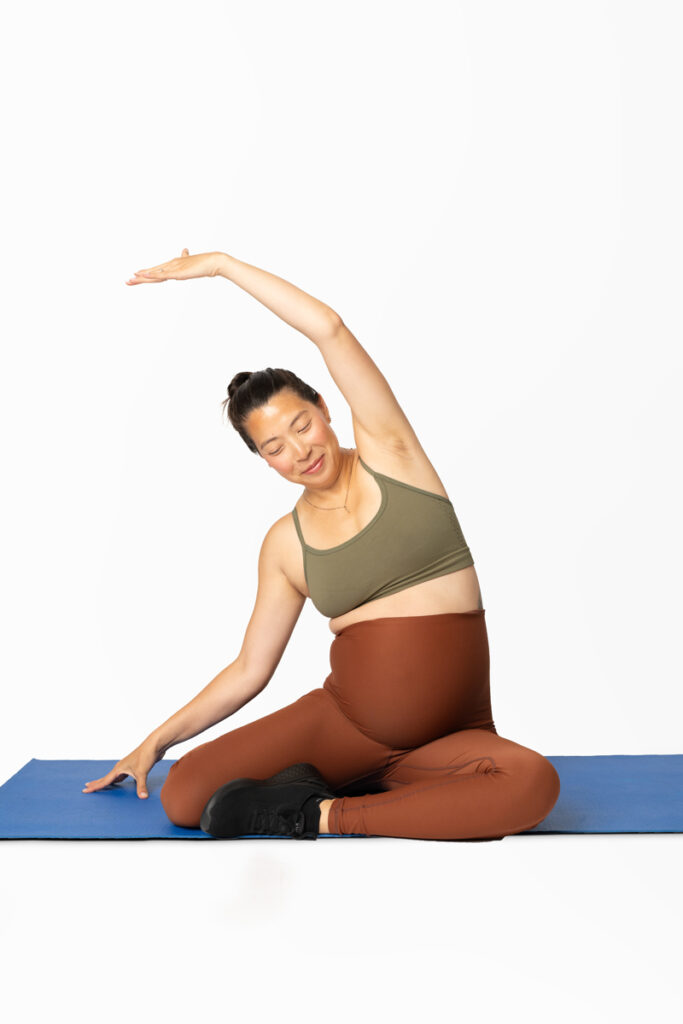
The round ligaments run vertically and can be influenced by side body compression and hip flexor tension. In the 90/90 side camel, we start with a side body opener (stretch in the side) to release side-body compression that may impact your round ligament tension (and overall comfort, hello rib discomfort).
Then you will progress to a camel pose, where you place the hand behind you and extend in the hips to stretch your hip flexor area. The round ligaments are located near your hip flexors, so stretching this area can help to also release tension in the round ligaments!
If you want more daily workouts to support a strong pregnancy as you prepare for birth, join our online prenatal fitness programs!
MamasteFit is unique in that we are one of the ONLY prenatal/postnatal training facilities in the United States. We develop our workout programs from our experience of working with in-person pre/postnatal fitness clients and work closely with physical therapists to refine our programming. In addition, we are birth workers, so we combine our experience as perinatal fitness trainers and birth professionals to ensure that our programs actually support your birth preparation and recovery!
Our prenatal fitness programs are offered in several formats:
- 40-Week Prenatal Strength Program in the Teambuildr App:
- This program is a self-paced workout with shorter demo videos. This is ideal if you like to workout in a gym setting and prefer a traditional workout delivery format.
- This program syncs to your current week of pregnancy, so you can start anytime, with one-time payment or month-to-month payment options.
- This program has a full and mini version, depending on how much time you have to dedicate to workouts!
- Prenatal On-Demand Fitness Program:
- If you prefer to follow a video as you workout at the same time, this workout program will be the best option!
- This program syncs to your current trimester, so you can grab the trimesters you need!
- Prenatal Yoga Classes:
- If you want prenatal yoga, join our prenatal yoga program! This also syncs to your current trimester.
3) Release the Broad Ligament, Uterosacral Ligaments, and Pelvic Floor: All Fours Pelvic Tilts

The all-fours hip shift is one of my favorite birth preparation exercises. In the all-fours hip shift, you will shift your weight toward the elevated knee. This will stretch the posterior pelvic floor of that elevated side (usually, we have more tension in the posterior pelvic floor) and uterosacral ligaments as it shifts the sacral position.
Then, as you do your pelvic tilts, exhale to pull the belly to the spine as you round in your back to increase the activation of your abdominal wall to support the broad ligament.
The broad ligament runs horizontally and is supported by your abdominal wall–a weak abdominal wall that allows the belly to fall forward can also strain the broad ligament. So, adding in core activation as you round in your back can help to release tension in the broad ligament!
Help Your Baby Find the BEST Position for Birth: Focus on the Path!
It can be stressful as you near the end of your pregnancy to feel like you need to force your baby into this perfect position–but different sources will say different positions are the best! One blog will say OA is the best position, and then your provider might say LOA is the best position.
The good news is you do NOT need to worry about WHAT position your baby is in during pregnancy–they will wiggle and move around no matter how much you try to force them into one position.
Rather, we can focus on ensuring their path to rotate is clear by releasing tension in the uterine ligaments, and muscles (such as the pelvic floor), and creating more space in the pelvis! This will be much more helpful when labor does begin! When you have strong uterine contractions, your baby will more easily be able to rotate to their best position with the path clear for them!


Learn the science of pregnancy and birth to take the mystery of labor away! Understand why you are feeling what you feel, and learn strategies to confidently move through pregnancy and birth!
- 9h+ of Video
- Support Group
- Close Captioning

- 5 Workouts/Week
- Gym Workouts
- Self-Paced

Instructor
GINA
Workout on-demand with our prenatal fitness workout videos! Each workout is 30-40 minutes to follow along as you exercise at the same time!
- Birth Prep
- All Trimesters
- Mobility Work

Instructor
GINA
Find comfort and relief from pelvic girdle pain throughout your pregnancy and postpartum period! This program incorporates myofascial sling focused exercises to stabilize across the pelvic girdle joints.
- 3 Weeks
- On Demand Workout Videos to Follow