
Table of Contents
I recently gave birth to my fourth baby–and it was my fastest active labor yet! I believe the speed of our labor was due to her being in a great position, my pelvis being able to open for her, and the relaxation of my pelvic floor. Throughout my pregnancy, I was using the MamasteFit Prenatal Fitness Program to not only stay strong and pain-free but also to prepare for birth. My daily workouts included exercises that improved my hip and pelvic mobility, released tension in my pelvic floor, and supported my baby’s position–even in the first and second trimesters! These are all things that are included in my book Training for Two!
But if you’re near your due date, there is still time to use movement to prepare for birth! In this blog, I’ll be sharing what I did during my early labor (because my early labors tend to be long) to open my pelvis, release tension in my pelvic floor, and support my baby’s position for birth–which led to my fastest active labor yet!
In my recent birth, I woke up around 7am to labor contractions. After a week of prodromal labor, I was unsure if I would be confident enough to know when it was the real deal–but I was able to tell that this was labor and we would be meeting our baby today (or early the following day).
After resting for a few hours and eating, I decided to do a short 20-30-minute pelvic opening workout to open up my pelvis, release tension in my pelvic floor, and support my baby’s position as my labor continued.
In this workout, I started with the MamasteFit Birth Prep Circuit, which includes six exercises to help my baby’s position and release common areas of prenatal tension to make it easier to open my pelvis for birth. Then, I moved through different strength and mobility exercises targeting each pelvic level and floor.
The MamasteFit Birth Prep Circuit
Since 20 weeks, I have started all of my prenatal workouts with the MamasteFit Birth Prep Circuit. The MamasteFit Birth Prep Circuit:
- Supports your baby’s position for birth with inversions
- Releases common areas of prenatal tension to make it easier for you to open your pelvis for birth
- Relaxes the pelvic floor
In early labor, as a part of my birth prep exercises, I included our birth prep circuit exercises. I even found myself finding some of these positions during my labor when I felt that my hips needed more of a release too!
In the MamasteFit Birth Prep Circuit, we include:
- Forward Leaning Inversions: inversions help to release tension in the lower uterine ligaments to make more space in the bottom of your uterus. This makes it easier for your baby to find a head down position AND lower their head into your pelvis.
- Standing Back Expansion: this breathing drill helps you release tension in your back to make it easier to find a rounded position.
- Forward Leaning Lat Stretch: this lat/back stretch is one of my favorites for releasing tension in the back! Tight back musculature can pull the back of the pelvis UP into an anterior tilt, so we need to release this tension to find a posterior tilt.
- Half Kneeling Hip Flexor Release: the hip flexors pull the front of the pelvis DOWN into an anterior tilt, so releasing tension here can improve pelvic mobility. Plus this exercise is great to help release tension in the round ligaments.
- All Fours Hip Shifted Pelvic Tilts: this exercise brings the hip into a closed position to find internal hip rotation and relieve tension in the posterior pelvic tilt (another area where we tend to have a lot of tension). When doing the pelvic tilts, you can exhale to pull belly up which can help to release tension in the horizontal broad ligament of the uterus too!
- Supported Standing Hip Shift: this is another posterior pelvic floor release exercise that I absolutely love!
We recommend incorporating this circuit into your weekly prenatal routine around 2-3 times a week after 20 weeks. But you can start earlier if you feel you have more tension!
We incorporate these exercises into our daily prenatal workouts in the MamasteFit Prenatal Fitness Programs.
Subscribe to our YouTube channel for expert prenatal and postnatal fitness tips, engaging workouts, and essential advice. Join our community and get motivated with fresh, practical content designed to support your journey every step of the way!
Birth Preparation Exercises: More Than Just Deep Squats
There is a lot of information about the BEST birth prep exercises, labor positions, and so on–but there is more nuance to it than “do squats.” There are three pelvic levels that all open with different types of movement patterns. In addition to the bony structure of the pelvis, we also need to consider the pelvic floor and your baby’s position as we prep for birth or move through early labor.
The pelvis has three levels that open with different hip movements:
- The Pelvic Inlet
- This is the top of the pelvis. The inlet opens more with wider knees (external hip rotation and abduction) and pelvic tilting from front to back (anterior to posterior pelvic tilts).
- Movements that favor wider knees (deep squats) and pelvic tilts tend to create more space in the top of the pelvis.
- Problem areas: posterior pelvic tilt and rounding in the back tend to be harder to find during pregnancy–this is a big reason why three exercises target finding a posterior pelvic tilt in the MamasteFit Birth Prep Circuit.
- The Midpelvis
- The middle of the pelvis opens more with asymmetrical movements–external hip and internal hip rotation or open and closed hip positions. Swaying or side-to-side movements help to open the midpelvis diagonally.
- Problem areas: finding internal hip rotation and closed hip positions can be more challenging during pregnancy.
- The Pelvic Outlet
- The bottom of the pelvis opens more with internal hip rotation with knees in and ankles out. Sacral mobility also creates more space in the outlet.
- Problem areas: similar to the midpelvis, internal hip rotation tends to be more challenging to find.
In my early labor workout (which you can do at any point during pregnancy), I did the following exercises to open each pelvic level and release my pelvic floor:
- 2 Rounds-Inlet Opening:
- 10x Deep Squats for Depth
- 1 minute of Deep Squat Holds with Knee Presses
- 10 Wide Knee Pelvic Tilts
- 2 Rounds- Midpelvis Opening and Pelvic Floor Release:
- 10x Elevated Lunge to Curtsey Lunges
- 10x Adductor Rock Backs
- 1 minute of Half Lunge Adductor Release
- 10x 90/90 Side Camels and Switches
- 2 Rounds– Outlet Opening and Pelvic Floor Release:
- 10x Archer Row
- 10x Heros Rock Back
In my book, Training for Two, you’ll learn more about how to create space in each pelvic level with prenatal exercises and labor positions!
Birth Prep: Open the Top of the Pelvis
The top of the pelvis opens more with wider knees (external hip rotation and abduction) and pelvic tilts. An anterior pelvic tilt (arched back) changes the pubic bone angle, making engaging the baby easier. It also makes finding external hip rotation easier, creating more space side-to-side. A posterior pelvic tilt (rounded back) creates more space front-to-back by moving the sacral promontory (junction of lower spine and sacrum) backward.
I started this portion of my birth prep workout with deep squats for depth–I went as low as I could. You could also do this with support, such as holding onto your partner’s hands or a supportive structure.

Then, I would finish my ten repetitions in the bottom of the squat and hold here for about 30 seconds to a minute. In the bottom of the squat, I would press my knees out and then added in thoracic rotations.
Following the squats, I moved to a tabletop position for wide knee pelvic tilts. In this position, my hips were in external rotation, with knees out and ankles in, which created more space side-to-side in the pelvic inlet. I repeated this short circuit two times, then progressed to the midpelvis opening and pelvic floor release exercises.
Birth Prep: Open the Middle of the Pelvis
My baby was already well-engaged by the time labor began, so I spent more time opening the middle of the pelvis. The middle of the pelvis opens more with asymmetrical movements–so swaying, side-to-side, and weight-shifting movements.
Starting with a strength exercise, I then transitioned to a series of exercises that focused on improving hip mobility, a key aspect during labor.
The first exercise was a curtsey lunge to elevated lunge–where I found a closed hip position (curtsey lunge with internal hip rotation) to an open hip position (rotational lunge with external hip rotation). This is a new exercise, so I don’t have a demo video yet. Here is a similar exercise using a step up from rotational to crossover step down.
Open hip positions with external hip rotation target the upper midpelvis. The upper midpelvis is where your baby begins their rotation into the pelvis (a great place to target if you are trying to rotate your baby from an OP position). Think of open hip positions as movements where the knee moves away from the midline and is wide.
Closed hip positions with internal hip rotation target the lower midpelvis. The lower midpelvis is where your baby finishes their rotation under the pubic bone (really important for pushing). If you have a late labor stall (stalls at 8cm or prolonged pushing), it could be related to mobility issues in the lower midpelvis.
In my birth prep workout, I included several movements with open and closed hip positions–to include lunge variation!
After the strength movement, I returned to an adductor rock to release the inner thighs. This helps to create more space in the upper midpelvis.
Another midpelvis opening mobility exercise I did was the 90/90 side camel to switches. The 90/90 side camel has been a favorite of mine for this pregnancy, as it releases the side body and hip flexors and improves hip mobility. The 90/90 includes external and internal hip rotation to open the middle of the pelvis–and was a position I found myself laboring in the birth pool!
If you want more daily workouts to support a strong pregnancy as you prepare for birth, join our online prenatal fitness programs!
MamasteFit is unique in that we are one of the ONLY prenatal/postnatal training facilities in the United States. We develop our workout programs from our experience of working with in-person pre/postnatal fitness clients and work closely with physical therapists to refine our programming. In addition, we are birth workers, so we combine our experience as perinatal fitness trainers and birth professionals to ensure that our programs actually support your birth preparation and recovery!
Our prenatal fitness programs are offered in several formats:
- 40-Week Prenatal Strength Program in the Teambuildr App:
- This program is a self-paced workout with shorter demo videos. This is ideal if you like to workout in a gym setting and prefer a traditional workout delivery format.
- This program syncs to your current week of pregnancy, so you can start anytime, with one-time payment or month-to-month payment options.
- This program has a full and mini version, depending on how much time you have to dedicate to workouts!
- Prenatal On-Demand Fitness Program:
- If you prefer to follow a video as you workout at the same time, this workout program will be the best option!
- This program syncs to your current trimester, so you can grab the trimesters you need!
- Birth Prep Workout Program:
- If you already have a workout routine or you only want birth prep-focused workouts, check out this program!
- This program includes full-length workout videos to follow as you workout at the same time.
- Prenatal Yoga Classes:
- If you want prenatal yoga, join our prenatal yoga program! This also syncs to your current trimester.
Birth Prep: Relax the Pelvic Floor
In addition to the midpelvis opening exercises, I also included pelvic floor release exercises in the midpelvis portion of my workout. The right half of my pelvic floor tends to be overactive, which has caused issues for me, so I focused on my birth prep to offload my pelvic floor. This was a big deal because the overactivity of my right pelvic floor was pushing my baby’s head forward in my pelvis instead of letting her head drop deeper into the pelvis. I spent a lot of time the last few weeks of my pregnancy offloading the right side with exercises, internal pelvic floor release, and working with a pelvic floor physical therapist.
The first pelvic floor exercise is the half-kneeling hip shift with adductor release. In this exercise, I am targeting the upper groin/adductor of the right side to offload that side of my pelvic floor.
Next, I incorporated a strength and mobility exercise, the Archer Row. This exercise targets the posterior pelvic floor with a hip shift, which tends to be tighter for most of us. If the posterior pelvic floor is tight, it can limit sacral mobility (essential for opening the pelvic outlet). Similar to what I discussed in the previous exercise, a tight posterior pelvic floor can push your baby’s head forward, making it harder for them to enter deeper into the pelvis.
My book, Training for Two, has an entire section on exercises to support your pelvic floor’s function and birth preparation. Hopefully, you can tell by now that there is more to birth prep than deep squats and butterfly poses. Several hip positions change the tension within the pelvic floor!
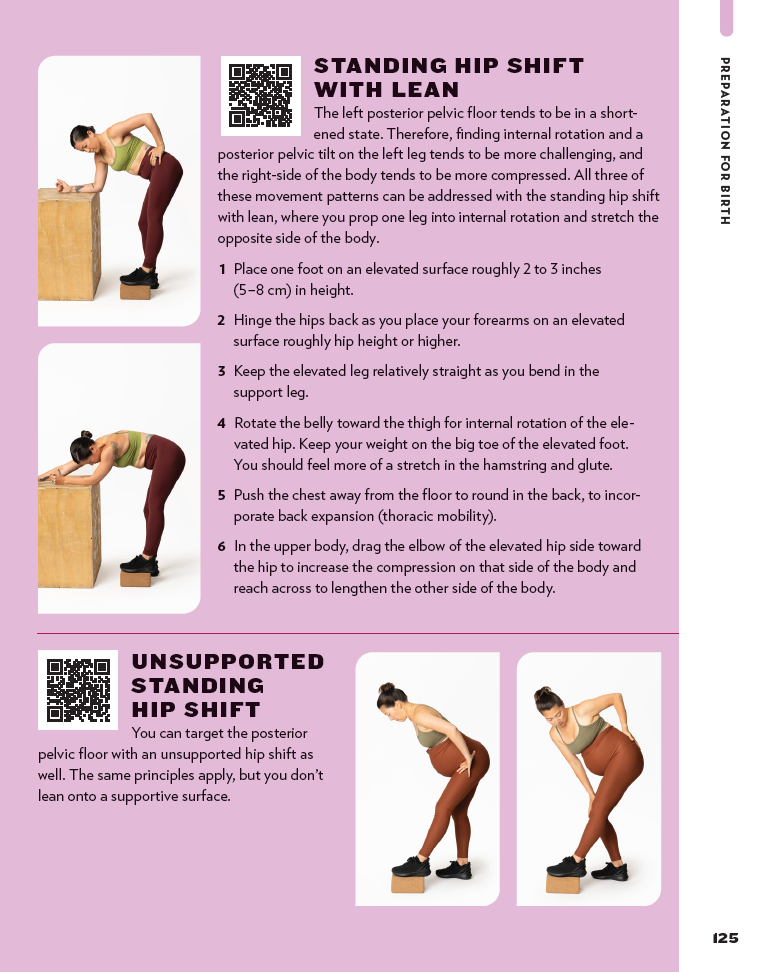
Here is a preview of two hip shift exercises that release the posterior pelvic floor. All exercises come with QR codes to a YouTube breakdown video to make it even easier for you to understand the nuance of each position!
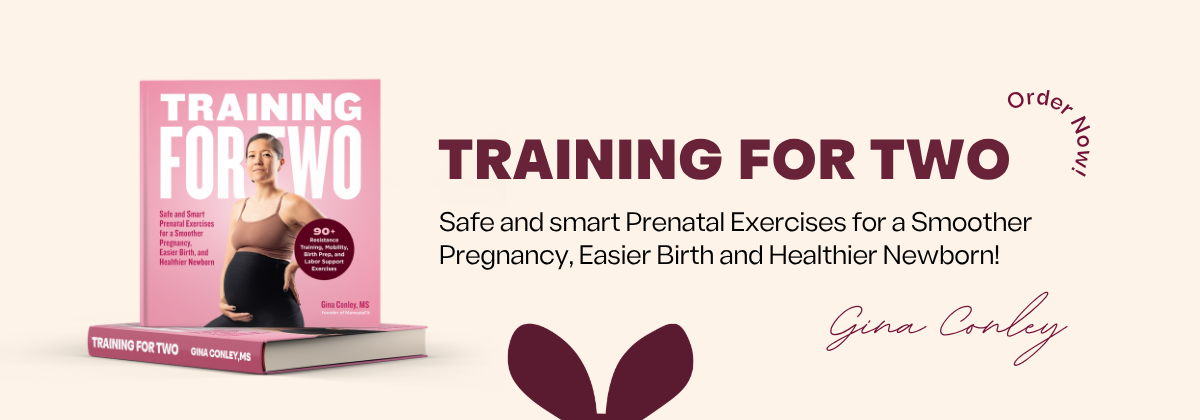
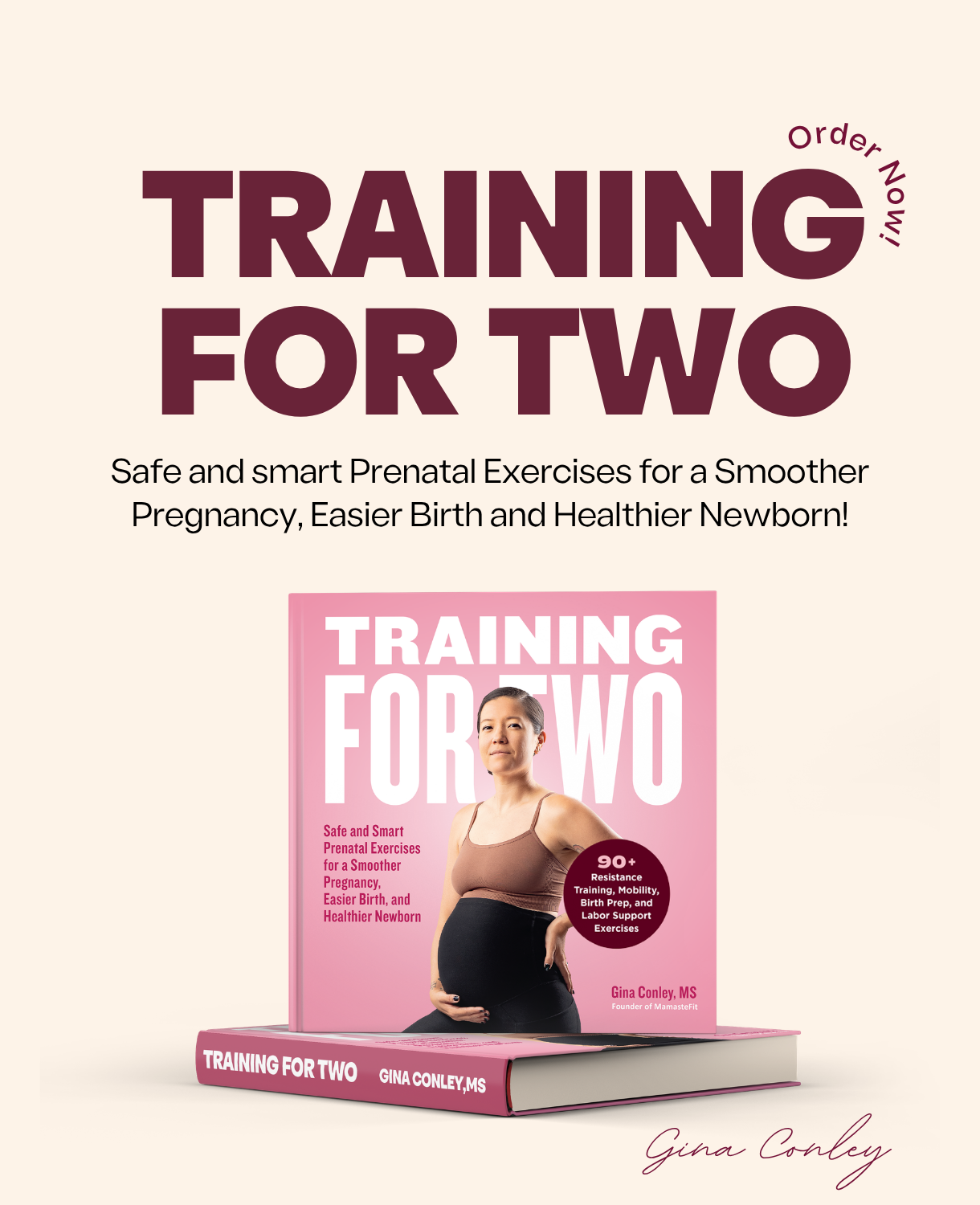
Are you ready to embrace a strong and pain-free pregnancy while preparing for a smoother birth? My book, Training for Two, is your ultimate guide to prenatal fitness, designed to keep you active and healthy every step of the way. You’ll find tailored lifting modifications to suit each trimester, practical birth prep exercises, pelvic floor workouts, and essential early postpartum recovery tips.
With detailed exercises, QR codes linking to helpful videos, and practical advice, Training for Two equips you with everything you need to stay strong and prepared for the incredible journey ahead. Invest in your pregnancy and a smoother birth experience—grab your copy today!
Birth Prep: Open the Bottom of the Pelvis
The final part of my birth prep workout focused on opening the bottom of my pelvis. The pelvic outlet opens more with internal hip rotation, knees in, and ankles out. The hero’s pose rock back has been a favorite of mine to do this pregnancy and ended up being the position I gave birth to my baby in! It is interesting how so many movements I did during this early labor workout were labor positions I did during birth!
Conclusion
You can physically prepare for birth–and you don’t need to wait until your third trimester or birth to start your prep! You can incorporate exercises that open each pelvic level throughout pregnancy and release tension within your pelvic floor. This ensures that you have the movement capability to create space in your pelvis when labor begins!
Prenatal Support Courses


Learn the science of pregnancy and birth to take the mystery of labor away! Understand why you are feeling what you feel, and learn strategies to confidently move through pregnancy and birth!
- 9h+ of Video
- Support Group
- Close Captioning

- 5 Workouts/Week
- Gym Workouts
- Self-Paced

Instructor
GINA
Workout on-demand with our prenatal fitness workout videos! Each workout is 30-40 minutes to follow along as you exercise at the same time!
- Birth Prep
- All Trimesters
- Mobility Work

Instructor
GINA
Find comfort and relief from pelvic girdle pain throughout your pregnancy and postpartum period! This program incorporates myofascial sling focused exercises to stabilize across the pelvic girdle joints.
- 3 Weeks
- On Demand Workout Videos to Follow