
If you scroll social media long enough, you’ll find a plethora of exercises that will supposedly induce your labor. This could include bouncing on your birth ball, going for walks, curb walking, and so many more movements. But is there a movement that will induce your labor?? Likely not!
In this blog, I will be debunking the myth that movement will induce labor and explain why this is a common belief! I will also be sharing exercises that you can do to prepare for birth, although they will likely not induce it.
Does Movement Induce Labor?? No... But Why Is This Promoted?
There isn’t really a movement that will induce labor, or cause labor to start unless you are just about to start labor. But, why is this a common belief? The main reason may be that when you are exercising, you may notice that you have more cramping and Braxton Hicks, and if you ARE in labor, movement can help with labor progress.
Movement Could Cause Practice Contractions
Braxton Hicks, or practice contractions, are a sudden tightening of your uterus. These are usually random and don’t result in any cervical change. Big things that contributed to Braxton Hicks are:
- Dehydration
- Fatigue
- Needing to pee
If you are noticing that you are experiencing a lot of Braxton Hicks, it could be related to one of those three reasons (or a combination of them all). If you are drinking a lot of water, but still noticing a lot of Braxton Hicks, you may need to add electrolytes to your water! I personally love LMNT electrolyte salts and drink about 1-3 packets a day to help balance my electrolytes for optimal hydration. If the Braxton Hicks are uncomfortable, your hydration status may be contributing to this discomfort, as well!
During my workouts and later in the evening I tend to notice more Braxton Hicks (which can start in the second trimester), so resting is key for me when I have uncomfortable ones!
Labor: Movement Speeds Up Birth!
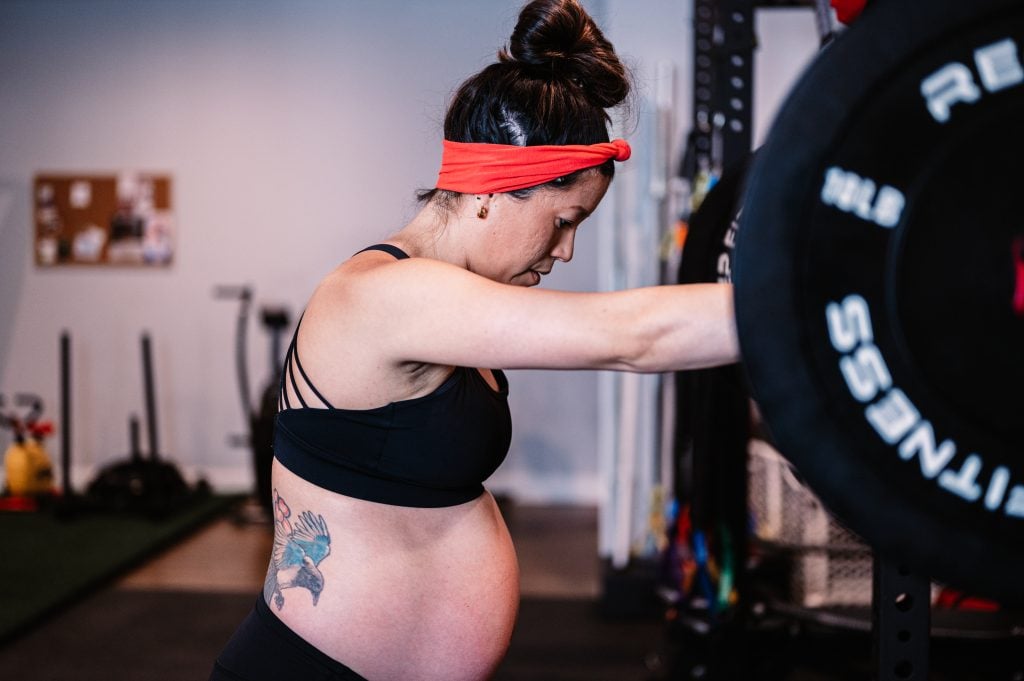

- 5 Workouts/Week
- Gym Workouts
- Self-Paced
During labor, movement is really helpful to continue your labor progress and help your baby wiggle and rock through your pelvis. The reason that movement tends to help with labor progress relates to your labor hormones!
Two main hormones support your labor: oxytocin and prostaglandins.
Your brain will release oxytocin, which triggers uterine contractions. These contractions then push your baby down on your cervix–which can be enhanced with upright movements. This increased pressure on the cervix releases prostaglandins that soften the cervix, making it easier to dilate and change.
During labor, it could be beneficial to labor in an upright position for a longer time so you enhance this release of labor hormones! This is a key reason why exercising throughout your pregnancy could speed up your labor–you have more stamina to maintain this upright position for longer.
Engagement = Labor Onset??
Another belief is that if you can get your baby into a perfect position or help your baby engage, labor will begin! However, where your baby is within your pelvis will also not start labor… unfortunately.
If you are having prodromal labor that starts and stops, then your baby’s position could be preventing labor from continuing–so focusing on helping to correct their position could be helpful! But if you are NOT in labor, then doing all the moves to force the baby into the “best” position or engage will not necessarily start labor.
But, you can still do exercises during your pregnancy to support your baby’s position for when labor DOES begin!
If you want more daily workouts to support a strong pregnancy as you prepare for birth, join our online prenatal fitness programs!
MamasteFit is unique in that we are one of the ONLY prenatal/postnatal training facilities in the United States. We develop our workout programs from our experience of working with in-person pre/postnatal fitness clients and work closely with physical therapists to refine our programming. In addition, we are birth workers, so we combine our experience as perinatal fitness trainers and birth professionals to ensure that our programs actually support your birth preparation and recovery!
Our prenatal fitness programs are offered in several formats:
- 40-Week Prenatal Strength Program in the Teambuildr App:
- This program is a self-paced workout with shorter demo videos. This is ideal if you like to workout in a gym setting and prefer a traditional workout delivery format.
- This program syncs to your current week of pregnancy, so you can start anytime, with one-time payment or month-to-month payment options.
- This program has a full and mini version, depending on how much time you have to dedicate to workouts!
- Prenatal On-Demand Fitness Program:
- If you prefer to follow a video as you workout at the same time, this workout program will be the best option!
- This program syncs to your current trimester, so you can grab the trimesters you need!
- Birth Prep Workout Program:
- If you have a current workout routine, and you want to add on workouts to prep for birth–check out this program!
- Prenatal Yoga Classes:
- If you want prenatal yoga, join our prenatal yoga program! This also syncs to your current trimester.
Exercises to Prepare for Birth
While there isn’t a movement to start labor, there are a lot of exercise you can do during your pregnancy to support your baby’s position and create space in your pelvis when labor does begin! So, it is still beneficial to incorporate different types of movements in your prenatal routine!
First, we can focus on supporting our baby’s position with movement! This includes exercises to help baby get into their best position and make it easier for them to rotate when labor does begin. Your baby hangs out in your uterus, and your uterus is supported by various ligaments that attach it to the surrounding structures. The tension in these ligaments can change the shape of your uterus, and if there is tension in them, could impede your baby’s path to rotate!
This birth prep circuit includes several exercises that target the various ligaments of your uterus: the uterosacral, round, and broad ligaments.
In addition, we can make it easier to open the pelvis and release tension in the pelvic floor to prepare for birth with the MamasteFit Birth Prep Circuit. This circuit includes six exercises that target common areas of tension that may impact your ability to open your pelvis in labor.
The circuit includes:
- Forward Leaning Inversion
- Back Expansion Breathing Drill
- Forward Lat Release
- Hip Flexor Release
- All Fours Hip Shift
- Standing Hip Shift
During pregnancy, we commonly favor certain postures–namely more arch in our back (anterior pelvic tilt with spinal extension) and external hip rotation (toes out). These two movement patterns are not inherently “bad” but if we get “stuck” in these positions, it can make it really hard for us to open each pelvic level.
There are three main pelvic levels: inlet, midpelvis, and outlet. Each pelvic level opens with different types of movement patterns!
The inlet, the top of the pelvis, opens more with external hip rotation with abduction (wide knees with ankles in, knees out) and pelvic tilting. An anterior pelvic tilt (arched back) makes it easier to find external hip rotation and can change the pubic bone angle to make it easier for baby to enter into the pelvis. A posterior pelvic tilt (rounded back) creates more space front to back in the top of the pelvis. So, for the inlet, we need a combo of wide knees and pelvic tilting to create space.
Since external hip rotation and an anterior pelvic tilt are usually easy to find during pregnancy, focusing on finding a posterior pelvic tilt can be helpful as you prep for birth. This could include exercises that involve releasing the lats and hip flexors and strengthening the hamstrings, adductors, and abs. This is something that is emphasized in our birth prep circuit and prenatal fitness programs!

Instructor
GINA
Workout on-demand with our prenatal fitness workout videos! Each workout is 30-40 minutes to follow along as you exercise at the same time!
- Birth Prep
- All Trimesters
- Mobility Work
The next pelvic level is the middle of the pelvis, known as the midpelvis. This pelvic level opens more with asymmetrical movements, such as one leg being in external hip rotation or an open hip position, and the other is more internally rotated (closed hip positions).
The midpelvis is where your baby rotates, but there may be more issues with the lower midpelvis. The lower midpelvis opens more with internal hip rotation, closed hip positions. However, since we tend to favor external hip rotation throughout pregnancy, internal hip rotation may be more challenging to find to open the bottom of the pelvis.
In our birth prep circuit and prenatal fitness programs, we incorporate several types of hip-shifted movements to open the lower midpelvis and release tension in the posterior pelvic floor.
The bottom of the pelvis is known as the pelvic outlet, and opens more with internal hip rotation (knees in, ankles out). Hip shifts and focusing on internal hip rotation can be really beneficial to prepare for pushing, as well!
Will Movement Induce Labor?? No... But Movement is Still Beneficial for Birth Prep!
There isn’t really a movement that will induce your labor, but this doesn’t mean exercising and preparing physically for birth is not beneficial! You can absolutely still include tons of exercises in your daily routine to prepare your body for birth–both by focusing on supporting your baby’s position and creating more space in your pelvis.
Prenatal Support Courses


Learn the science of pregnancy and birth to take the mystery of labor away! Understand why you are feeling what you feel, and learn strategies to confidently move through pregnancy and birth!
- 9h+ of Video
- Support Group
- Close Captioning
- 5 Workouts/Week
- Gym Workouts
- Self-Paced
Instructor
GINA
Workout on-demand with our prenatal fitness workout videos! Each workout is 30-40 minutes to follow along as you exercise at the same time!
- Birth Prep
- All Trimesters
- Mobility Work

Instructor
GINA
Find comfort and relief from pelvic girdle pain throughout your pregnancy and postpartum period! This program incorporates myofascial sling focused exercises to stabilize across the pelvic girdle joints.
- 3 Weeks
- On Demand Workout Videos to Follow